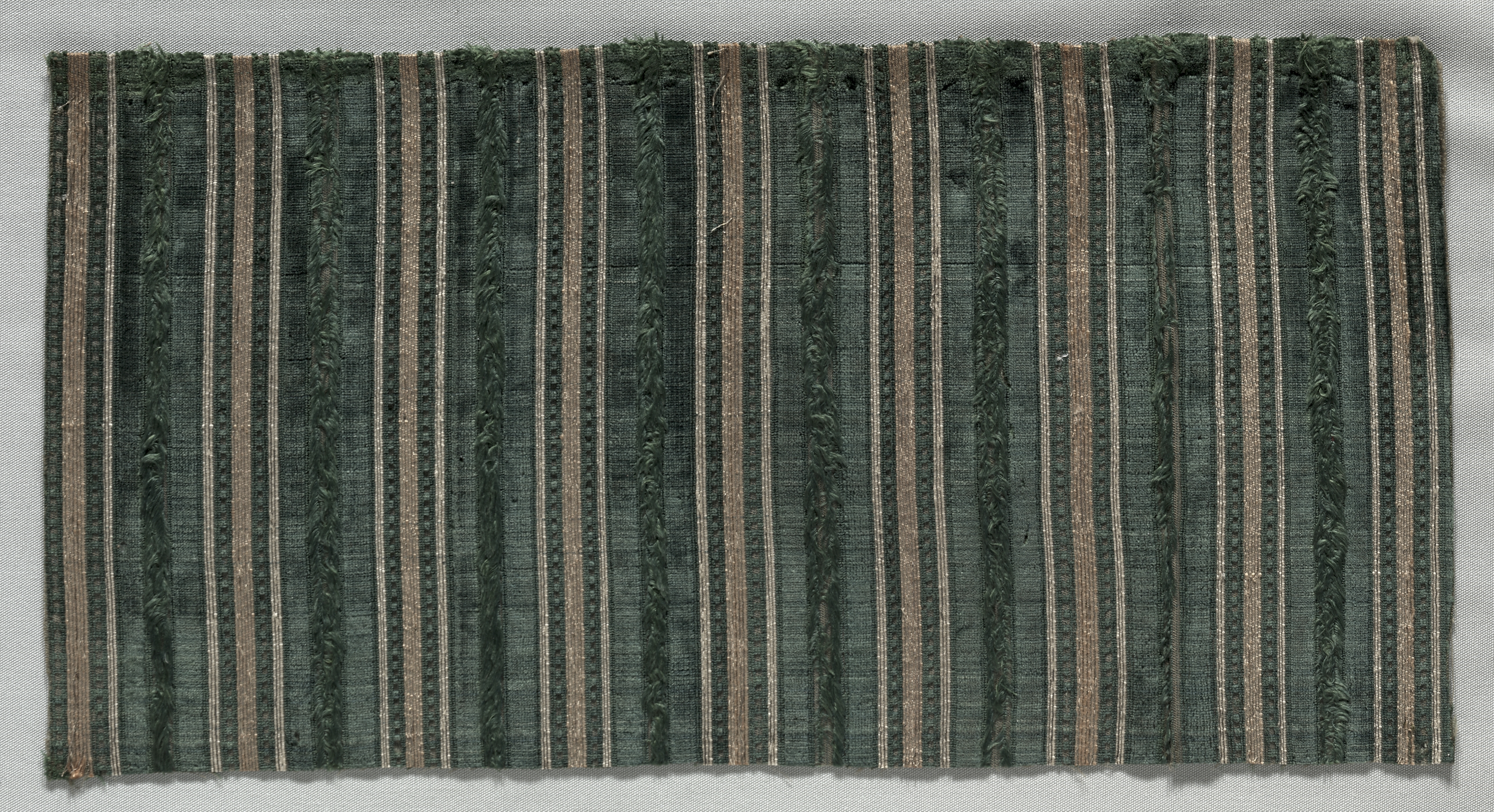
Technical Analysis: The Velvet Fragment
The provided fragment, originating from 18th-century Italy, represents a pinnacle of historical textile craftsmanship. Technically, this is a voided velvet, a complex weave structure where areas of cut pile (the velvet) are juxtaposed against a smooth, plain-weave ground (the void). This creates its characteristic pattern through texture and light absorption alone. The base is likely a finely spun silk, with the pile formed from additional silk warp threads. The density of the pile is exceptionally high, indicating the use of a draw loom, a precursor to the Jacquard loom, which allowed for intricate, pre-programmed pattern weaving. The sheen is deep and directional, a result of the precise angle at which the silk filaments were cut. The color, now faded but hinting at a profound crimson, would have been achieved through costly dye sources like kermes or cochineal, signifying immense value. This fragment is not merely fabric; it is a dense, tactile archive of pre-industrial ingenuity.
Deconstructive Reference: The New DNA Strand
The directive to reference a "New DNA Strand" is a powerful conceptual pivot. In genomics, a new strand is synthesized complementary to an existing template; it is both a replication and the foundation for future expression. Applying this to our velvet fragment, we move beyond literal upcycling. The fragment becomes the template strand, its genetic code containing sequences for "luxury," "textural contrast," "historical narrative," and "artisanal complexity." Our avant-garde mission is not to replicate the velvet but to synthesize its complementary strand. If the original is opulent and ornate, the new strand might code for radical minimalism or digital abstraction. Its technical mastery prompts us to explore complementary opposites: algorithmic pattern generation versus hand-drawn loom cards, synthetic bio-filaments versus organic silk, deconstructed dimensionality versus flat, woven planes. The new garment grown from this DNA will share a structural kinship with the original but express a wholly contemporary phenotype.
Avant-Garde Development Pathway
Guided by this synthetic DNA model, the development for Zoey Fashion Lab will follow a tripartite pathway: Material Transmutation, Structural Re-coding, and Contextual Replication.
Material Transmutation: From Silk to Bio-Polymer
The first act of deconstruction is molecular. We will not use the fragment as a patch but as a biological catalyst. Partnering with a biomaterials lab, we will isolate the fungal or bacterial microfibers found in the fragment's degradation—the very agents of its aging. These will be cultivated to produce a new, lab-grown cellulose or protein-based biopolymer filament. This new yarn, while born from the old, will possess a different hand and sheen—perhaps matte, slightly irregular, and thermo-responsive. The conceptual link is profound: we use the fabric's own "ecosystem" to generate its successor, creating a literal genetic lineage in material form. The luxuriousness is redefined from historic opulence to futuristic sustainability and scientific narrative.
Structural Re-coding: The Pattern Disrupted
The voided velvet's pattern, once a symbol of status, will be re-coded through digital disruption. Using 3D scanning, we will create a high-fidelity point-cloud map of the fragment's topography—its peaks (pile) and valleys (void). This digital terrain will then be subjected to algorithmic erosion, shear, and replication processes, generating a new, non-repeating pattern that retains the original's textural logic but expresses it as a topographic distortion. This pattern will not be woven but constructed. We propose employing a hybrid technique: ultrasonic welding and laser-cutting of the new bio-polymer fabric onto a base of recycled technical tulle. The "pile" becomes raised, welded seams or laser-sintered appliqués, creating the shadow and depth of velvet through entirely contemporary, zero-waste means. The structure is a ghost of the original, rendered in the language of digital fabrication.
Contextual Replication: The Garment as Architecture
The final synthesis must manifest in a garment that carries the conceptual weight of its origin. The avant-garde silhouette will be informed by the fragment's original context—the exaggerated proportions of 18th-century court dress (panniers, bustles, heavy draping)—but re-interpreted through a lens of architectural deconstruction. Imagine a modular harness system built from recycled aerospace aluminum, onto which panels of our new bio-textile are attached via magnetic or tension-fit closures. The silhouette is both rigid and fluid, historical and futuristic. The wearer engages with the garment, potentially reconfiguring the panels to shift between a structured coat and a draped form. This embodies the "new strand" philosophy: it is wearable, interactive architecture that dialogues directly with the static, ceremonial purpose of the original velvet. The luxury is in the experience of wear and transformation, not passive display.
Conclusion: The Synthesized Legacy
For Zoey Fashion Lab, this 18th-century Italian velvet fragment is not a relic but a living template. By treating it as a DNA strand, we have moved past aesthetic homage into the realm of conceptual synthesis. The resulting avant-garde collection will stand as a direct, complementary organism to its historical predecessor. It will translate tactile opulence into sustainable innovation, woven mastery into digital craftsmanship, and courtly grandeur into interactive architecture. This process ensures that the fragment's value is not conserved in a vault but is actively replicated and expressed in a radical new form. We are not preserving history; we are initiating its next mutation, creating a powerful, wearable dialogue between the zenith of the 18th-century loom and the frontier of 21st-century design thought. The new strand is complete, ready for expression.