Deconstructing the Code: Samite Roundels as a New DNA Strand for Avant-Garde Fashion
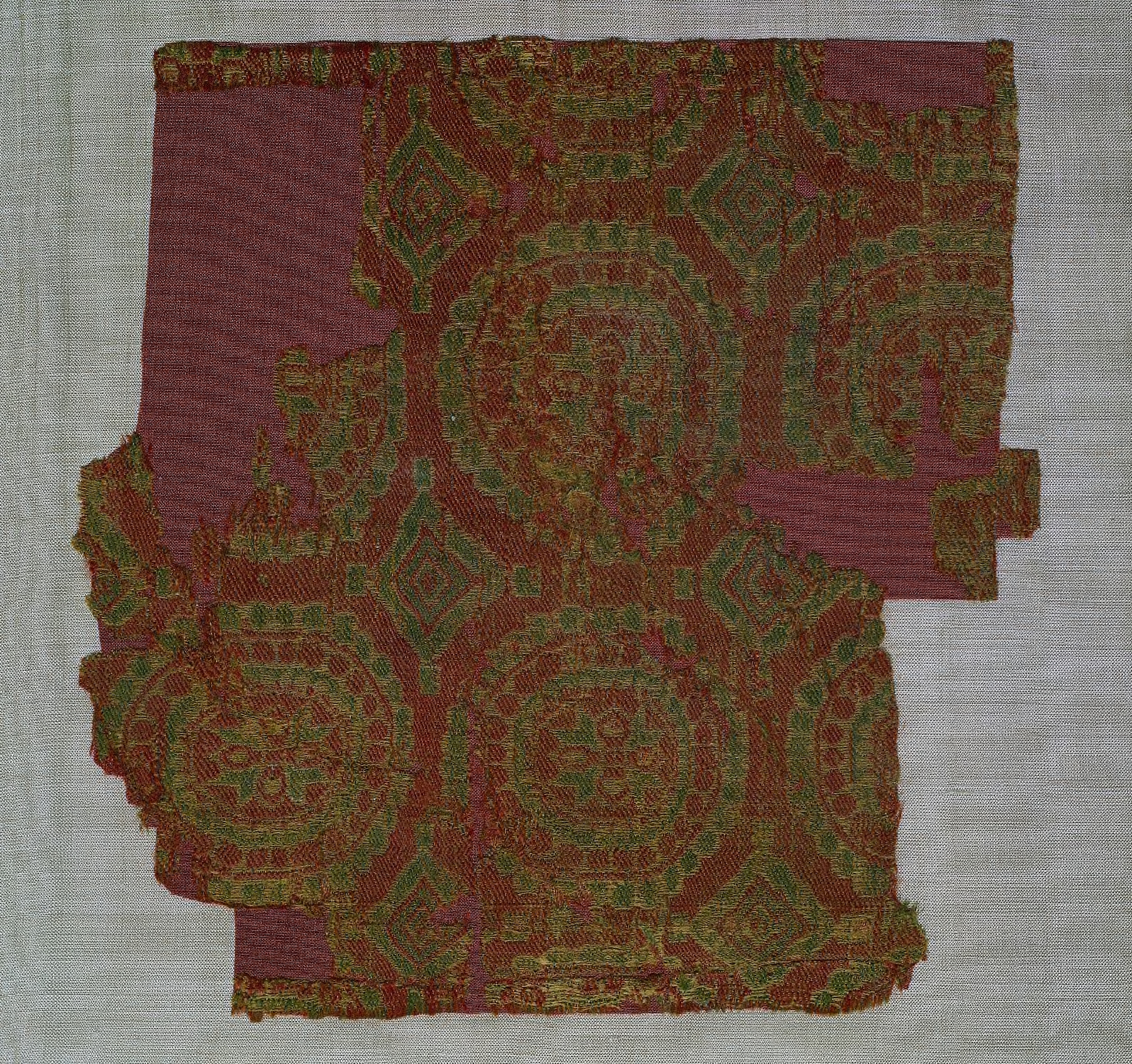
At Zoey Fashion Lab, our mission is to unravel the historical and technical DNA of textiles, then re-code them for the future. The subject of this analysis—a fragment of samite from Iran, adorned with roundels of rosettes—presents a profound opportunity. This is not merely a relic; it is a blueprint. Our deconstruction reveals that this silk weave, with its specific technical constraints and symbolic geometry, can be re-engineered into a New DNA Strand for an avant-garde collection that challenges both form and function.
I. The Original Blueprint: Technical and Symbolic Analysis
Samite, derived from the Old French samit and ultimately from the Greek hexamiton (meaning "six threads"), is a weft-faced compound weave. Its structure is defined by a main warp, a binding warp, and multiple weft systems—often in silk and sometimes metallic threads. The Iranian origin of this piece is critical. Persian samite from the Sasanian and early Islamic periods (6th–10th centuries) was a pinnacle of textile engineering, used for royal robes, ecclesiastical vestments, and diplomatic gifts. The technical mastery required to produce such fabric—with its precise tension, color registration, and pattern repeat—was a form of power projection.
The roundels of rosettes are equally significant. The roundel (or medallion) is a universal motif in Persian art, often representing the cosmos, eternity, or the celestial sphere. The rosette within it, with its radial symmetry, symbolizes the sun, life, and divine order. In the context of this fabric, the roundel is not just a decorative element; it is a structural anchor. The pattern repeat is dictated by the loom’s width, and the roundel serves as a modular unit—a cellular structure that can be scaled, rotated, or fragmented. This geometric discipline is the fabric’s original code.
From a material science perspective, the silk itself is a protein fiber with unique properties: high tensile strength, luster, and a natural triangular cross-section that refracts light. The weft-faced structure means that the pattern is created by the weft threads, which are packed tightly to cover the warp. This results in a dense, heavy fabric with a distinct drape—less fluid than modern silk charmeuse, but more structured and architectural. The color palette, likely involving deep indigos, madder reds, and golds, was achieved through natural dyes that required complex chemical processes.
II. The Deconstruction: Breaking the Code for Avant-Garde Application
To transform this samite into a New DNA Strand for avant-garde fashion, we must first deconstruct its core elements: structure, pattern, and materiality. The goal is not to replicate but to re-code—to extract the genetic logic and mutate it into something that challenges contemporary norms of wearability, form, and identity.
Structural Deconstruction: The samite’s weft-faced compound weave is inherently rigid. For avant-garde design, we can subvert this by introducing de-construction techniques. Imagine laser-cutting the roundels from the fabric, leaving a negative-space lattice that reveals the body beneath. The roundels can be detached and re-applied as modular patches, allowing for a garment that is assembled and disassembled at will. Alternatively, the binding warp can be selectively removed, creating fringed edges that mimic the fraying of time—a deliberate imperfection that speaks to the fabric’s history. This process transforms the samite from a finished textile into a raw material for sculptural construction.
Pattern Re-coding: The roundels of rosettes are a repetitive, symmetrical motif. In an avant-garde context, symmetry can be disrupted. We can apply digital distortion to the pattern: stretching, skewing, or fragmenting the roundels into asymmetrical forms. For example, a single rosette can be blown up to an oversized scale, becoming a singular focal point on a garment, while others are reduced to micro-embroidery. The radial symmetry of the rosette can be broken by rotating only half of the motif, creating a visual tension that mirrors the tension between tradition and innovation. This re-coding honors the original geometry while introducing a chaotic, organic element—a nod to the randomness of genetic mutation.
Material Re-engineering: The silk’s natural luster and weight can be manipulated. We can combine the samite with technical fabrics like neoprene or mesh, creating a hybrid structure where the historical textile floats over a modern base. The silk can be treated with resin to become rigid, allowing it to hold sculptural shapes—like a collar that stands away from the neck or a sleeve that maintains a bell-shape without internal support. Alternatively, we can reverse the fabric’s face, exposing the back side where the warp threads are more visible, creating a matte, textural contrast to the glossy weft. This material deconstruction emphasizes the fabric’s dual nature: its opulence and its underlying engineering.
III. The New DNA Strand: From Textile to Garment Architecture
The final output of this deconstruction is a garment collection that functions as a living archive. Each piece will be a mutation of the original samite code, designed to be worn, studied, and deconstructed further by the wearer. Below are three conceptual designs that exemplify this approach.
Design 1: "The Lattice Rosette" Coat
A floor-length coat constructed from a single panel of the deconstructed samite. The roundels have been laser-cut out, leaving a lattice of rosette-shaped voids. The coat is lined with a high-sheen technical silk in a contrasting color (e.g., electric blue against the original indigo), visible through the cutouts. The sleeves are asymmetrical: one is full-length and intact, the other is cropped and fringed. The coat closes with magnetic fasteners hidden within the remaining rosette motifs, allowing the wearer to adjust the silhouette. This design re-codes the roundel as both a structural element and a window into another layer.
Design 2: "Fractured Medallion" Dress
A body-hugging dress made from a hybrid of samite and black neoprene. The samite is applied as a patchwork of fragmented roundels, each piece rotated at a different angle. The rosettes are embroidered with metallic thread that catches light, creating a constellation effect. The dress is cut on the bias, allowing the silk to stretch and distort the pattern further. A single, oversized rosette is positioned at the left hip, its petals extending into the neoprene through hand-stitched seams that resemble scars. This design embodies the tension between control and chaos, history and mutation.
Design 3: "Rigid Rosette" Corset
A sculptural corset made from samite that has been treated with a resin-hardening process. The fabric is molded into a series of concentric rosette shapes that wrap around the torso, creating an armor-like structure. The roundels are not flat but three-dimensional, with each petal curving outward. The corset is worn over a sheer silk base, and the back is left open, secured only by a single leather strap. This piece re-codes the samite’s original rigidity into a deliberate, wearable sculpture, challenging the notion of fabric as soft and pliable.
IV. Conclusion: The Future of the Code
This analysis demonstrates that the Iranian samite with roundels of rosettes is not a static artifact but a dynamic code—a set of rules for structure, pattern, and material that can be rewritten for the avant-garde. By deconstructing its technical weave, disrupting its symmetrical motifs, and re-engineering its material properties, Zoey Fashion Lab can create garments that are both a homage to the past and a provocation for the future. The New DNA Strand is not about preservation; it is about evolution. The roundel becomes a portal, the rosette a mutation, and the samite a living language that speaks to the wearer’s identity as a participant in the ongoing history of textile innovation. This is the future of fashion: a continuous dialogue between the loom and the lab, the thread and the code.