Deconstructing the Divine: The Tunjos as Avant-Garde Architectural Blueprint
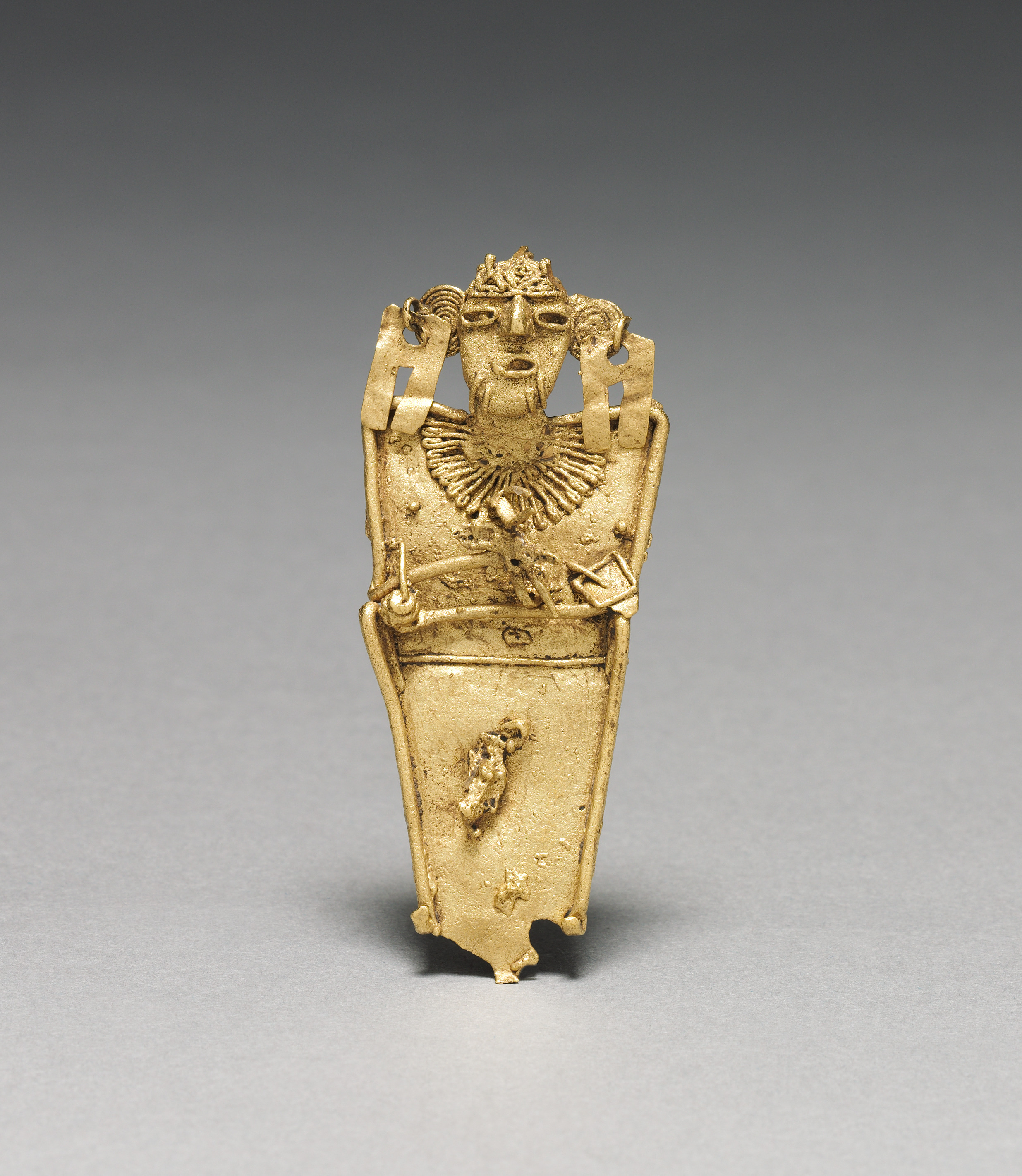
At Zoey Fashion Lab, the act of deconstruction is not one of destruction, but of revelation. We excavate the architectural DNA of sacred artifacts, extracting their latent narratives to inform a new, avant-garde aesthetic. The subject of this analysis—the Muisca Tunjo (votive offering figurine) from Colombia, cast in gold—presents a profound paradox. It is a mass-produced object of profound spiritual intimacy, a standardized token of individual supplication. To the avant-garde eye, the Tunjo is not merely a figurine; it is a pre-Columbian blueprint for wearable architecture, a model for a garment that exists between the sacred and the structural.
Archive Resonance: The Mirror and the Stone
Our analysis is anchored by an Archive Resonance: “一面是光洁银镜上以黄金镶嵌的纷繁棕叶纹,另一面是冰冷石棺板上以浮雕诉说的生命叙事——《Mirror with Split-Lea...” This fragmented reference—a mirror of polished silver inlaid with gold palm fronds on one side, a stone sarcophagus narrating life in bas-relief on the other—is the key to decoding the Tunjo’s potential. The Tunjo, in its raw form, occupies a liminal space. It is both the mirror (a reflective, idealized offering to the gods) and the stone (a cold, compressed narrative of human mortality). It is a frozen gesture, a prayer made material. Our task is to split the leaf—to bifurcate this duality into a garment that is simultaneously a reflective surface and a narrative relief.
Material and Technique: The Alchemy of Cast Gold
The technical process of lost-wax casting is the first point of avant-garde extraction. The Tunjo is not carved from a solid block; it is born from a void. A wax model is formed, encased in clay, and then melted away, leaving a negative space that is flooded with molten gold. This is a metaphor for the garment as absence. The final form is a skin that once wrapped a ghost. For Zoey Fashion Lab, this translates to a design philosophy where the negative space—the void left by the wax—is as important as the positive form. We propose a collection of “negative garments”: structures that define the body not by covering it, but by creating a golden cage of absence around it.
The gold itself is not the opulent, polished gold of colonial treasures. Muisca gold is often a tumbaga alloy—a mix of gold and copper, with a distinct reddish, matte finish. This is a democratic gold, a material of the earth, not of the crown. In our avant-garde translation, this becomes a textile of oxidized metal. We envision laser-sintered gold-plated bronze mesh, treated with patinas to mimic the ritualistic burial of the Tunjos. The surface is not smooth; it is granular, pitted, and imperfect—a record of the earth’s pressure and time’s passage. This is the mirror’s dark twin: a reflective surface that has been deliberately tarnished to reveal its narrative depth.
Form and Function: The Figurine as Structural Prototype
The typical Tunjo is a flat, schematic figure—a simplified human form with exaggerated attributes (often genitalia or headdresses), rendered in a stylized, almost geometric abstraction. This is not realism; it is symbolic compression. The avant-garde designer sees in this flatness a pattern piece. The Tunjo is a 2D projection of a 3D ritual. We deconstruct this flatness into a garment that is assembled from planar gold panels, hinged together with fine chains or leather thongs.
Consider the exaggerated headdress of a Muisca chief Tunjo. It becomes a miter-like collar, a rigid, flared structure that frames the face and extends into sharp, asymmetrical points—a golden sunburst that is also a cage. The flattened limbs become articulated armor plates that wrap the torso, not for protection, but for ritual exposure. The garment is a wearable votive offering: the wearer becomes the figurine, offering themselves to the gaze of the contemporary world as a sacred object. The void between the limbs is as crucial as the gold itself. These gaps are filled with negative space webbing—fine, almost invisible monofilament or liquid metal thread—creating a lattice of absence that traces the body’s contours without ever touching them.
Narrative Relief: The Sarcophagus on the Body
The second half of the Archive Resonance—the stone sarcophagus with life narrated in bas-relief—directs our surface treatment. The Muisca Tunjos were often deposited in sacred lakes (like Guatavita) or buried in tombs. They are objects of submersion and burial. Their surfaces, though cast, are not narrative in the way a Greek frieze is. The narrative is implied by the gesture—the raised arms, the open mouth, the offering pose. For the avant-garde, we must inscribe the narrative onto the gold itself.
We propose a technique of negative relief engraving. Using a high-precision CNC router or hand-chased burins, we carve the surface of the gold panels with abstracted Muisca pictograms: spirals representing the sun, stepped pyramids representing the earth, and zigzag lines representing the serpent. These are not decorative; they are structural seams. The relief lines are deep enough to catch light and shadow, creating a shifting, chimeric surface that changes with the wearer’s movement. This is the sarcophagus on the body: a garment that tells the story of its own creation, its ritual purpose, and its eventual burial. The garment is a palimpsest, where the narrative of the Muisca people is overlaid with the narrative of the contemporary wearer.
The Avant-Garde Synthesis: A Wearable Ritual Object
The final synthesis is a garment that is neither clothing nor sculpture, but a third object: a wearable ritual apparatus. It is heavy, not in weight, but in symbolic density. The wearer is not a model, but a votive figure in a living ritual. The garment’s construction mirrors the lost-wax process: the body is the wax, the garment is the mold, and the ritual of wearing is the molten gold that fills the void.
We call this collection “The Guatavita Vestments.” Each piece is a singular Tunjo, cast in a limited edition, with its own unique patina and narrative relief. The mirror side is the outward-facing surface: polished, reflective, and adorned with the split-leaf palm fronds of the Archive Resonance, rendered in micro-cast gold appliqués. The stone side is the inner surface, against the skin: cold, matte, and carved with the wearer’s own story—a relief of their life, their offerings, their mortality. The garment is a dialectic between the sacred and the structural, the mirror and the stone, the gold and the void.
In conclusion, the Tunjo is not a historical artifact to be copied, but a generative algorithm for avant-garde design. It teaches us that the most profound garments are those that hold a prayer, that archive a resonance, and that split the leaf between the reflective and the narrative. At Zoey Fashion Lab, we do not make clothes. We make votive offerings for the future, cast in the gold of forgotten gods and the shadow of the stone that remembers.