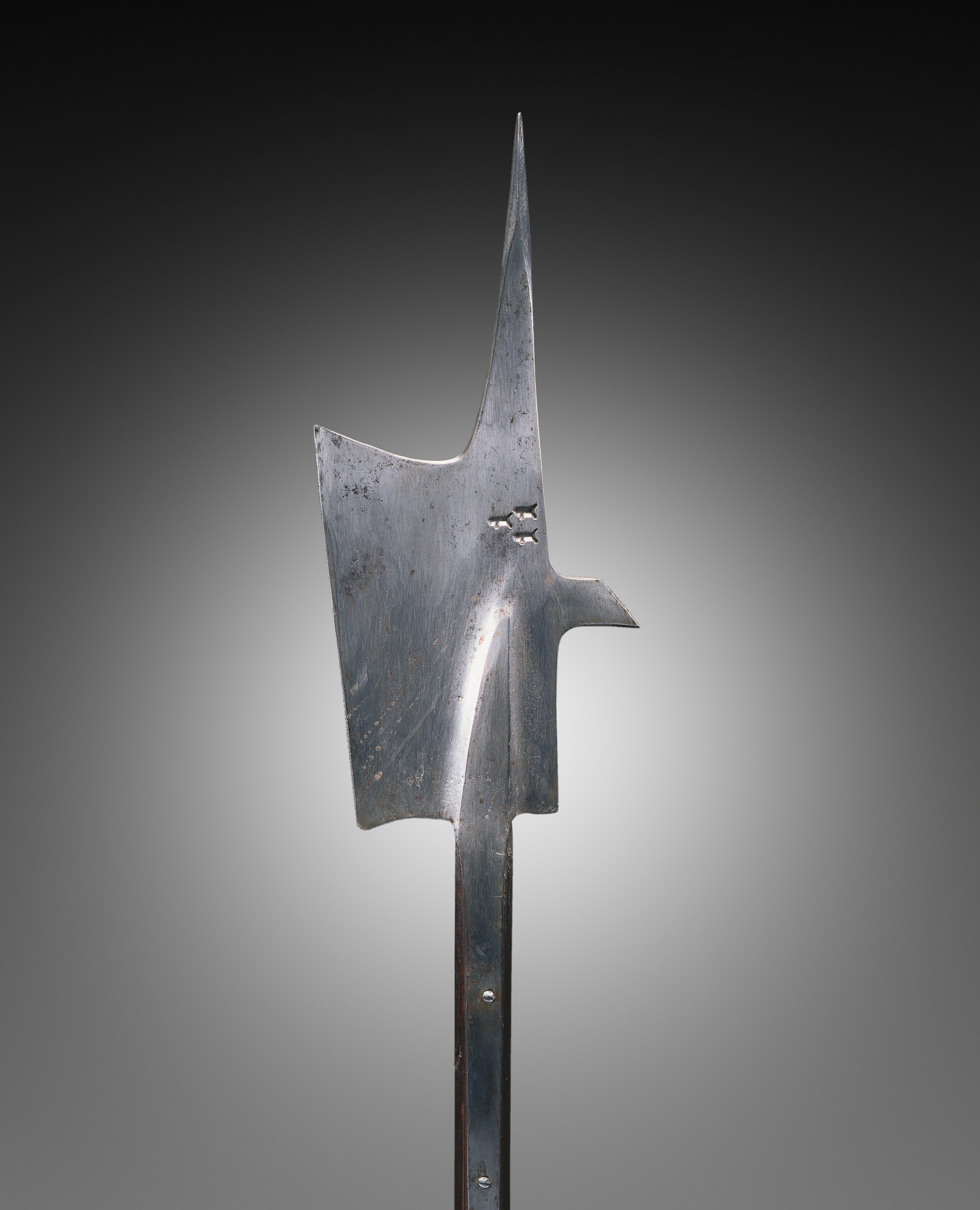
Deconstructing the Halberd: An Avant-Garde Analysis for Zoey Fashion Lab
As the Chief Fabric Deconstructionist for Zoey Fashion Lab, my role is to dissect historical artifacts not as relics of warfare, but as blueprints for radical textile innovation. The subject of this analysis—a Swiss halberd, circa 15th century—presents a unique opportunity to translate the language of medieval metallurgy and carpentry into the vocabulary of avant-garde fashion. This weapon, with its steel blade and rectangular wooden haft, serves as a New DNA Strand for our lab, a genetic code that can be spliced, mutated, and rewoven into garments that challenge form, function, and materiality. The halberd is not a tool of aggression; it is a structural poem, a study in tension, balance, and the marriage of disparate elements. We will extract its core principles—force, leverage, segmentation, and asymmetry—and apply them to our fabric and silhouette research.
I. The Steel Blade: Translating Metallic Rigidity into Textile Structure
A. The Axe-Head as Collar and Shoulder Armature
The halberd’s axe blade, a broad, sweeping crescent of steel, is the weapon’s most aggressive element. In our avant-garde interpretation, this becomes a sculptural collar or asymmetrical shoulder piece. The challenge is to replicate the blade’s rigid, unforgiving geometry without using metal. Instead, we will employ a technique of thermal bonding and resin-infused textiles. A base of heavyweight wool or linen felt is layered with a thermoplastic polymer film. When heated and pressed into a mold, this composite becomes a stiff, shell-like form that retains the blade’s sharp, sweeping arc. The surface is then treated with a metallic foil finish—oxidized silver or gunmetal gray—to mimic the patina of aged steel. The result is a collar that juts forward, creating a dramatic, confrontational silhouette, echoing the halberd’s primary function: to strike and hook.
B. The Spike: Verticality and the Spine of the Garment
The top spike of the halberd, a long, needle-like point, extends upward from the axe head. This vertical element translates into a central spine or structural seam running down the back of a coat or jacket. We can achieve this by integrating a carbon-fiber or Kevlar ribbon into the fabric’s warp, creating a rigid, unyielding line that forces the garment to stand away from the body. Alternatively, a series of progressively smaller, overlapping fabric panels—each stiffened with a fusible interfacing—can be sewn in a ladder-like configuration, mimicking the spike’s tapering form. This spine not only provides architectural support but also creates a visual line of force, drawing the eye upward and elongating the wearer’s silhouette, much like the halberdier’s weapon extends his reach.
II. The Wooden Haft: The Rectangular Core and Its Planed Corners
A. The Haft as a Structural Ribbon
The halberd’s haft is described as rectangular with planed corners—a subtle but critical detail. This is not a rough-hewn branch but a precisely shaped beam, designed for grip and leverage. In our textile analysis, this translates to a ribbon or band that functions as a structural exoskeleton. We will create a fabric ribbon using a double-weave technique with a high-tensile strength core, such as a braided aramid fiber. The ribbon’s width is uniform, but its edges are finished with a planed, flat-felled seam, mimicking the haft’s smoothed corners. This ribbon can be applied to the garment as a corset-like lacing system, a series of horizontal bands across the torso, or a spiral wrap around a sleeve. The planed corners are crucial: they prevent the ribbon from rolling or twisting, ensuring it lies flat and exerts even pressure, just as the haft provides a stable grip for the wielder.
B. The Rectangular Cross-Section: Modularity and Segmentation
The rectangular shape of the haft suggests modularity and segmentation. Unlike a round staff, a rectangular beam can be easily joined, stacked, or rotated. This principle informs a new approach to garment construction: interlocking fabric panels. We can design a jacket or skirt composed of rectangular fabric modules, each with planed-edge seams that slot into one another like tongue-and-groove joinery. These modules are not sewn together but held in place by a secondary structure—a harness or a series of straps—allowing for reconfiguration. The wearer can adjust the garment’s length, volume, or even its silhouette by adding or removing modules. This echoes the halberd’s versatility: the haft could be lengthened or shortened depending on the battlefield context. The avant-garde fashion statement is one of kinetic adaptability, where the garment is a living, changeable system.
III. The New DNA Strand: Force, Leverage, and Asymmetry
A. Force Vectors and Draping
The halberd is a weapon of leverage: the long haft amplifies the force applied at the head. In our fabric deconstruction, we translate this into directional draping and tension lines. A garment can be designed with a single, heavy focal point—a weighted hem, a metal bead, or a dense fabric panel—that pulls the surrounding material into sharp, diagonal folds. These folds mimic the trajectory of a halberd’s swing. The fabric is cut on the bias to allow for maximum stretch and distortion, and then anchored at strategic points (shoulders, hips, wrists) to create a dynamic, off-balance silhouette. The wearer becomes the fulcrum, and the fabric the lever arm, creating a visual tension that suggests impending motion.
B. Asymmetry as a Core Principle
The halberd is inherently asymmetrical: the axe head is on one side, the spike on top, and the haft is held at one end. This asymmetry is a foundational design principle for our avant-garde collection. We reject bilateral symmetry in favor of intentional imbalance. A single exaggerated sleeve, a one-sided collar, a skirt that dips dramatically to one side—these elements echo the halberd’s functional asymmetry. The garment’s center of gravity is shifted, forcing the wearer to adopt a new posture, a new way of moving. This is not about discomfort but about embodied awareness. The wearer becomes acutely conscious of their body’s position in space, much like a halberdier must be aware of the weapon’s reach and balance.
IV. Material Synthesis: Steel and Wood in Textile Form
A. The Steel-Fabric Hybrid
To fully integrate the halberd’s DNA, we must create fabrics that are hybrids of hard and soft. A chainmail-like knit using stainless steel wire interwoven with silk or merino wool offers both protection and fluidity. The steel provides the visual weight and metallic sheen of the blade, while the wool or silk adds warmth and drape. This fabric can be used for panels that require rigidity—shoulders, elbows, knees—while the rest of the garment remains soft and pliable.
B. The Wood-Grain Textile
To replicate the haft’s wood, we explore jacquard weaves with a wood-grain pattern, but with a twist: the pattern is not printed but created through differential yarn tension. Warp threads of linen (for strength) and weft threads of rayon (for sheen) are woven at varying densities, creating a raised, three-dimensional grain that mimics the texture of planed ash or oak. The rectangular cross-section is echoed in the fabric’s square repeat pattern, with each square representing a segment of the haft. The planed corners are recreated using a satin stich edge that prevents fraying and gives a clean, sharp finish.
V. Conclusion: The Halberd as a Living Garment
The Swiss halberd, when deconstructed through the lens of Zoey Fashion Lab, ceases to be a weapon and becomes a generative system for avant-garde design. Its steel blade informs rigid, sculptural collars and spines; its rectangular haft inspires modular, interlocking panels and structural ribbons; and its principles of force and asymmetry drive dynamic draping and intentional imbalance. The New DNA Strand we have extracted is not a literal copy but an abstract code—a set of rules for creating garments that are simultaneously architectural, kinetic, and deeply connected to the human body’s potential for power and grace. This halberd-inspired collection will not merely clothe the wearer; it will redefine their relationship with space, movement, and materiality, turning the body into a living, breathing weapon of style. The result is fashion that is not worn but wielded.