Deconstructing the Velvet Fragment: A Zoey Fashion Lab Analysis
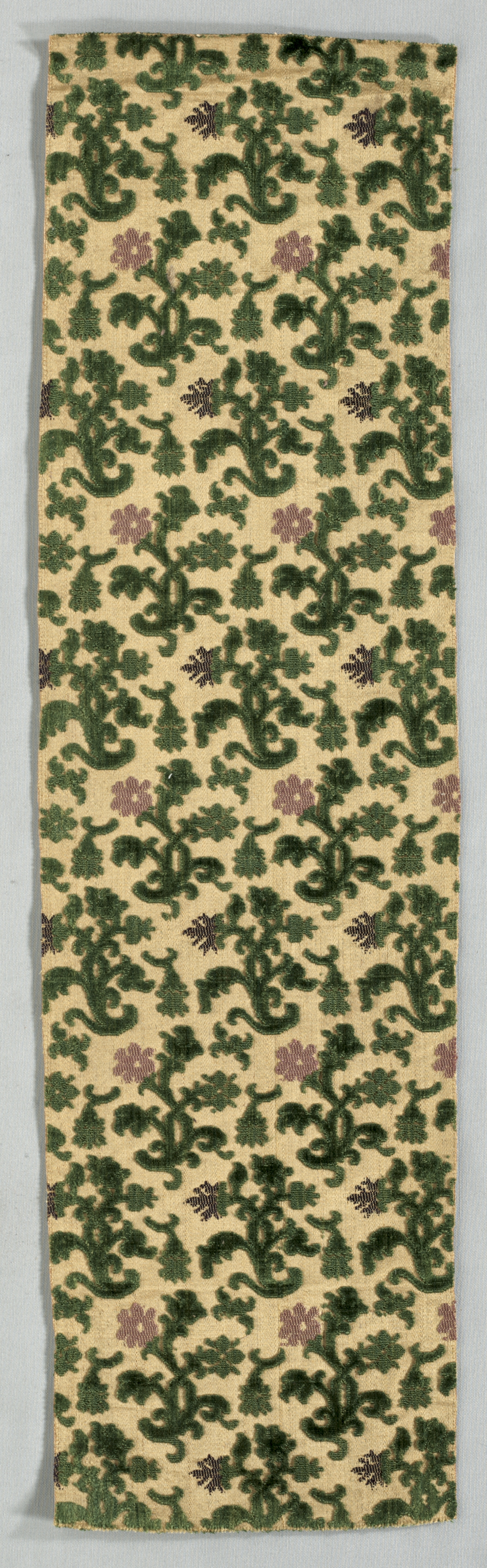
At Zoey Fashion Lab, our mission is to dissect historical textiles not merely as artifacts, but as living blueprints for avant-garde expression. The subject of this analysis is a velvet fragment originating from early 17th-century Italy, a period of opulent artistry and technical mastery. This piece, composed of cut, uncut, and voided silk velvet, is not a relic of the past but a New DNA Strand—a genetic code for radical, futuristic design. Below, we deconstruct its material, technique, and historical context, and propose how to re-engineer its essence for the avant-garde.
Material Provenance and Historical Context
The fragment hails from early 17th-century Italy, a golden age for velvet production in cities like Genoa, Venice, and Florence. During this period, velvet was a symbol of wealth, power, and ecclesiastical prestige, often used for courtly garments, liturgical vestments, and aristocratic furnishings. The silk used in this fragment is of exceptional quality—lustrous, dense, and resilient—indicating it was likely woven for a high-status patron. The color palette, though faded, suggests deep jewel tones: burgundy, emerald, or sapphire, typical of the Baroque era’s love for dramatic contrast. This historical context is crucial: it anchors the fragment in a tradition of luxury and craftsmanship that we at Zoey Fashion Lab seek to subvert and reimagine.
Technical Analysis: Cut, Uncut, and Voided Velvet
The fragment employs three distinct velvet techniques, each contributing to its textural and visual complexity. Cut velvet involves shearing loops of silk to create a plush, dense pile that catches light and shadows. Uncut velvet retains the loops, producing a softer, more matte surface that resists directional sheen. Voided velvet deliberately leaves areas of the ground weave exposed, creating negative space—a pattern of voided regions that contrast with the pile. Together, these techniques create a dynamic interplay of height, depth, and texture. The cut areas rise like sculpted hills, the uncut loops form gentle valleys, and the voided sections act as rivers of raw silk, revealing the underlying structure. This tripartite system is a masterclass in controlled chaos, a balance of opulence and restraint that we can reinterpret as a New DNA Strand for avant-garde fashion.
The Fragment as a New DNA Strand
In our lab, we view this fragment not as a finished product but as a genetic sequence—a set of instructions for creating new forms. The New DNA Strand concept treats the velvet’s technical and aesthetic properties as modular units that can be recombined, mutated, or amplified. For instance, the cut pile can be seen as a gene for tactile excess, the uncut loops as a gene for soft resistance, and the voided areas as a gene for structural absence. By isolating these genes, we can engineer fabrics that challenge traditional notions of garment construction. Imagine a coat where cut velvet forms exaggerated, asymmetric shoulders; uncut velvet creates a fluid, rippling back; and voided sections expose the wearer’s skin or a contrasting underlayer. This is not mere decoration—it is a deliberate, deconstructive act that honors the original while propelling it into the future.
Avant-Garde Reimaginings: From Fragment to Form
The avant-garde style demands that we break conventions and provoke new ways of seeing. For Zoey Fashion Lab, this velvet fragment inspires three radical applications:
1. Deconstructed Layering: The voided technique suggests transparency and absence. We can use laser-cutting or digital jacquard weaving to create garments with deliberate “holes” that reveal the body or structural seams. Paired with cut velvet panels that mimic armor, this creates a dialogue between vulnerability and protection—a core theme in avant-garde design.
2. Textural Hybridization: Combine the cut and uncut pile with non-traditional materials like recycled plastics, metallic threads, or bio-fabricated cellulose. The silk’s natural luster can be contrasted with matte, industrial surfaces. For example, a dress might feature cut velvet sleeves and a voided velvet bodice, with the voided areas filled with transparent organza or LED-lit mesh. This hybridization respects the original’s luxury while injecting a dystopian, cybernetic edge.
3. Kinetic and Responsive Fabrics: The uncut loops, with their soft, pile-like structure, can be engineered to respond to movement or environmental triggers. Imagine a fabric where the loops flatten when touched, revealing hidden patterns, or where the voided areas are embedded with shape-memory alloys that change the garment’s silhouette. This transforms the fragment from a static object into a living, interactive system—a true New DNA Strand that evolves with the wearer.
Preservation and Ethical Considerations
While we deconstruct and reimagine, we must also preserve. The original fragment is a fragile witness to history, and any avant-garde reinterpretation should be approached with reverence. At Zoey Fashion Lab, we advocate for digital archiving of such textiles—3D scanning, multispectral imaging, and material analysis—to create a virtual “DNA library.” This allows designers worldwide to study and remix the fragment without risking damage to the physical artifact. Furthermore, we must consider the ethical sourcing of silk and the environmental impact of modern velvet production. Our avant-garde reimaginings should prioritize sustainable alternatives, such as lab-grown silk or recycled fibers, ensuring that the New DNA Strand is not only innovative but responsible.
Conclusion: The Fragment as a Living Code
This early 17th-century Italian velvet fragment is far more than a decorative textile. It is a complex, multi-layered system of material intelligence—a New DNA Strand that encodes possibilities for texture, structure, and meaning. By deconstructing its cut, uncut, and voided techniques, Zoey Fashion Lab unlocks a vocabulary for avant-garde fashion that is both historically informed and radically forward. We do not simply replicate the past; we mutate it, splice it with contemporary technologies, and re-express it in forms that challenge, delight, and provoke. In this fragment, we find not an ending but a beginning—a genetic seed for the next evolution of fashion.