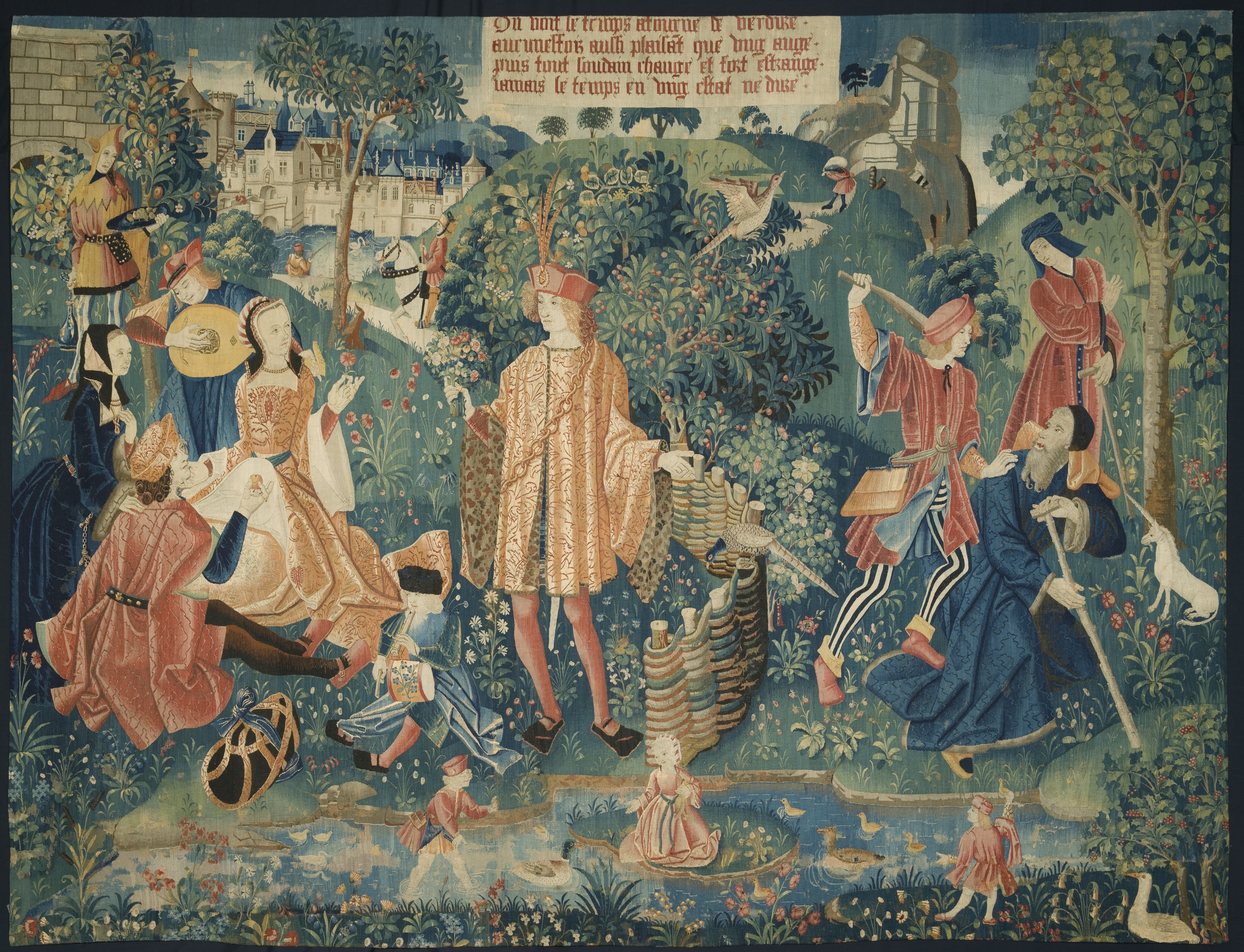
Deconstructing the Threads of Time: An Avant-Garde Analysis of a 16th-Century Tapestry Fragment
At Zoey Fashion Lab, our mission is to unearth the latent narratives within historical textiles, transforming them into blueprints for avant-garde design. The artifact before us—a fragment of a tapestry from the Chateau de Chaumont set, originating in Lyon, France, circa early 16th century—is not merely a decorative relic. Woven from silk and wool in a meticulous tapestry weave, it represents a frozen moment of labor, luxury, and cultural memory. For the avant-garde designer, this fragment is not a finished garment but a new DNA strand: a genetic code of texture, structure, and symbolism that can be spliced, mutated, and re-expressed in contemporary form. This analysis will deconstruct the fragment’s material, technical, and conceptual DNA, proposing how its essence can be translated into a radical, forward-facing collection.
Material DNA: Silk and Wool as Opposing Forces
The choice of silk and wool in a single weave is a dichotomy that speaks directly to the avant-garde’s fascination with tension. Silk, with its lustrous, smooth, and reflective surface, embodies fragility, opulence, and the ephemeral. Wool, conversely, is matte, resilient, and grounding—a material of the earth, of warmth and wear. In the tapestry weave, these fibers are not blended but interlocked, creating a fabric that is simultaneously rigid and supple, luminous and muted. For Zoey Fashion Lab, this dualism becomes a design principle. We can deconstruct this material DNA by:
- Reverse Weave Engineering: Instead of a flat tapestry, we propose a double-faced fabric where silk dominates the exterior for sheen, while wool is exposed on the interior for texture. This creates a garment that changes character as the wearer moves—a literal skin of time.
- Deconstructed Warp and Weft: Isolate the silk threads as structural, translucent overlays, while the wool serves as a dense, sculptural base. This echoes the tapestry’s original function as a wall hanging, but reimagined as a wearable architecture—a portable fragment of a chateau.
- Contrast in Drape: The weight of wool combined with the fluidity of silk produces a fabric that resists and yields simultaneously. For avant-garde silhouettes, this allows for controlled volume—sharp, angular shoulders softened by a liquid-like silk train, or a rigid wool corset over a silk underlayer that billows like a forgotten banner.
Technical DNA: The Tapestry Weave as a Codex
The tapestry weave is a slow, deliberate process—each colored thread interlocks with its neighbor, creating a seamless image without a distinct weft direction. This technique is a form of writing, where every thread is a character in a visual story. For the avant-garde, this technical DNA offers a radical departure from conventional garment construction. Consider these interpretations:
- Pixelated Weaving: Modern tapestry can be reimagined using digital jacquard looms, but with intentional glitches. We can introduce broken threads, irregular slubs, or gaps in the weave to mimic the fragment’s own decay. This creates a garment that is intentionally incomplete—a narrative of erosion that challenges the perfectionism of fast fashion.
- Structural Tapestry: Instead of a flat panel, the tapestry weave can be used to construct three-dimensional forms. By varying tension and thread density, we can create sculptural folds, pockets, and pleats that are integral to the fabric, not added later. This echoes the tapestry’s original role as a spatial divider, but now on the body.
- Interactive Weave: The interlacing of silk and wool can be manipulated by the wearer. Imagine a garment where wool threads can be pulled to tighten the weave, altering the silhouette, or where silk threads can be loosened to create fringed, unraveling edges. This transformable textile empowers the wearer to become a co-creator, a concept central to Zoey Fashion Lab’s ethos.
Conceptual DNA: Time, Memory, and the Avant-Garde
The Chateau de Chaumont set is a document of its era: a symbol of aristocratic power, religious devotion, or mythological allegory. But for the avant-garde, the fragment’s true value lies in its representation of time itself. The early 16th century was a period of flux—the dawn of the Renaissance, the rise of humanism, and the beginning of global exploration. This tapestry, woven in Lyon—a hub of silk trade and craftsmanship—is a nexus of these forces. To translate this conceptual DNA, we propose:
- Time as Fabric: The fragment’s wear, fading, and fraying are not flaws but evidence of history. For the avant-garde, we can accelerate this process through controlled distressing, dyeing with natural pigments that shift over time, or embedding time-release capsules that slowly change the fabric’s color or texture with exposure to light or moisture. The garment becomes a living artifact.
- Narrative Fragmentation: The original tapestry likely told a story—a hunt, a battle, a biblical scene. Our design can fragment this narrative into abstract motifs, using only partial imagery, distorted proportions, or reversed perspectives. This mirrors the way memory works: not as a linear story but as a collection of emotional fragments.
- The Chateau as Body Armor: The tapestry’s original function as a wall covering suggests a protective, enclosing quality. For avant-garde fashion, this translates into architectural garments that shield and reveal. A jacket might have exaggerated, tapestry-covered shoulder pads reminiscent of castle turrets, or a skirt that flares like a tapestry hanging from a gallery wall.
Stylizing the Avant-Garde: From Fragment to Collection
To realize this DNA in a collection, Zoey Fashion Lab proposes a three-part strategy:
- The Unraveling Series: Garments that emphasize the tapestry’s raw edges—silk threads left to dangle, wool yarns pulled to create deliberate holes, and seams that are visible and unfinished. This series celebrates imperfection as a design language, referencing the fragment’s incomplete state.
- The Structural Series: Pieces that use the tapestry weave as a structural element—corsets, bustiers, and oversized coats where the weave’s density creates shape without boning. The silk-wool blend offers a new kind of armor—lightweight yet protective, luxurious yet tactile.
- The Transformative Series: Interactive garments that allow the wearer to alter the design. For example, a dress with removable tapestry panels that can be swapped or rearranged, or a coat with drawstrings that change its silhouette from a cape to a fitted jacket. This series embodies the avant-garde’s rejection of stasis.
Conclusion: The New DNA Strand
The 16th-century tapestry fragment from Chateau de Chaumont is more than a historical curiosity; it is a genetic blueprint for radical design. Its silk and wool fibers, its interlaced weave, and its embedded narratives offer a rich vocabulary for the avant-garde. By deconstructing its material, technical, and conceptual DNA, Zoey Fashion Lab can create garments that are not merely inspired by the past but that reanimate it—transforming a static fragment into a dynamic, living form. In this translation, time itself becomes a fabric, and the wearer, a weaver of new histories.