Deconstructing the Architectural Feminine: A Salted Paper Blueprint for SS26
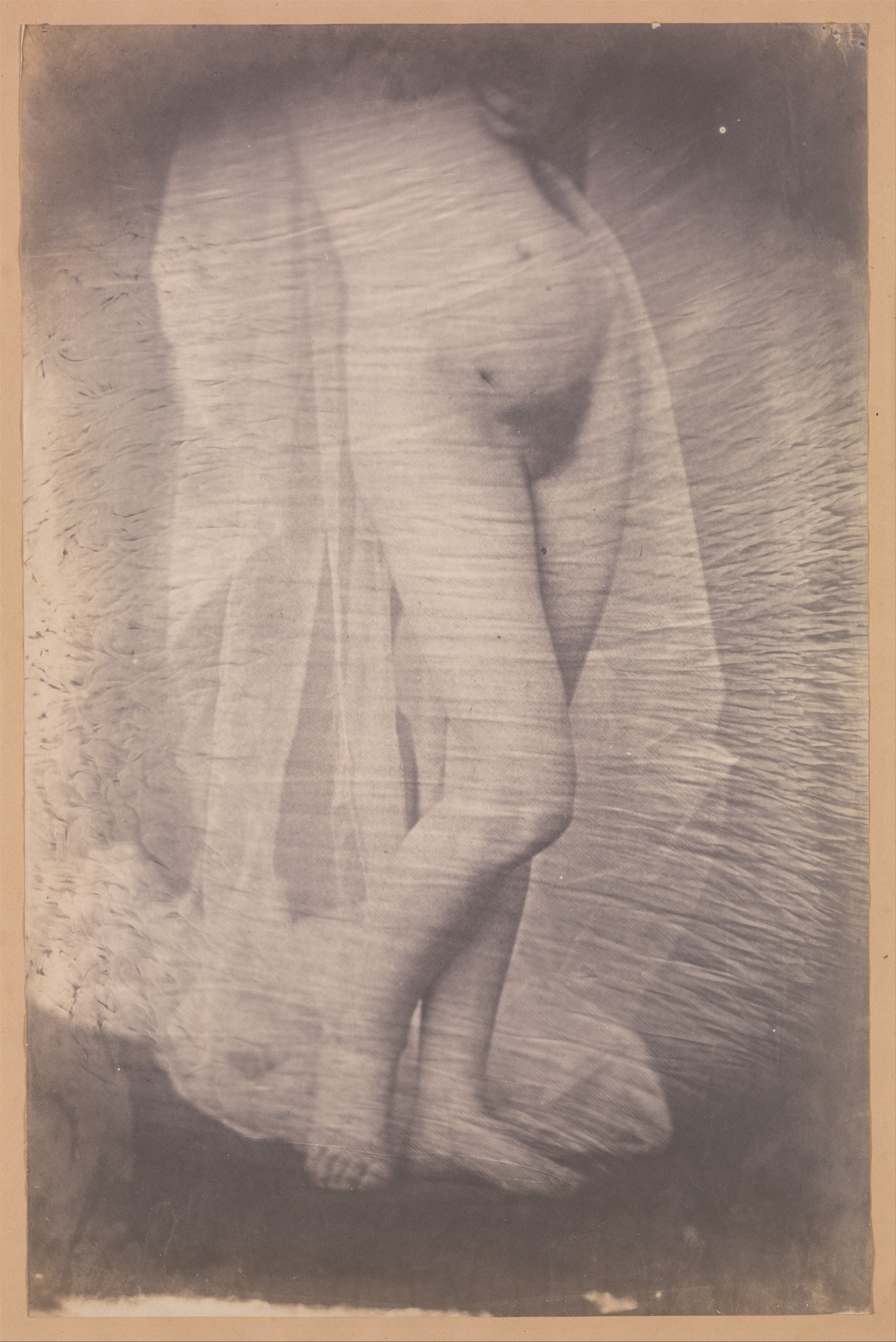
The avant-garde imperative demands a constant renegotiation of form, material, and the very essence of the human silhouette. For Zoey Fashion Laboratory’s SS26 collection, the starting point is not a textile swatch or a 3D-printed prototype, but a singular, haunting artifact: the Standing Female Nude, rendered as a salted paper print from a collodion glass negative. This is not a nostalgic exercise. Rather, this 19th-century photographic process—with its soft, granular surface and its inherent tension between the fleeting moment and the permanent record—serves as a radical conceptual framework for a new structural lexicon. We are not reproducing the body; we are interrogating its architectural potential, its capacity to be both a support and a sculpture.
The salted paper print, by its very nature, is a study in light and shadow without hard edges. There is no sharp contour, no definitive boundary between the figure and the ground. This absence of a clear silhouette is the first and most profound instruction for our SS26 collection. We must move beyond the conventional garment that clings to or defines the body’s outline. Instead, we propose silhouettes that exist in a state of perpetual flux, where the garment’s edge bleeds into the surrounding space, much like the photographic image bleeds into its paper support. The body is not a mannequin but a generator of form, a dynamic node within a larger atmospheric field.
From Collodion to Couture: Material Alchemy
The collodion glass negative is a paradox: a fragile, transparent substrate that holds a dense, inverted reality. Its materiality is our primary design driver. Translating this into garment architecture requires a rethinking of structural innovation. We are not interested in rigid exoskeletons or soft draping in isolation. The goal is a hybrid of tensile membrane and crystalline frame.
Consider the primary structural element: a series of interlocking, semi-transparent panels made from a new bio-composite—a resin-infused cellulose acetate that mimics the brittle, glossy quality of the glass negative. These panels are not sewn; they are carved and assembled via a system of magnetic or pneumatic fasteners, allowing the garment to be reconfigured in real-time, mirroring the photographer’s ability to adjust the negative’s position. The panels are not opaque but possess a graduated translucency, shifting from near-total clarity at the center of the body to a milky, diffused opacity at the edges, exactly as the collodion process creates a vignette effect. This creates a futuristic silhouette that is both armored and ethereal, a protective shell that simultaneously reveals the body’s energy rather than its literal form.
The Silhouette of the Unseen: Negative Space as Volume
A salted paper print is defined as much by what is absent (the unexposed, unpigmented paper) as by what is present (the silver image). This principle of negative space as primary volume is the cornerstone of our SS26 silhouette architecture. We reject the traditional notion of volume as positive, additive mass. Instead, we construct volume through strategic voids, cantilevered forms, and air-filled chambers.
Imagine a jacket where the sleeves are not attached to the body but are suspended via a carbon-fiber lattice that mirrors the photographer’s darkroom clamps. The armhole is not a hole but a defined, positive space—a void in the shape of a limb that never touches the limb itself. The garment’s “fit” is not measured in centimeters of circumference but in centimeters of distance from the skin. The silhouette is therefore a diagram of potential energy, a frozen moment of the body’s interaction with its own absence. The standing nude is not clothed; she is surrounded by a field of structural possibility, her form defined by the negative space of the garment.
Structural Innovation: The Photographic Gesture
The collodion process demands a long exposure—a period of stillness that is also a period of intense, invisible activity. This temporal paradox informs our approach to kinetic structure. The garments for SS26 are not static. They are designed with embedded shape-memory alloys and micro-actuators that respond to the wearer’s breath, heart rate, or ambient light. The silhouette is not a fixed state but a slow, deliberate metamorphosis, echoing the long exposure’s transformation of a living moment into a fixed image.
Consider a skirt constructed from a series of overlapping, paper-thin metal “leaves.” In a state of rest, they form a smooth, columnar shape. As the wearer moves—or as the light changes—the leaves curl and unfurl, creating a shifting, organic silhouette that is part sculpture, part living organism. This is not a garment that you wear; it is a photographic process that you inhabit. The structural innovation lies not in the complexity of the mechanism but in its elegant simplicity of expression, a direct translation of the analog photographic gesture into a digital-physical hybrid.
Conclusion: The Body as a Developing Image
The Standing Female Nude as a salted paper print is a ghost, a record of light that no longer exists. For Zoey Fashion Laboratory’s SS26, this ghost is not a memory but a prophecy. The collection will not dress the body; it will expose the body’s potential as a structural and conceptual apparatus. The futuristic silhouette is not a sleek, aerodynamic form. It is a fractured, luminous, and deeply architectural landscape, a testament to the beauty of the developing image—both in the darkroom and on the runway. We are not designing clothes. We are designing the negative space of a future human, one that is as fragile, as permanent, and as profoundly enigmatic as the photographic artifact that inspired it.