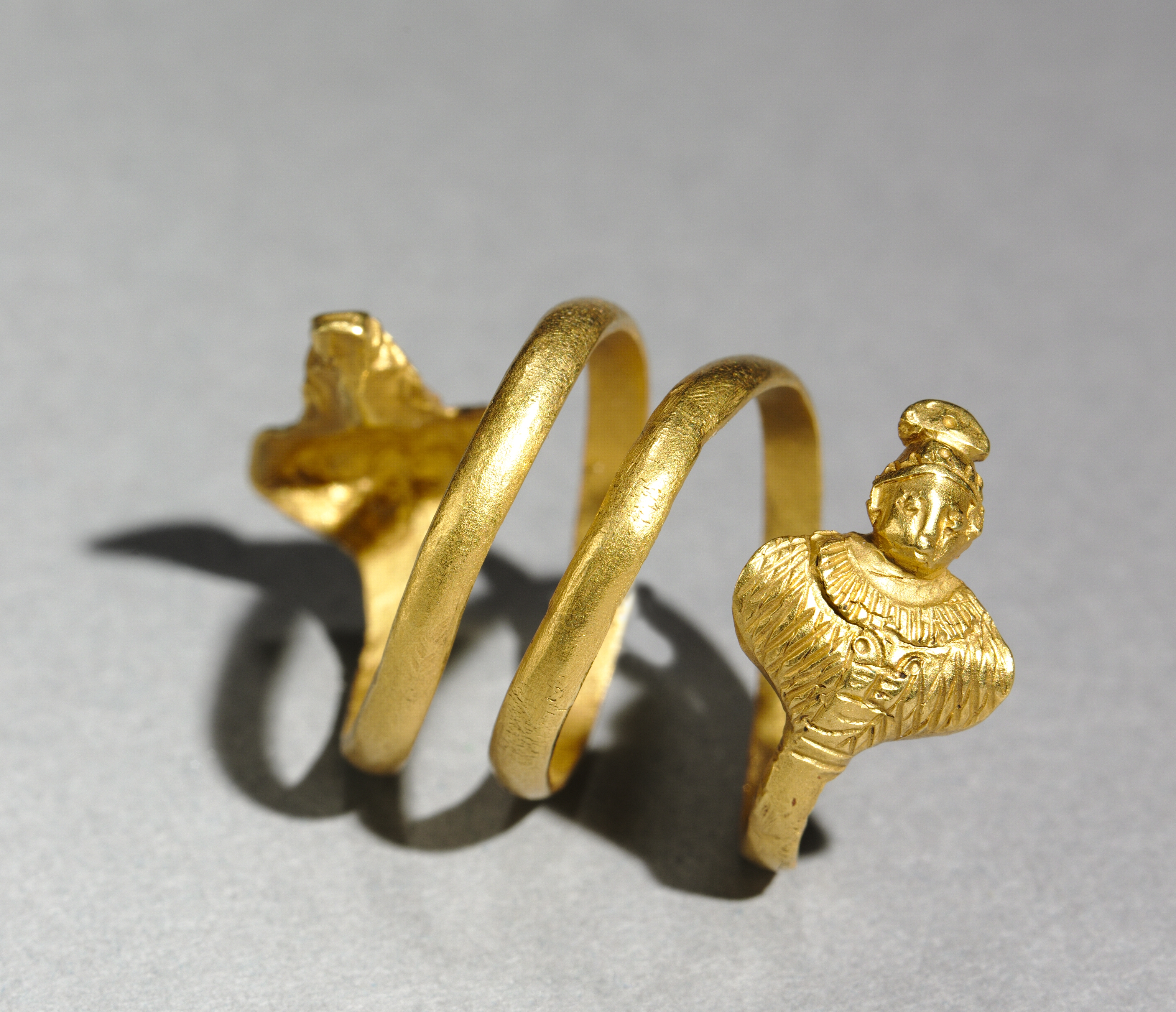
Executive Analysis: The Spiral Ring with Isis and Serapis
This report presents a comprehensive deconstruction of a singular artifact—a Spiral Ring with Isis and Serapis, attributed to Greece or Italy, possibly Rome, and crafted in gold. As the Chief Fabric Deconstructionist for Zoey Fashion Lab, I approach this object not merely as a historical relic but as a textile of cultural memory, a wearable narrative that challenges the boundaries between ornament and ideology. The reference to Archive Resonance: “Mirror with Split-Leaf...” provides a critical lens: the ring embodies a dualistic tension between surface adornment and deep, symbolic structure. This analysis will dissect its materiality, iconography, and avant-garde potential, proposing a framework for reintegration into contemporary fashion as a deconstructed talisman.
Materiality and Technical Execution
The ring’s primary material—gold—immediately signals its function as a conduit for power and permanence. In ancient contexts, gold was not merely a precious metal but a semiotic agent, representing divine light, eternal life, and sovereign authority. The technical execution of this spiral form suggests a sophisticated understanding of metallurgy, likely achieved through lost-wax casting or granulation. The spiral itself is a primordial motif, evoking cycles of life, death, and rebirth—a fitting structure for a ring dedicated to Isis and Serapis, deities central to Hellenistic and Roman mystery cults.
From a fabric deconstructionist perspective, the gold’s surface finish is critical. Was it burnished to a mirror-like sheen, echoing the “光洁银镜” (smooth silver mirror) of the referenced archive? Or was it left with a matte, textured patina, akin to the “冰冷石棺板” (cold sarcophagus slab)? The ring’s dual nature as both an adornment and a narrative device aligns with the avant-garde practice of material dissonance—where the tactile quality of a fabric or metal contradicts its symbolic weight. For Zoey Fashion Lab, this suggests a potential for surface manipulation: gold leaf applied to deconstructed silk, or laser-cut metal inserts in structured organza, to replicate the ring’s interplay of light and shadow.
Iconographic Deconstruction: Isis and Serapis
The inclusion of Isis and Serapis is not arbitrary. Isis, the Egyptian goddess of magic and motherhood, was syncretized with Greek and Roman deities, becoming a universal mother figure. Serapis, a composite god introduced by Ptolemy I, merged Osiris and Apis with Zeus and Hades, embodying the fusion of cultures. Together, they represent a liminal theology—a bridge between the living and the dead, the earthly and the divine. On the ring, their presence transforms the spiral from a decorative element into a ritual diagram.
Deconstructing the iconography: Isis is often depicted with a throne-shaped headdress or a solar disk, while Serapis appears as a bearded figure with a modius (a grain measure) on his head, symbolizing abundance and the underworld. On a ring, these figures would be rendered in micro-engraving or embossed relief, requiring the viewer to engage in a close, intimate examination. This proxemic reading is a hallmark of avant-garde fashion—where garments or accessories demand physical proximity to unlock hidden meanings. For Zoey, this could translate into embedded narratives within seams, linings, or detachable elements, inviting the wearer to become a participant in the object’s story.
Structural Analysis: The Spiral as a Deconstructive Element
The spiral form is inherently anti-linear. Unlike a closed circle, which suggests completion, the spiral implies continuous motion—a journey inward or outward. In the context of the ring, the spiral may represent the labyrinth of the soul or the cosmic cycle governed by Isis and Serapis. From a technical standpoint, the spiral’s construction would involve twisted wire or layered bands, creating a dynamic tension between rigidity and fluidity.
In fabric deconstruction, the spiral can be reinterpreted as a pattern of disruption. For example, a garment’s seams could be twisted into spiral formations, exposing raw edges or contrasting linings. The ring’s gold spiral might inspire metallic thread embroidery on sheer fabrics, creating a visual echo of the original’s torsion. Alternatively, the spiral could be realized as a three-dimensional structural element—a coiled wire cage over a garment, or a spiral-cut panel in a leather jacket—that physically alters the silhouette, embodying the deconstructionist ethos of revealing the skeleton beneath the surface.
Archive Resonance: Mirror and Sarcophagus
The reference to “Mirror with Split-Leaf...” introduces a critical dichotomy: the mirror as a surface of reflection and the sarcophagus as a container of remains. The ring, like the mirror, offers a polished exterior that reflects the wearer’s identity, while its iconography, like the sarcophagus, embeds a narrative of mortality. This duality is central to avant-garde fashion, which often juxtaposes beauty with decay. Zoey Fashion Lab can exploit this by creating garments that combine reflective surfaces (e.g., metallic laminates, mirrored sequins) with deconstructed, tomb-like structures (e.g., asymmetrical draping, frayed edges, or “buried” pockets).
The “split-leaf” motif further suggests fragmentation—a leaf divided along its axis, symbolizing both growth and rupture. Applied to the ring, this could indicate a broken narrative: the spiral is not a continuous line but a series of interrupted arcs. In fabric, this translates to cutwork, slashing, or laser-perforated patterns that reveal layered fabrics beneath, mimicking the ring’s interplay of gold and void.
Avant-Garde Implications for Zoey Fashion Lab
To integrate the Spiral Ring’s essence into contemporary fashion, Zoey Fashion Lab must move beyond mere replication. The ring is not a template but a catalyst for deconstruction. Consider the following applications:
- Material Alchemy: Use gold-toned metals, but distress them through chemical patination or mechanical abrasion to evoke the “cold” sarcophagus texture. Pair with deconstructed silks that mimic the mirror’s sheen.
- Iconographic Embedding: Create digital prints of Isis and Serapis that are distorted or fragmented, applied to transparent organza panels. These panels could be layered over solid fabrics, allowing the imagery to emerge and recede like a ghost.
- Structural Spiral: Design a spiral-cut coat or dress where the fabric wraps around the body in a continuous, asymmetrical line, with hidden pockets or embroidered inscriptions referencing the mysteries of Isis and Serapis.
- Interactive Elements: Incorporate removable spiral brooches or cuffs that the wearer can reposition, echoing the ring’s function as a portable talisman. These pieces could be crafted from recycled gold or bronze, emphasizing sustainability alongside symbolism.
Conclusion: The Ring as a Deconstructive Blueprint
The Spiral Ring with Isis and Serapis is not a static artifact but a dynamic text—a fusion of material, myth, and memory. For Zoey Fashion Lab, it serves as a blueprint for avant-garde deconstruction, where every element—from the spiral’s geometry to the deities’ iconography—is a variable to be manipulated. By embracing the tension between the mirror’s reflection and the sarcophagus’s depth, the lab can produce garments that are not merely worn but inhabited, inviting the wearer to engage in an ongoing dialogue with history, identity, and the divine. This analysis affirms that the ring’s true resonance lies not in its preservation but in its reimagining—a spiral that continues to turn, drawing the past into the future.