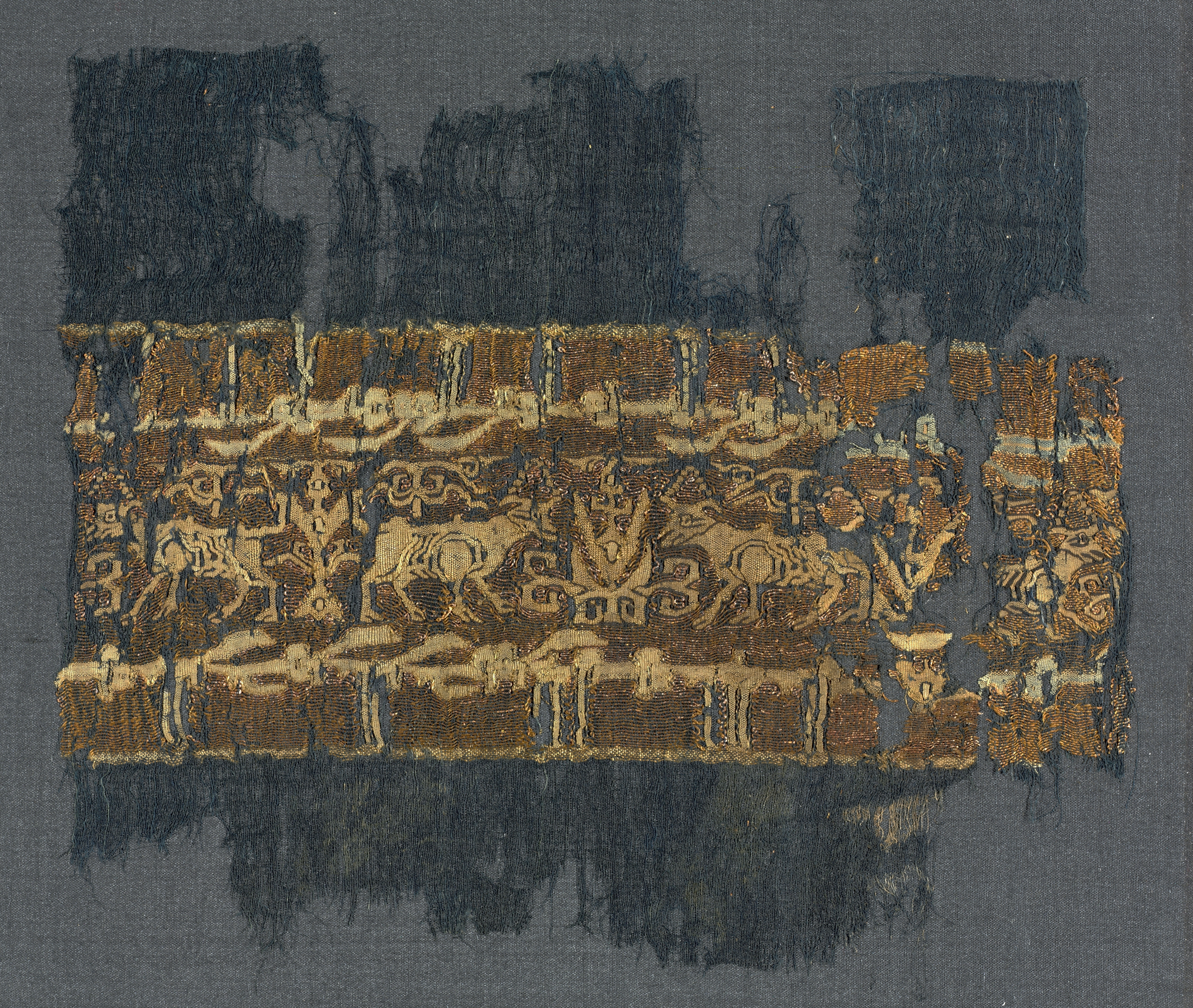
Deconstruction of the Fatimid Tiraz: A Study in Avant-Garde Textile Alchemy
At Zoey Fashion Lab, we approach historical textiles not as relics, but as living archives of material intelligence. The Tiraz fragment from the Fatimid period, reign of Caliph al-Zahir (1020–1035), presents a profound case study in the avant-garde potential of pre-modern craftsmanship. This linen, silk, and gold filé textile, executed in plain weave with inwoven tapestry technique, embodies a dialectical tension between opulence and austerity—a quality that resonates deeply with contemporary fashion’s pursuit of conceptual depth. Our analysis will deconstruct this artifact through the lens of materiality, structural logic, and symbolic resonance, drawing parallels to the mirrored and carved narratives suggested by the reference to the "Mirror with Split-Leaf" archive.
Material Heterodoxy: The Alchemy of Gold, Silk, and Linen
The Tiraz’s material composition is a deliberate study in contrasting energies. Linen, derived from flax, is a fiber of the earth—cool, crisp, and structurally rigid. It speaks of the functional, the everyday, the ground beneath the feet. Silk, by contrast, is a fiber of the air—luminous, fluid, and sensuous. It evokes the ethereal, the courtly, the breath of the divine. Gold filé, a metal thread wrapped around a silk core, is the third element: a material of pure light, of immutable value and celestial authority. In the avant-garde context, this triad is not merely decorative; it is a syntax of conflict. The linen resists the silk’s softness; the gold imposes its weight upon both. This is not a harmonious blend but a charged coexistence, akin to the juxtaposition of a polished silver mirror and a cold stone sarcophagus in the reference text.
For Zoey Fashion Lab, this material heterodoxy informs our design philosophy. We deconstruct the Tiraz by separating its fibers conceptually. Imagine a garment where the linen forms a rigid, architectural base—a sculpted corset or a sharp-shouldered jacket—while the silk bleeds through as a diaphanous overlay, and the gold filé is applied as fractured, non-representational lines that disrupt the surface. The gold is not used to depict palmettes or script, but to create abstract scars, mirroring the split-leaf motif’s inherent duality: growth and rupture, mirror and tomb.
Structural Logic: The Tapestry Weave as Narrative Interruption
The technical execution—plain weave with inwoven tapestry—is crucial to the Tiraz’s avant-garde identity. Plain weave is the most fundamental textile structure: a simple over-under grid. It is the ground zero of weaving, the neutral field upon which meaning is inscribed. The tapestry weave, however, is an interruption. It introduces discontinuous wefts, allowing for localized color and pattern without disrupting the overall plain weave ground. This creates a topography of emphasis: the gold and silk motifs rise from the linen field like islands from a sea, or like embossed narratives on a stone slab.
In our deconstruction, we view this as a prototype for digital-age texturing. The tapestry sections are not integrated seamlessly; they are intrusions, accents, and ruptures. The Fatimid weaver controlled the tension between ground and figure with precision, but we can imagine a radical reinterpretation: deliberate misalignments, where the tapestry wefts are left loose, creating loops and floats that break the plane. This would evoke the split-leaf motif’s organic, almost chaotic growth, while the gold filé could be used as a conductive thread, suggesting a hidden circuitry of power and ritual. The Tiraz becomes a textile motherboard, where the gold carries the charge of sovereignty and the linen acts as the insulating substrate.
Symbolic Resonance: The Mirror and the Sarcophagus
The reference to the "Mirror with Split-Leaf" archive is a powerful lens for interpreting the Tiraz. The mirror, as a surface, is reflective and illusory, while the sarcophagus is monumental and commemorative. The Tiraz, as a garment or furnishing textile, exists in a similar liminal space. It was worn or displayed in the Fatimid court, a space of performative power and ritualized display. The gold inscriptions—likely bearing the Caliph’s name and blessings—functioned as a textual mirror, reflecting the ruler’s authority onto the wearer. Simultaneously, the textile’s fragility and eventual decay into archaeological fragments render it a sarcophagus for a lost world, preserving the touch of hands and the gaze of eyes long vanished.
In an avant-garde fashion context, we can activate this duality. A garment derived from the Tiraz could be designed with two distinct faces. One side, the "mirror," features the gold filé in highly polished, reflective surfaces, perhaps using modern metallic laminates or laser-cut gold leaf. The other side, the "sarcophagus," is left raw, with the linen thread ends exposed, the silk frayed, and the gold appearing tarnished or embedded in a resin-like coating. The wearer becomes a living archive, turning between the glittering present and the textured past. The split-leaf motif, with its symmetrical yet organic form, can be abstracted into a binary code of growth and decay, rendered as a digital print that bleeds into the weave.
Avant-Garde Application: The Zoey Fashion Lab Protocol
Our protocol for reinterpreting the Fatimid Tiraz involves three stages: extraction, distortion, and reintegration. First, we extract the material DNA: the linen’s structural grid, the silk’s chromatic range, and the gold’s linear precision. We then distort these elements through an avant-garde filter: the grid is broken into asymmetrical panels; the silk is treated with heat to create crinkled, memory-fabric textures; the gold is applied as sprayed or vaporized particles, creating a ghostly aura rather than defined lines. Finally, we reintegrate these components into a garment that is both a tribute and a critique—a deconstructed abaya or a fragmented caftan that reveals its construction, its history, and its potential for future narratives.
The result is a piece that resists easy consumption. It demands that the viewer engage with the weight of history and the lightness of innovation. Like the Fatimid Tiraz, it is a textile paradox: plain yet opulent, stable yet fragile, commemorative yet ephemeral. For Zoey Fashion Lab, this is the essence of the avant-garde: not the rejection of tradition, but its radical reanimation.