The Tsuba Deconstructed: Forging the Armature of SS26
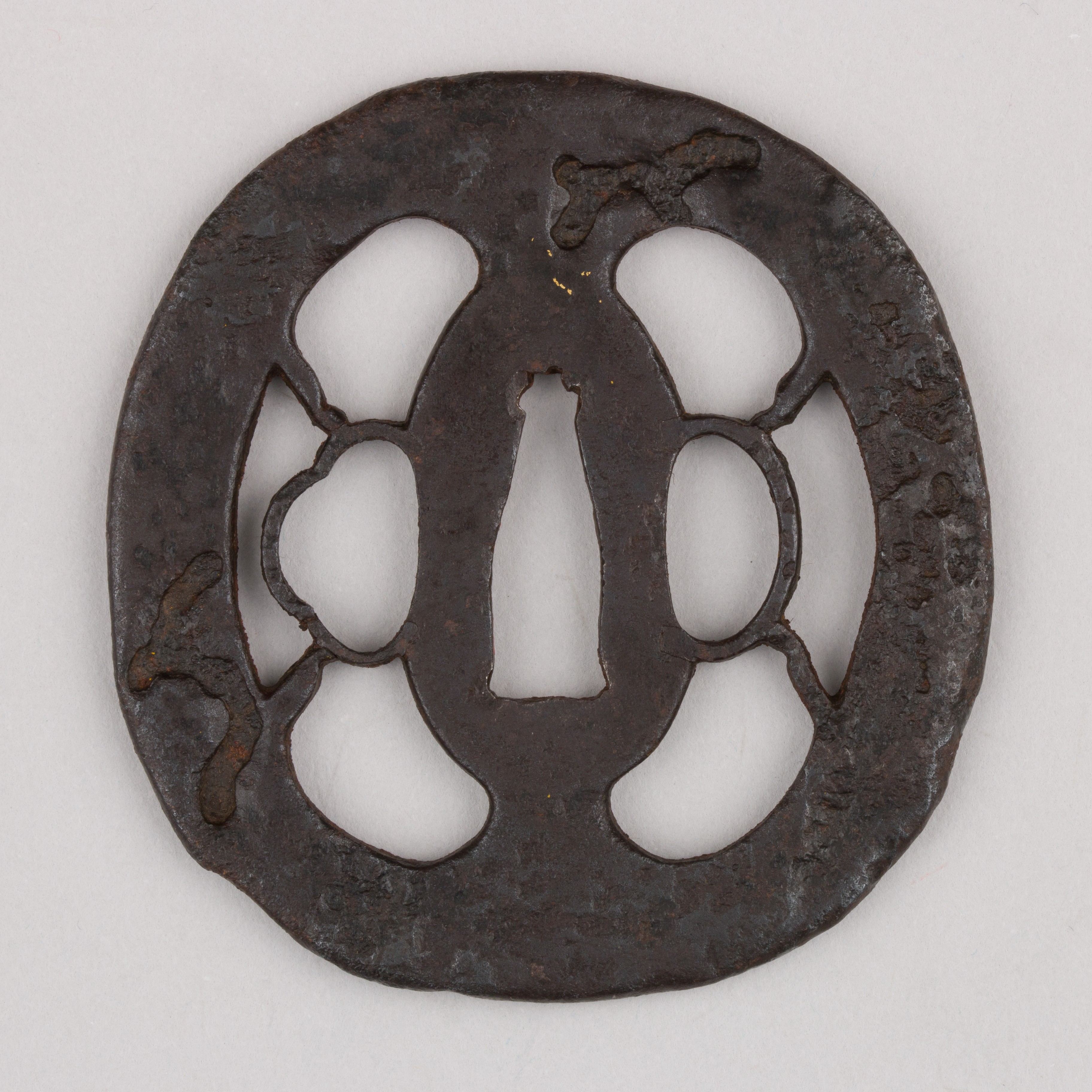
The sword guard, or tsuba, is a paradox of Japanese metalwork: an object of profound restraint that simultaneously enables lethal motion. For SS26, Zoey Fashion Laboratory interrogates this artifact not as a historical relic, but as a blueprint for structural innovation. The tsuba’s architecture—its negative space, its asymmetrical silhouette, its fusion of disparate metals—becomes the generative grammar for a new avant-garde couture language. This analysis dissects how iron, gold, and copper converge to produce futuristic silhouettes that defy the body’s organic limits, redefining the garment as a mobile armature.
Iron: The Skeletal Framework of Negative Space
Iron, the tsuba’s foundational material, offers a lesson in structural integrity through absence. Traditional tsuba designs feature intricate cutouts—hitsu-ana—that lighten the guard while maintaining its defensive core. For SS26, this principle translates into garments where the skeleton is the silhouette. Consider a jacket constructed from laser-cut iron-plated panels, each perforated with geometric voids that echo the tsuba’s openwork. The negative space is not decorative; it is load-bearing. The garment’s architecture relies on these voids to reduce weight, distribute tension, and create a dynamic interplay of light and shadow. The iron’s raw, unpolished surface—a deliberate rejection of refinement—speaks to a future where couture embraces the industrial sublime. The silhouette becomes a cage of potential energy, the wearer’s movement activating the armor’s latent kinetic force. This is not clothing; it is a wearable contradiction: heavy yet airy, rigid yet fluid.
Gold: The Luminescence of Asymmetry
Gold in the tsuba is rarely uniform; it appears as inlays, partial overlays, or delicate filigree that disrupts the iron’s monochrome. This asymmetrical application of precious metal is a direct challenge to Western couture’s obsession with symmetry. For SS26, gold is deployed as a strategic accent—a single sleeve traced in 24-karat wire, a collar gilded only on one side, a hemline where gold leaf fractures into a constellation of micro-panels. The effect is disorienting, forcing the eye to map the garment’s architecture in fragments. The futuristic silhouette emerges from this imbalance: a dress that swells on the left, contracts on the right, its volume dictated by gold’s reflective density. The metal’s warmth contrasts with iron’s coldness, creating a dialogue between power and opulence. Here, gold is not ornament; it is a structural counterweight, a deliberate flaw that perfects the whole. The asymmetry becomes a form of dynamic equilibrium, a nod to the tsuba’s own off-center design, which accommodates the sword’s blade while subverting visual expectation.
Copper: The Patina of Temporal Draping
Copper introduces the element of time. Its natural patination—from bright orange to verdigris green—offers a blueprint for temporal draping, where fabric or metal is designed to evolve with wear. For SS26, copper is woven into the garment’s infrastructure as thin, oxidized sheets that mimic the tsuba’s aged surfaces. These sheets are not static; they are articulated through micro-hinges and flexible joints, allowing the copper to shift and crease like fabric. The silhouette thus becomes a living organism, its patina deepening in areas of highest contact—the shoulder, the hip, the wrist. This is a futuristic reinterpretation of draping, where the body’s heat and moisture accelerate the metal’s transformation. The garment’s structural innovation lies in its acceptance of entropy: the copper will never remain as it was at the runway show. Each wearer becomes a collaborator, their unique chemistry dictating the final form. The tsuba’s copper inlays, once static, are here liberated into a mutable architecture that challenges the very notion of a finished garment.
The Silhouette as Armature: From Guard to Garment
The tsuba’s most radical contribution to SS26 is its silhouette—an abstraction of defense. Where traditional couture shapes the body as a vessel for fabric, the tsuba-inspired silhouette treats the body as a core around which an exoskeletal armature is built. Consider a gown where the waist is encircled by a tsuba-inspired ring of iron, gold, and copper, its inner edge carved to accommodate the torso’s movement. The ring’s asymmetry—one side broader, the other tapered—creates a visual torque that propels the eye upward. Above this ring, the garment dissolves into a lattice of metal ribbons; below, it cascades into a train of oxidized copper scales. The silhouette is not a line but a volume, defined by the voids between its components. This is a structural innovation that borrows from the tsuba’s negative space: the garment’s power lies not in what covers the body, but in what is left exposed. The shoulder, the hip, the spine—these become architectural foci, framed by metalwork that both reveals and conceals.
Futuristic Context: The SS26 Manifesto
For SS26, Zoey Fashion Laboratory positions the tsuba as a harbinger of a new design paradigm: functional ornamentalism. In an era of digital saturation, the tsuba’s physicality—its weight, its patina, its asymmetry—offers a tactile counterpoint. The iron provides structural honesty; the gold, strategic disruption; the copper, temporal depth. Together, they forge a silhouette that is both ancient and futuristic, a hybrid of samurai armor and cybernetic exoskeleton. This is not nostalgia; it is a reclamation of craft as a tool for innovation. The tsuba teaches that the most profound design arises from constraint: the sword guard’s limited surface area forces a compression of intent. For SS26, every gram of metal, every millimeter of void, is calibrated to produce maximum impact. The result is a collection that does not clothe the body so much as arm it, transforming the wearer into a living artifact—a guardian of a future where fashion is armor, and armor is art.
In conclusion, the tsuba’s integration of iron, gold, and copper provides a masterclass in material dialogue. Zoey Fashion Laboratory’s SS26 interpretation elevates this dialogue into a structural lexicon, where asymmetry, patina, and negative space become the building blocks of a new avant-garde. The garment is no longer a second skin; it is a third dimension, a portable architecture that redefines the relationship between body, space, and time. This is the definitive avant-garde couture analysis—a blueprint for a future forged in the crucible of the past.