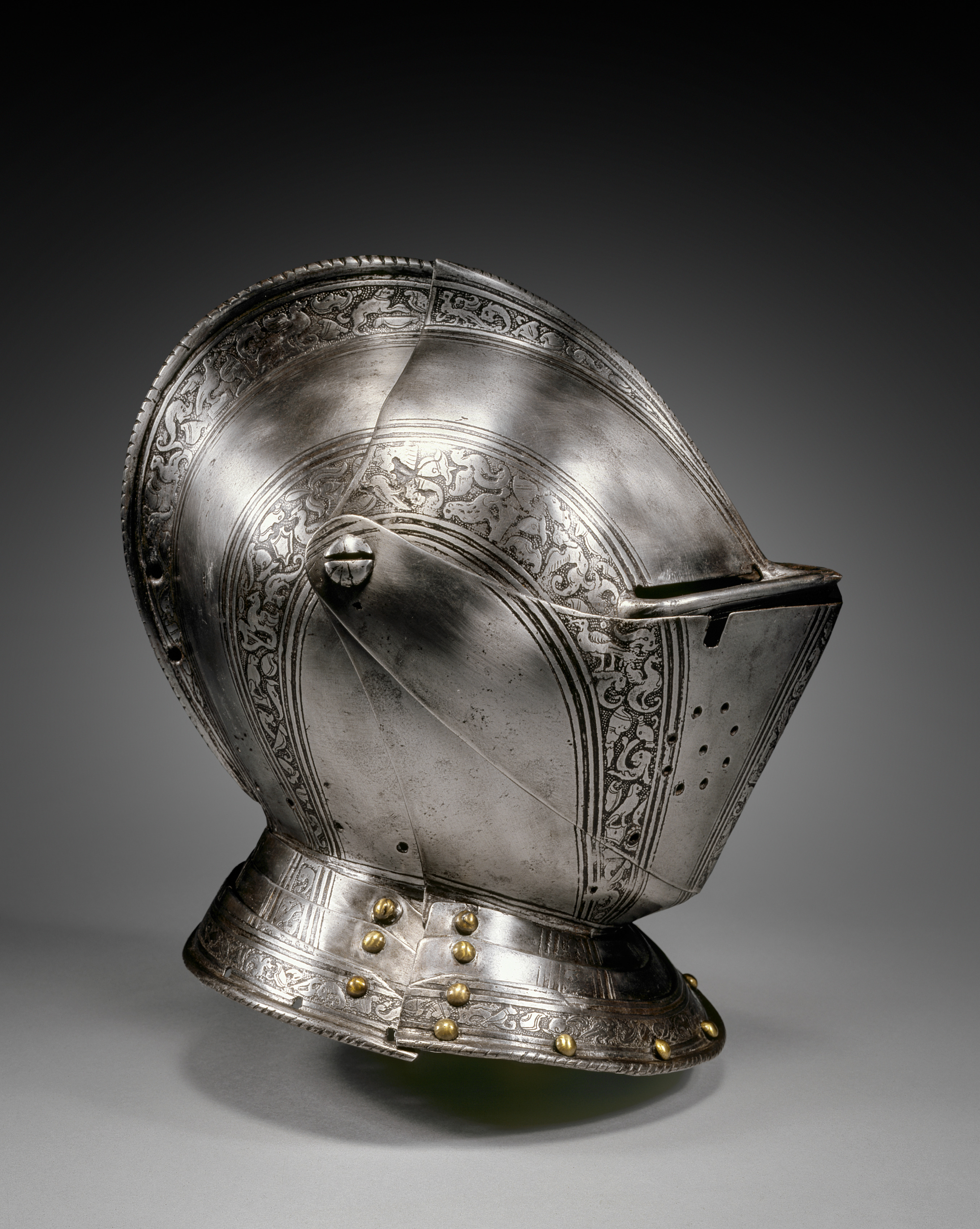
Deconstructing the Brescia Close Helmet: A Zoey Fashion Lab Analysis
At Zoey Fashion Lab, our mission is to unearth the latent narratives within historical artifacts and translate them into avant-garde design language. Today, we turn our focus to a 16th-century close helmet, likely forged in the armories of Brescia, North Italy. This object, crafted from steel and adorned with etched decorative bands and roundels, is far more than a relic of warfare. It is a New DNA Strand—a genetic blueprint for a future where protection, ornamentation, and identity are fused in radical, unexpected ways. Our analysis deconstructs this helmet’s technical, aesthetic, and symbolic DNA to reveal its potential as a progenitor of avant-garde fashion.
Technical DNA: The Architecture of Protection and Precision
The close helmet’s primary technical function was to encase the head completely, offering maximum protection in close combat. Its construction—a skull piece, visor, bevor, and gorget—demonstrates a sophisticated understanding of ergonomics and impact distribution. The steel, likely hardened through quenching and tempering, represents a material that balances tensile strength with the ability to absorb shock. For Zoey Fashion Lab, this translates into a foundational principle: form must serve function, but function can be poetic.
The etched decorative bands and roundels are not merely embellishments; they are a technical innovation in surface treatment. Etching, achieved by applying acid-resistant wax, incising the design, and then exposing the metal to acid, creates a permanent, tactile pattern that simultaneously weakens and strengthens the metal. This paradox—decoration as a form of controlled degradation—is central to our avant-garde interpretation. We see this as a metaphor for vulnerability as strength. In our designs, we might replicate this effect through laser-cut perforations in structural fabrics like carbon fiber or treated leather, creating patterns that reduce material weight while adding visual and textural complexity. The roundels, circular motifs often containing religious or heraldic imagery, become movable joints or focal points for modular accessories. Imagine a garment where circular, etched metal or resin discs can be rearranged to alter silhouette or protection level, echoing the helmet’s adjustable visor.
Furthermore, the helmet’s articulation—the precise riveting and sliding mechanisms that allowed the visor to open and close—is a lesson in kinetic design. Our lab can translate this into garments with transformable elements: collars that rise into protective hoods, sleeves that lock into articulated cuffs, or entire silhouettes that shift from closed, armored forms to open, flowing ones. The close helmet’s ability to seal the wearer from the environment while permitting vision and breath inspires a new category of responsive body armor for the 21st century—not for battle, but for navigating urban, digital, or even psychological landscapes.
Aesthetic DNA: Ornamentation as Identity and Resistance
The etched bands and roundels on this Brescia helmet are not random; they are a coded language of status, allegiance, and belief. In the 16th century, such decoration signaled the wearer’s wealth, patronage, and martial identity. The bands, often geometric or foliate, frame the helmet’s structure, while roundels might display a saint’s image or a family crest. For Zoey Fashion Lab, this is a profound lesson in wearable narrative. Our avant-garde approach strips away the literal heraldry but retains the concept of surface as a canvas for personal or collective storytelling.
The aesthetic DNA we extract is one of contrast and tension. The cold, hard steel is softened by the intricate, almost lace-like etching. The helmet’s imposing, anonymous form is personalized by the roundels. This duality—between the impersonal and the intimate, the brutal and the beautiful—is a cornerstone of our design philosophy. We envision garments that juxtapose rigid, high-tech armature with delicate, hand-embroidered patterns. The etched bands become digital or hand-painted motifs that wrap around the body, suggesting both constraint and adornment. The roundels evolve into interchangeable medallions—perhaps embedded with NFC chips or bioluminescent elements—that allow the wearer to broadcast identity in real-time, much like a 16th-century knight displayed his colors.
The color palette of the original helmet—the grey-black of oxidized steel, the matte sheen of polished metal, and the subtle highlights of the etched lines—inspires a monochromatic yet texturally rich scheme. Our materials will mimic this: matte carbon fiber, polished aluminum, blackened silver, and laser-engraved leather. The roundels, often gilded or inlaid with brass, introduce a flash of warmth. We translate this as strategic accents of gold or copper thread in embroidery, or small, glowing LED elements that echo the roundel’s focal power.
Symbolic DNA: The Helmet as a New DNA Strand for Avant-Garde Fashion
The close helmet is a potent symbol of protection, anonymity, and transformation. It simultaneously hides the wearer’s face and projects a fearsome, idealized identity. In the context of Zoey Fashion Lab, this becomes a meditation on the modern self. We live in an era where we constantly curate our digital and physical personas, often hiding behind screens or stylized appearances. The Brescia helmet, with its etched identity and closed visor, is a perfect metaphor for this condition.
Our avant-garde interpretation sees the helmet as a New DNA Strand—a genetic code for a fashion that is both armor and ornament, both private and public. The etched bands represent the societal patterns that shape us; the roundels, the moments of individual choice and expression. The helmet’s ability to close off the wearer from the world—or open to reveal the face—is a powerful design tool. We can create garments with morphing surfaces: smart textiles that change opacity or pattern in response to the wearer’s biometrics or environment, mimicking the visor’s action. A jacket that becomes opaque when the wearer feels threatened, or a hood that reveals a digital roundel when approached, directly channels the helmet’s symbolic function.
Furthermore, the helmet’s origin in Brescia, a city known for its arms production, speaks to a culture of craftsmanship and conflict. Our lab honors this by insisting on high-quality construction and materials, even as we push boundaries. The “New DNA Strand” concept implies that this historical object is not a dead artifact but a living code that can be recombined, mutated, and expressed in new forms. We see the helmet’s structural elements—the rivets, the sliding pins, the overlapping plates—as connective tissue for a new kind of fashion system. Garments become modular, repairable, and adaptable, much like a suit of armor was tailored and maintained over a lifetime.
In conclusion, the 16th-century close helmet from Brescia is a masterclass in integrated design. Its technical precision, aesthetic richness, and symbolic depth provide Zoey Fashion Lab with a robust New DNA Strand. Our avant-garde collections will echo its architecture through transformable, protective silhouettes; its ornamentation through coded, interactive surfaces; and its symbolism through a meditation on identity and concealment. This helmet is not a relic; it is a blueprint for a future where fashion is both a shield and a declaration. At Zoey Fashion Lab, we are proud to deconstruct and reforge this DNA into garments that speak to the warrior, the artist, and the visionary within every wearer.