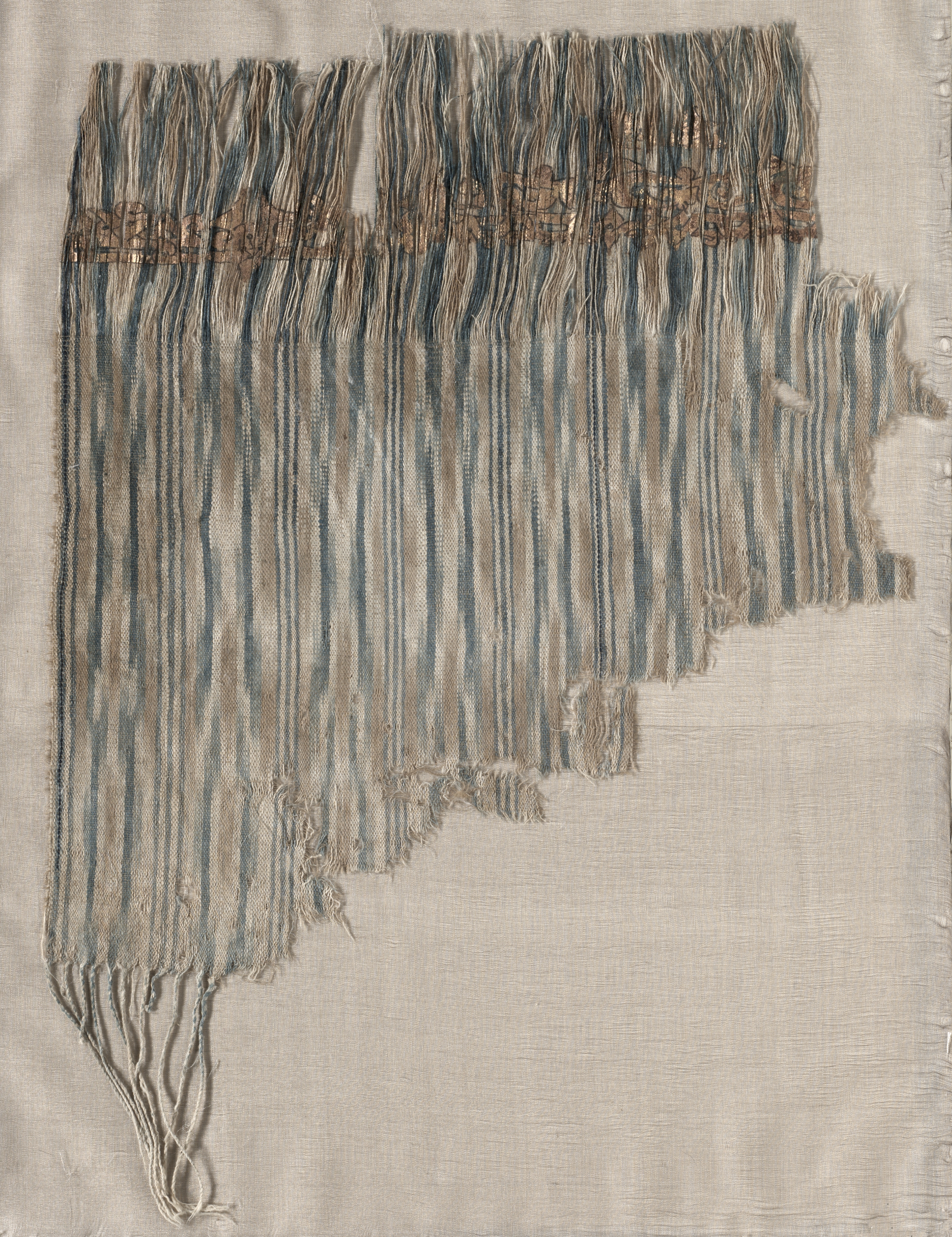
Deconstructing the Ikat Tiraz: A Yemeni Textile as Avant-Garde Blueprint
At Zoey Fashion Lab, our mission is to dismantle the conventional and reassemble it into something that challenges the very definition of fashion. We do not merely study historical textiles; we extract their DNA—their technical, cultural, and aesthetic codes—and mutate them into new forms. The subject of this analysis, an Ikat Tiraz from San'a, Yemen, dating to the reign of the Rassid Imams, is a prime candidate for such deconstruction. Crafted from cotton and gold leaf, employing a resist-dyed warp (ikat) and a plain weave with inscription, this fragment is far more than a relic. It is a manifesto of power, precision, and paradox—a perfect precursor to the avant-garde.
Technical Deconstruction: The Warp of Resistance
The technical foundation of this textile is its ikat warp. The process of resist-dyeing the warp threads before weaving is an act of calculated chaos. The artisan binds, dyes, and then unbinds the threads, creating a pattern that is both predetermined and subject to the unpredictable bleeding of color. This is not a passive craft; it is a dialogue between control and accident. For Zoey Fashion Lab, this speaks directly to our avant-garde ethos: we embrace the controlled imperfection as a design principle.
The cotton base provides a humble, breathable ground, while the gold leaf application—likely applied after weaving or as a supplementary weft—introduces a stark, metallic interruption. This juxtaposition of the organic (cotton, natural dyes) and the inorganic (gold leaf) creates a tension of materials. In an avant-garde context, we would amplify this tension. Imagine a garment where the cotton is left raw and unfinished, while the gold leaf is applied in jagged, asymmetrical streaks, mimicking the irregular resist-dye marks. The inscription, woven in a plain weave, becomes a textural scar rather than a legible text, a ghost of authority that we can reinterpret as a code of rebellion.
The plain weave structure is deceptively simple. It is the most fundamental of weaves, yet it serves as the canvas for both the complex ikat pattern and the gold leaf embellishment. This paradox—the mundane supporting the extraordinary—is a core tenet of avant-garde design. We would strip the weave to its barest form, perhaps leaving floating warp threads or deliberately distorting the tension to create a deconstructed silhouette, where the garment's construction becomes its primary ornament.
Cultural and Political Resonance: The Tiraz as Power Script
The tiraz tradition—the weaving of inscriptions, often including the name of the ruling Imam, religious phrases, or blessings—was a state-sponsored act of propaganda. These textiles were not mere clothing; they were mobile declarations of sovereignty. The Rassid Imams, who ruled Yemen from the 9th to the 19th centuries, used such textiles to assert their legitimacy and divine favor. The gold leaf and intricate ikat were not just decorative; they were the visual language of power.
In the context of Archive Resonance’s reference to the 16th and 17th centuries, this textile sits at a crossroads of global trade and local identity. Yemen was a nexus of Indian Ocean commerce, and the ikat technique itself likely traveled from India or Southeast Asia, while the gold leaf and cotton may have come from Africa or the Levant. This textile is a palimpsest of global influences, yet it is unmistakably Yemeni in its execution and purpose.
For the avant-garde, this is a rich vein to mine. We would extract the inscription as a symbol of authority and subvert it. Instead of the Imam’s name, we would weave fragments of protest poetry, binary code, or even the names of forgotten artisans. The gold leaf, once a marker of elite status, could be applied to the inside of a garment—hidden from view, a secret rebellion against the external display of power. The ikat pattern, originally a sign of regional identity, could be distorted into a digital glitch, referencing the fragmentation of identity in the modern world.
Aesthetic Alchemy: The Avant-Garde Transformation
The aesthetic of this Ikat Tiraz is one of restrained opulence. The colors, likely indigo blues, madder reds, and the shimmer of gold, are rich but not gaudy. The pattern is geometric yet organic, a result of the resist-dye process. The inscription is formal, yet its placement within the weave creates a rhythmic, almost musical quality. This is a textile that demands to be read, not just seen.
To translate this into an avant-garde collection, Zoey Fashion Lab would focus on dissonance and fragmentation. We would deconstruct the silhouette: a long, flowing robe (referencing traditional Yemeni dress) but with asymmetrical hems, raw edges, and deliberate holes that expose the underlying structure. The ikat pattern would be replicated through digital printing on sheer organza, layered over a solid cotton base, creating a ghostly double of the original. The gold leaf would be replaced with metallic foil appliqués that are deliberately peeling or cracked, suggesting decay and the passage of time.
The inscription would be reimagined as a tactile element. We would use embroidery or even chainmail to spell out the words, but in a font that is illegible at a distance—only revealing its meaning upon close inspection. This plays with the concept of hidden power, just as the original tiraz was a subtle but potent assertion of authority. The garment would be designed to be worn inside out, or with multiple layers that can be rearranged, allowing the wearer to control the narrative of the textile.
Conclusion: The Textile as Time Machine
This Yemeni Ikat Tiraz is not a static artifact. It is a time machine, carrying within it the echoes of Rassid power, the hands of anonymous weavers, and the global currents of trade and culture. For Zoey Fashion Lab, it is a starting point for a radical reimagining. We do not aim to replicate its beauty; we aim to amplify its contradictions. The tension between control and accident, between the organic and the metallic, between the local and the global—these are the very tensions that define the avant-garde.
By deconstructing this textile, we create a new language of fashion that is both deeply historical and aggressively futuristic. The Ikat Tiraz becomes a blueprint for garments that are unstable, provocative, and alive. In the hands of Zoey Fashion Lab, this fragment of Yemeni heritage is not preserved in amber; it is reborn as a weapon of aesthetic disruption.