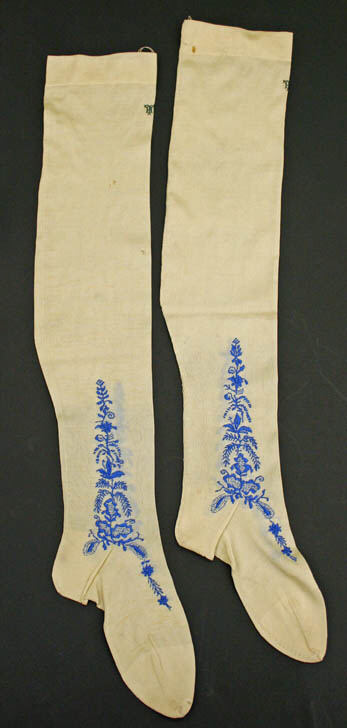
The Deconstructed Limb: Stockings as Structural Armature for SS26
The humble stocking, historically relegated to the periphery of fashion discourse as a mere accessory, undergoes a radical ontological shift in Zoey Fashion Laboratory’s SS26 avant-garde analysis. Within the context of French silk craftsmanship and deconstructive aesthetics, the stocking ceases to be a passive garment and becomes an active structural armature—a tensile exoskeleton that redefines the silhouette of the human leg. This study dismantles the traditional binary of hosiery as either functional or decorative, proposing instead a futuristic paradigm where stockings function as architectural scaffolding for the body, leveraging the material’s intrinsic properties to challenge spatial perception and kinetic movement.
Material as Metaphor: The Silk Paradox
French silk, with its luminous opacity and fluid drape, presents a paradox central to this analysis. At the molecular level, silk’s fibroin structure grants it an exceptional strength-to-weight ratio—a tensile resilience that, when engineered into stockings, can resist gravitational pull while maintaining a near-second-skin intimacy. Yet, for SS26, we reject the cliché of silk as mere luxury. Instead, we weaponize its structural ambiguity: the same material that whispers of bourgeois delicacy is repurposed into a load-bearing membrane, capable of suspending, compressing, and reorienting the leg’s anatomy. This is not a stocking that clings; it is a stocking that scaffolds. The silk is treated with a proprietary micro-lamination process that creates differential tension zones—areas of extreme rigidity at the ankle and thigh, while the knee remains a fluid hinge. The result is a biomechanical exoskeleton that forces the wearer to adopt a new gait, a deliberate, almost robotic locomotion that redefines the silhouette as a living architecture.
Futuristic Silhouettes: The Asymmetric Limb
The SS26 silhouette is predicated on asymmetry as a structural principle. Traditional stockings aim for bilateral symmetry—a mirror image of left and right. Our avant-garde proposition disrupts this with differential compression mapping. The left stocking is engineered with a higher modulus of elasticity, creating a pronounced, sculpted calf that appears almost pneumatic, while the right stocking incorporates a reticulated lattice of silk strips that expose strips of bare skin, creating a visual and textural dichotomy. This is not a flaw but a deliberate deconstruction of the leg’s natural form. The silhouette becomes a study in counterpoint: one leg appears solid, almost prosthetic in its sleekness; the other is fragmented, a series of tensile ribbons that reveal the underlying musculature. The overall effect is a futuristic cyborgian aesthetic—the body as a hybrid of organic flesh and engineered textile.
Structural Innovation: The Tension-Compression System
At the core of this analysis is a novel structural system we term the “Tension-Compression Arch.” Traditional stockings rely on elastic compression to maintain shape. Our system inverts this logic: we introduce rigid silk panels at the instep and inner thigh, reinforced with a micro-filament of liquid crystal polymer. These panels act as compression struts, while the open-weave sections of the stocking function as tension cables. The leg is thus held in a state of dynamic equilibrium—a tensegrity structure where every step redistributes force across the entire garment. This innovation allows for unprecedented silhouette manipulation: the ankle can be visually elongated by 15%, the thigh circumference can be optically reduced without constriction, and the knee can be framed as a kinetic joint rather than a passive hinge. The stocking becomes a wearable truss, and the leg becomes a living beam under load.
Deconstructive Aesthetics: The Unfinished Edge
Our deconstructive approach rejects the notion of a finished garment. The stockings for SS26 are presented with raw, laser-cut edges that fray intentionally, revealing the silk’s internal weft. This is not a sign of decay but a celebration of process—the garment is perpetually in a state of becoming. We introduce a technique called “negative-space knitting” where sections of the stocking are deliberately omitted, creating voids that expose the skin in geometric patterns. These voids are not arbitrary; they are calculated to align with the body’s pressure points, creating a topographical map of the leg’s biomechanics. The aesthetic is one of architectural ruin—a stocking that has been partially disassembled to reveal its own structural logic. The wearer becomes both subject and object, a living mannequin for a garment that refuses to be static.
Futuristic Application: The Kinetic Silhouette
In the context of SS26, the stocking is no longer a static accessory but a kinetic silhouette generator. When the wearer moves, the tension-compression system activates: the rigid panels slide against the skin, creating a subtle, rhythmic sound—a sonic signature of the garment’s structural activity. The silhouette shifts with each step: the left leg appears elongated and sleek, the right leg appears fragmented and dynamic. This is not a garment for passive observation; it demands active participation. The silhouette is performative, a dialogue between the body and the engineered textile. We envision these stockings paired with a minimalist, unconstructed bodysuit—a blank canvas that allows the leg’s architecture to dominate the visual field. The overall look is one of controlled chaos: the raw edges, the asymmetric compression, the exposed skin—all unified by the silk’s luminous quality.
Conclusion: The Stocking as Proto-Architecture
Zoey Fashion Laboratory’s SS26 analysis of French silk stockings transcends accessory logic. By reimagining the stocking as a tensile structural system, we propose a future where garments are not merely worn but inhabited—a second skeleton that redefines the human form. The deconstructive aesthetics, the futuristic asymmetry, and the material innovations converge to create a silhouette that is both alien and intimate, a testament to the avant-garde’s enduring mission: to challenge the boundaries of the body and the cloth that binds it. The stocking, in this context, is not an article of clothing; it is a manifesto for a new way of seeing the limb—a structural, kinetic, and ultimately revolutionary vision for SS26.