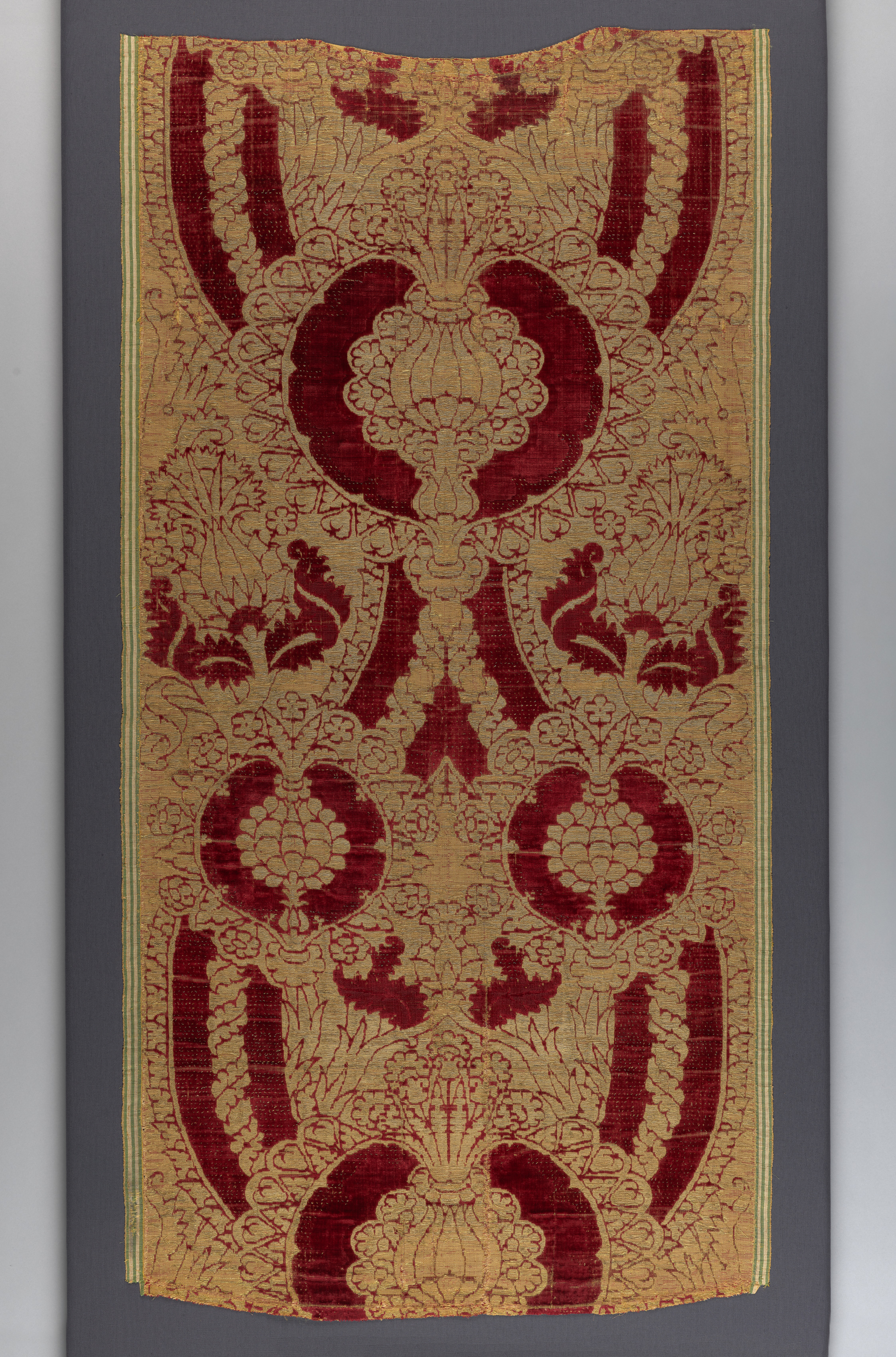
Deconstructing the Divine: An Avant-Garde Analysis of 15th-Century Florentine Silk Velvet
At Zoey Fashion Lab, our mandate is not merely to preserve historical textiles but to deconstruct them—to sever their threads from the loom of time and re-weave them into the language of the future. The subject of this analysis, a fragment of Italian silk velvet from the 15th century, possibly Florentine, presents a paradox of immense creative potential. It features a pomegranate pattern executed in silk, gold thread, and a complex interplay of cut pile in two heights, uncut pile loops, and gold-thread loops. This is not a relic; it is a blueprint for an avant-garde insurrection against flatness, symmetry, and the tyranny of the two-dimensional.
To approach this fabric is to confront a technology of opulence so advanced it borders on the alien. The pomegranate motif, a symbol of fertility, resurrection, and imperial power, is rendered not through mere dye or print, but through a topographical manipulation of surface. The velvet’s structure—its cut pile, uncut loops, and metallic threads—creates a living, breathing topography. This is not a textile to be looked *at*, but one to be read through touch, a tactile manuscript of wealth and divine order. For the avant-garde designer, this is the ultimate challenge: to translate a 15th-century obsession with heavenly hierarchy into a 21st-century language of deconstruction, asymmetry, and raw materiality.
Technical Dissection: The Architecture of Opulence
The technical specifications of this velvet are its most radical feature. The use of two heights of cut pile introduces a dynamic chiaroscuro, a sculptural depth that traditional flat weaving cannot achieve. When light strikes the higher pile, it casts a shadow on the lower, creating a flickering, almost holographic effect. The uncut pile loops, known as *bouclé* or *bouclettes*, act as a third dimension—a field of textured static that disrupts the smooth flow of the cut velvet. Finally, the gold-thread loops, often formed by a metal-wrapped silk core, are not merely decorative; they are architectural anchors that catch and reflect light with a hard, metallic glare, in stark contrast to the soft, absorbent silk pile.
This technical complexity is the foundation for an avant-garde aesthetic. Consider the following deconstructionist principles:
- Surface as Depth: The velvet rejects the flat plane. An avant-garde garment could amplify this by cutting away sections of the pile to reveal the bare silk foundation, creating negative space. The two heights of pile could be exaggerated through chemical or mechanical distressing, making the higher pile collapse in places while the lower pile remains rigid, creating a decayed, archaeological feel.
- Loop as Lure: The uncut loops and gold-thread loops are inherently unstable. They can be pulled, snagged, or broken. An avant-garde treatment would weaponize this instability. Imagine a garment where the gold loops are deliberately left unsecured, allowed to dangle and catch on the wearer’s environment. The loops become a performative element, a trace of the garment’s interaction with the world.
- Metallic as Memory: The gold thread is not just a signifier of wealth; it is a memory of fire and alchemy. In an avant-garde context, this gold could be tarnished, patinated, or partially dissolved using chemical agents. The resulting surface would speak not of eternal glory but of entropy and the passage of time—a direct counterpoint to the Renaissance desire for immortal perfection.
Pattern and Symbol: The Pomegranate as Fractal
The pomegranate pattern itself is a dense, symmetrical, and highly structured motif. It typically features a central fruit, often split open to reveal seeds, surrounded by stylized leaves and tendrils. In the 15th century, this pattern was a symbol of cosmic order, a microcosm of the divine hierarchy. The seeds represent the multitude of souls, the fruit the Church or the State, and the gold the light of God.
For the avant-garde, this order is not to be revered but fractured. The pomegranate becomes a fractal—a self-similar pattern that can be infinitely scaled and distorted. A deconstructionist approach would involve:
- Displacement: Cutting the pattern into fragments and reassembling them on a new, asymmetrical silhouette. The central fruit might be relocated to a shoulder seam, its seeds spilling down the arm. The leaves could become detached, floating across the fabric like digital noise.
- Repetition and Glitch: The pattern’s inherent symmetry can be broken by introducing a “glitch”—a misaligned repeat or a deliberate warp in the weave. This could be achieved through digital printing on a velvet base, where the pomegranate is scanned, pixelated, and then re-embroidered with gold thread in a distorted, error-filled version. The result is a conversation between the hand of the Renaissance weaver and the cold logic of the algorithm.
- Inversion: The gold thread, traditionally the highlight, could be used as the background. The silk pile, normally the field, becomes the motif. This inversion of figure and ground would create a negative-space pomegranate, where the fruit is defined by its absence, a ghost in the machine of luxury.
Avant-Garde Manifestation: From Archive to Armor
How does this translate into a garment or an object for Zoey Fashion Lab? The reference to Archive Resonance—the juxtaposition of a “silver mirror with gold palm leaves” and a “cold sarcophagus with a narrative in relief”—is crucial. This fabric is both a mirror (reflecting the glory of its patron) and a sarcophagus (entombing the labor and belief of its maker). The avant-garde garment must embody this duality.
Envision a deconstructed doublet or a sculptural cape. The body of the garment is the original velvet, preserved in its most pristine state on one panel. On another, the fabric is violently deconstructed: the cut pile is sheared away in patches, revealing the raw linen or silk foundation. The gold loops are pulled out and allowed to hang like metallic tears. The pomegranate pattern is cut along its outlines, creating a lattice of negative space that reveals a second layer—perhaps a stark, black, high-tech mesh or a reflective Mylar surface. This second layer acts as the “silver mirror,” while the original velvet is the “sarcophagus.”
The construction itself must be anti-tailoring. Seams are exposed, raw edges are left unfinished, and the gold thread is used not for embroidery but for structural binding, as if the garment is held together by its own wealth. The two heights of cut pile can be exploited by burning or laser-cutting the higher pile to create a pattern of scars, a deliberate defacement of the sacred motif. The uncut loops can be left as tactile hazards, inviting the wearer (and the viewer) to question the very definition of luxury.
Conclusion: The Future of the Past
This 15th-century Florentine silk velvet is not a museum piece to be revered from a distance. It is a challenge to the contemporary designer. Its technical complexity demands a response that is equally complex—not in terms of skill, but in terms of conceptual violence. To deconstruct this fabric is to acknowledge that beauty and decay are inseparable, that wealth and labor are entangled, and that the past is not a static archive but a dynamic material for future insurrection.
At Zoey Fashion Lab, we do not restore; we rupture. We see in this velvet a map of a world we must unmake in order to remake. The gold is not eternal; it is a temporary state of matter. The pomegranate is not a symbol of life; it is a seedbed of disruption. The velvet is not a surface; it is a battleground. And on that battleground, we will build the armor of the new world—a world where opulence is not a given but a question, and where every thread is a potential act of rebellion.