Technical Deconstruction & Material Intelligence: The Substrate
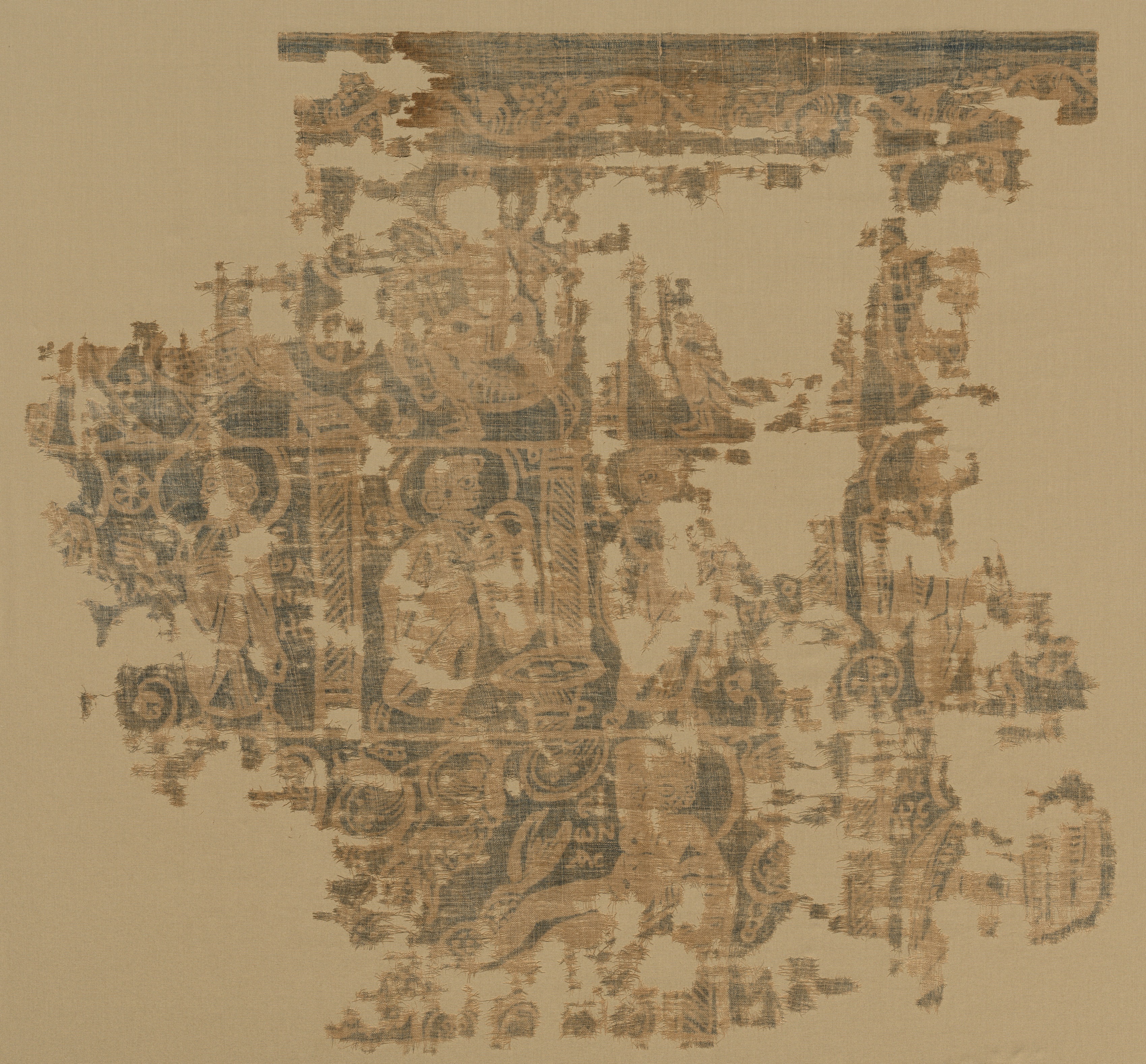
The artifact presents as a primary plane of plain weave linen, a deliberate and significant foundation. In the context of Byzantine Egypt, linen was not merely a commodity; it was a statement of regional identity and technical pragmatism. Unlike the silks of Constantinople, Egyptian linen speaks of the Nile Valley's agricultural prowess and a textile tradition stretching back to the Pharaohs. The plain weave structure is a masterclass in strategic minimalism. It provides a neutral, stable, and absorbent ground, essential for the precise execution of the resist-dye technique. This is not a fabric designed to dazzle with structural complexity, but to serve as a perfect, receptive canvas for narrative. The inherent strength and slight texture of the linen would have influenced the fluidity of the dye, creating the subtle, feather-edged boundaries that define the resist-dyed aesthetic—a harmonious dialogue between material and method.
Archive Resonance: A Pattern of Converging Lines
The provided archival fragment—"在人类文明的长河中,器物与绘画不仅是时代技艺的结晶,更是文化碰撞与美学交融的无声见证。十六至十七世纪...."—though temporally displaced from the Byzantine period, offers a critical conceptual lens. It speaks of objects as "silent witnesses to cultural collision and aesthetic blending." This is the core code we must decrypt in the hanging. We transpose this principle to 5th-7th century CE Egypt, a crucible where Greco-Roman naturalism, Coptic Christian devotion, and enduring Near Eastern visual schemas converged. The hanging is a node in this network. The biblical scenes are not purely Byzantine imports; they are localized interpretations. The stylistic rendering of figures, the organization of space, and the very choice of iconography would have been filtered through the Coptic sensibility, creating a unique aesthetic alloy. This is not a mere copy, but a creolized visual language born at the crossroads of empire, faith, and trade.
Avant-Garde Analysis: The Resist-Dye as Disruptive Technology
To analyze this through an avant-garde framework is to recognize the resist-dye technique itself as a radical, proto-conceptual act. In an age where pictorial narrative was dominated by the additive processes of painting (encaustic, fresco, tempera) or the costly intricacy of tapestry, resist-dyeing was a subtractive, negative-space technology. The image was not built up but revealed through a process of prevention and exposure.
Imagine the process: areas of the linen were sealed—likely with a wax or paste resist—blocking the penetration of the dye (typically a deep indigo or madder-based hue). The entire piece was then submerged, and upon removal and clearing of the resist, the narrative emerged in the original ground color against a dyed field. This is a philosophy of creation akin to modern photography's negative or the cut-out techniques of a Matisse. The artist worked not with the image itself, but with its silhouette and barrier. The resulting aesthetic is defined by crisp, graphic contrasts, a flattening of form, and an inherent abstraction. Details must be suggested through shape rather than meticulous line. This technological constraint births a powerful, symbolic visual language where light (the undyed linen) literally emerges from darkness (the dyed ground), a metaphor perfectly aligned with theological narratives of revelation and salvation.
Form & Narrative: Deconstructing the Iconographic Code
The biblical scenes, rendered in this graphic medium, undergo a transformation. The potential for naturalistic modeling is surrendered to the power of the iconic sign. Figures become archetypal silhouettes; gestures are distilled to their most essential, communicative forms. The composition likely employs horizontal registers or framed vignettes, a compositional strategy that echoes both Roman narrative art and earlier Egyptian friezes, yet is adapted to the textile's format and function.
As a hanging, this object existed in architectural and ritual space. It was not inert. It would have moved with air currents, the light playing across the textured linen, causing the stark positive-negative image to subtly shift and vibrate. This introduces a fourth dimension—time and movement—into the devotional experience. The static, eternal narrative gained a quality of liveliness, a whisper of the divine breath (pneuma). Its function as a spatial demarcator or a focal point for contemplation turns the environment itself into an extension of the artwork, a precursor to immersive installation.
Zoey Fashion Lab Synthesis: Prototyping the Future from Ancient Code
For Zoey Fashion Lab, this artifact is not a relic but a generative algorithm. Our deconstruction yields the following core protocols for avant-garde development:
1. Negative-Space Narratives: Embrace resist-dye, shibori, and digital laser-cut resists as primary design tools. Let the story be told by what is protected, hidden, and then revealed. Develop prints where the ground and the pattern are in a dynamic, reversible relationship.
2. Material as Memory: Source and celebrate foundational materials with deep cultural and technical biographies—like Egyptian linen, hemp, or peace silk. Use their inherent properties (drape, absorbency, texture) to dictate and dialogue with the surface design, creating a unified material intelligence.
3. Graphic Iconography: Move beyond literal representation. Distill concepts, identities, and emotions into stark, powerful silhouettes and glyphs. Create a new lexicon of forms that speak through clarity and reduction, inspired by the communicative efficiency of these ancient scenes.
4. Spatial Garments: Conceptualize garments as architectural hangings for the body. Design pieces that transform the wearer's space, with layers, extensions, or kinetic elements that interact with movement and environment, creating personal micro-climates of meaning.
5. Cultural Convergence as Code: Intentionally hybridize techniques and motifs from disparate traditions—not as pastiche, but as a deliberate synthesis to create a new, resonant visual language for a globalized world, mirroring the Byzantine-Coptic-Near Eastern synthesis of the original.
This Byzantine resist-dyed hanging is a beacon. It demonstrates that true avant-garde practice is not a linear progression forward, but a strategic excavation and recombination of deep historical codes. It reminds us that the most profound innovations often lie in the radical re-application of an ancient technology, viewed through a new and converging lens. The task for Zoey is to execute this synthesis, weaving the silent witness of the past into the declarative fashion of the future.