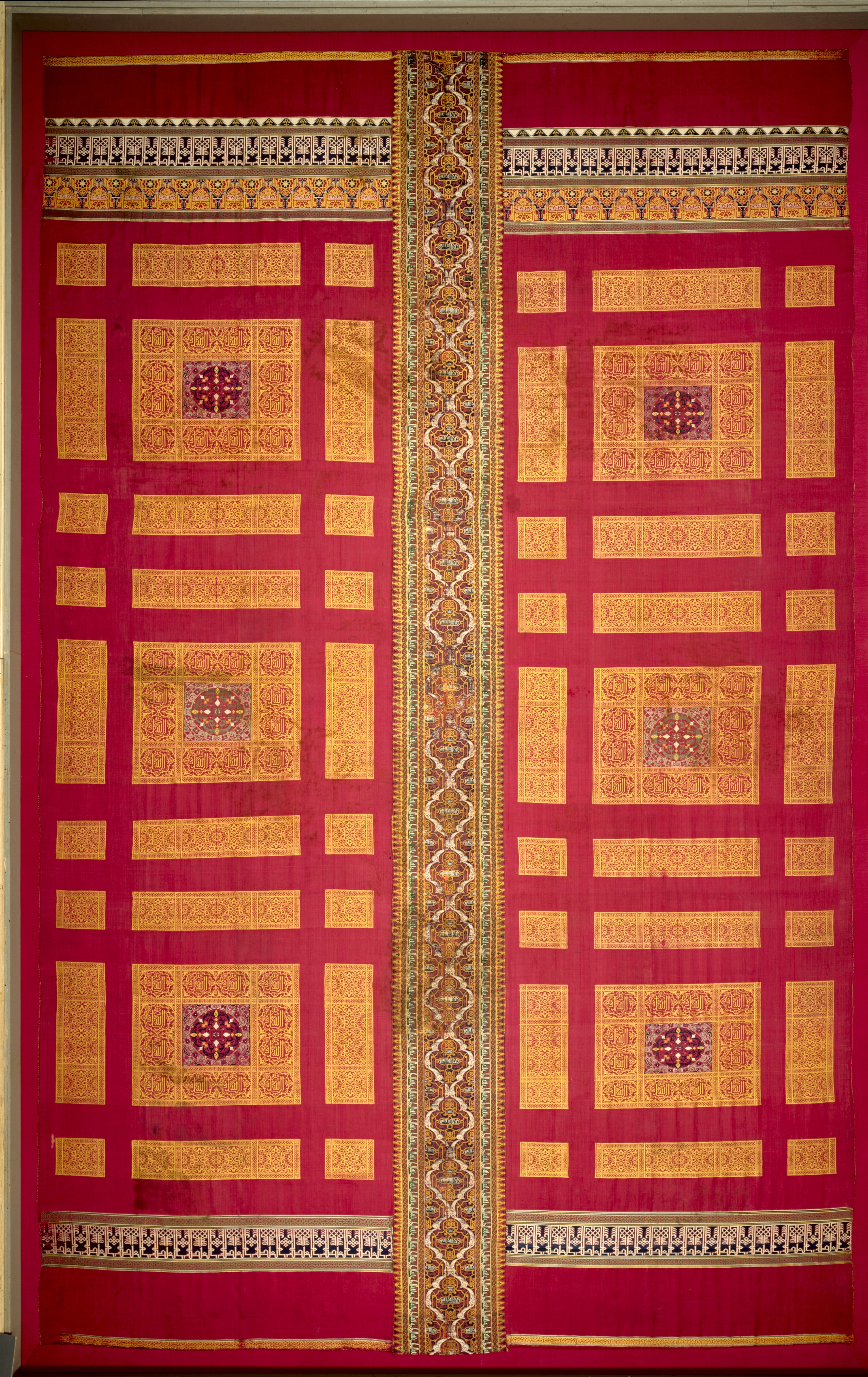
Deconstructing the Alhambra Palace Silk Curtain: An Avant-Garde Analysis for Zoey Fashion Lab
At Zoey Fashion Lab, our mission is to unearth the latent narratives within historical textiles, transforming them into catalysts for avant-garde design. The Alhambra Palace Silk Curtain, a fragment from the Nasrid period in Granada, Spain, offers a profound case study. This object—woven in silk using the complex lampas technique—is not merely a decorative artifact; it is a New DNA Strand for fashion, encoding principles of geometry, light, and power that resonate with the most radical contemporary aesthetics. This analysis deconstructs the curtain’s material, technical, and symbolic DNA to propose a blueprint for a new, disruptive collection.
Material DNA: The Silk as a Conductor of Light and Shadow
The primary material, silk, is the first locus of avant-garde potential. In the Nasrid context, silk was a political and spiritual statement—a luminous, costly fiber that captured the filtered light of the Alhambra’s arcades. For Zoey Fashion Lab, this silk is not a fabric but a light-responsive substrate. Its natural luster and ability to absorb dyes with unparalleled depth create a dynamic surface that shifts from matte to iridescent. The avant-garde interpretation must exploit this: consider garments that appear solid in one light but reveal intricate, ghostly patterns in another. The silk’s fragility, too, is a feature. We propose treating it with micro-encapsulated pigments or heat-reactive polymers, creating a fabric that “breathes” with the wearer’s body heat, echoing the Alhambra’s interplay of shade and sun. This transforms the curtain’s static elegance into a living, responsive membrane.
Technical DNA: The Lampas Weave as a Structural Grid
The lampas weave is the technical core of the curtain. Unlike simpler weaves, lampas employs a ground warp and a pattern warp, allowing two or more weft systems to create complex, multi-layered designs. This is a structural language of control and chaos. For the avant-garde, this technique suggests a new approach to garment construction. We can deconstruct the lampas logic: instead of weaving two layers, we can laminate or laser-cut multiple fabric layers to mimic the weave’s depth. Imagine a coat where an outer silk shell is precisely perforated to reveal a contrasting inner layer, creating a pattern that shifts with movement—a literal “curtain” of fabric. The lampas weave also produces a fabric with a distinct front and back, a duality that avant-garde design can exploit through reversible or transformable garments. The structural integrity of the weave, with its dense, almost architectural feel, invites us to create garments that stand away from the body, like the Alhambra’s stalactite ceilings (muqarnas) made wearable.
Geometric DNA: The Alhambra’s Non-Euclidean Logic
The Alhambra’s decorative program—star polygons, interlocking lattices, and infinite repeats—is a pre-modern exploration of non-Euclidean geometry. For Zoey Fashion Lab, this is a direct challenge to conventional pattern-making. The curtain’s motifs are not merely aesthetic; they are mathematical models of symmetry and tessellation. We propose translating these into algorithmic pattern cutting. Using 3D simulation software, we can generate garment panels that fold and drape according to the same geometric rules that govern the Alhambra’s tilework. This results in garments that are both sculptural and functional—dresses that create their own negative space, jackets that form geometric apertures. The key is to avoid literal reproduction. Instead, we extract the rule set: the use of 5-fold and 8-fold symmetry, the principle of infinite repetition, and the interplay of positive and negative space. These become the generative algorithms for a collection that feels both ancient and futuristic.
Symbolic DNA: Power, Intimacy, and the Veil
The curtain is a liminal object—a barrier that also invites passage. In the Alhambra, silk curtains separated public from private, ruler from subject. This symbolic duality is rich for avant-garde exploration. We can design pieces that play with revelation and concealment: translucent silk panels that obscure the body, laser-cut screens that fragment the silhouette, or garments that can be physically “drawn” or “closed” like a curtain. The curtain’s origin as a sign of Nasrid power also suggests a commentary on contemporary authority and spectacle. Imagine a collection that uses the curtain’s motifs to critique the opulence of power, or to reclaim the veil as a tool of personal agency rather than oppression. The avant-garde must engage with this history, not romanticize it. We propose a series of “deconstructed curtains”—garments that appear torn, reassembled, or inverted, challenging the original’s pristine, hierarchical order.
From Fragment to Collection: A New DNA Strand
To operationalize this analysis, Zoey Fashion Lab will develop a capsule collection titled “Alhambra Code.” The collection will consist of five key pieces, each derived from a different DNA strand:
1. The Light Conductor: A floor-length gown in iridescent silk taffeta, treated with a thermochromic coating that shifts from deep indigo to gold with body heat. The pattern is a digital print of the curtain’s star polygons, but distorted through a pixelation algorithm—a nod to the Nasrid love of geometry and the digital age.
2. The Structural Grid: A tailored jacket constructed from two layers of silk organza, laser-cut with a lattice pattern inspired by the lampas weave. The outer layer is cut away to reveal a contrasting inner layer of matte silk, creating a trompe-l’oeil effect. The jacket is reversible, offering a solid exterior and a patterned interior.
3. The Algorithmic Drape: A dress generated by 3D modeling software using the Alhambra’s 8-fold symmetry as the pattern algorithm. The dress is cut from a single piece of silk charmeuse, with folds and tucks that create a sculptural, non-repeating silhouette. The hem is asymmetrical, echoing the curtain’s frayed edges.
4. The Liminal Veil: A cape made from a double layer of silk chiffon, with a hidden zipper system that allows the wearer to “close” the cape into a fully enclosed garment. The inner layer is printed with a micro-scale version of the curtain’s geometric pattern, visible only when the cape is drawn tight.
5. The Power Fragment: A deconstructed dress that appears to be a torn section of the original curtain, reassembled with visible stitching and raw edges. The silk is deliberately distressed, and the pattern is fragmented, creating a garment that comments on decay, history, and the fragility of power.
Conclusion: The Avant-Garde as Historical Recoding
The Alhambra Palace Silk Curtain is not a relic to be preserved but a code to be rewritten. By deconstructing its material, technical, geometric, and symbolic DNA, Zoey Fashion Lab can produce garments that are not merely inspired by the past but are active interventions in it. The avant-garde is not about rejecting history; it is about recontextualizing it, making it strange, and forcing it to speak to the present. This curtain, with its silk threads and lampas weave, offers a blueprint for a fashion that is at once algorithmic, sensual, and politically charged. It is a New DNA Strand—one that we will splice, edit, and express in a collection that redefines the boundaries of the wearable. The Alhambra’s light, geometry, and power will not be imitated; they will be translated into a new language of form—the language of the avant-garde.