Deconstructing the Cuff: An Avant-Garde Analysis of Indigenous Materiality and Genetic Code
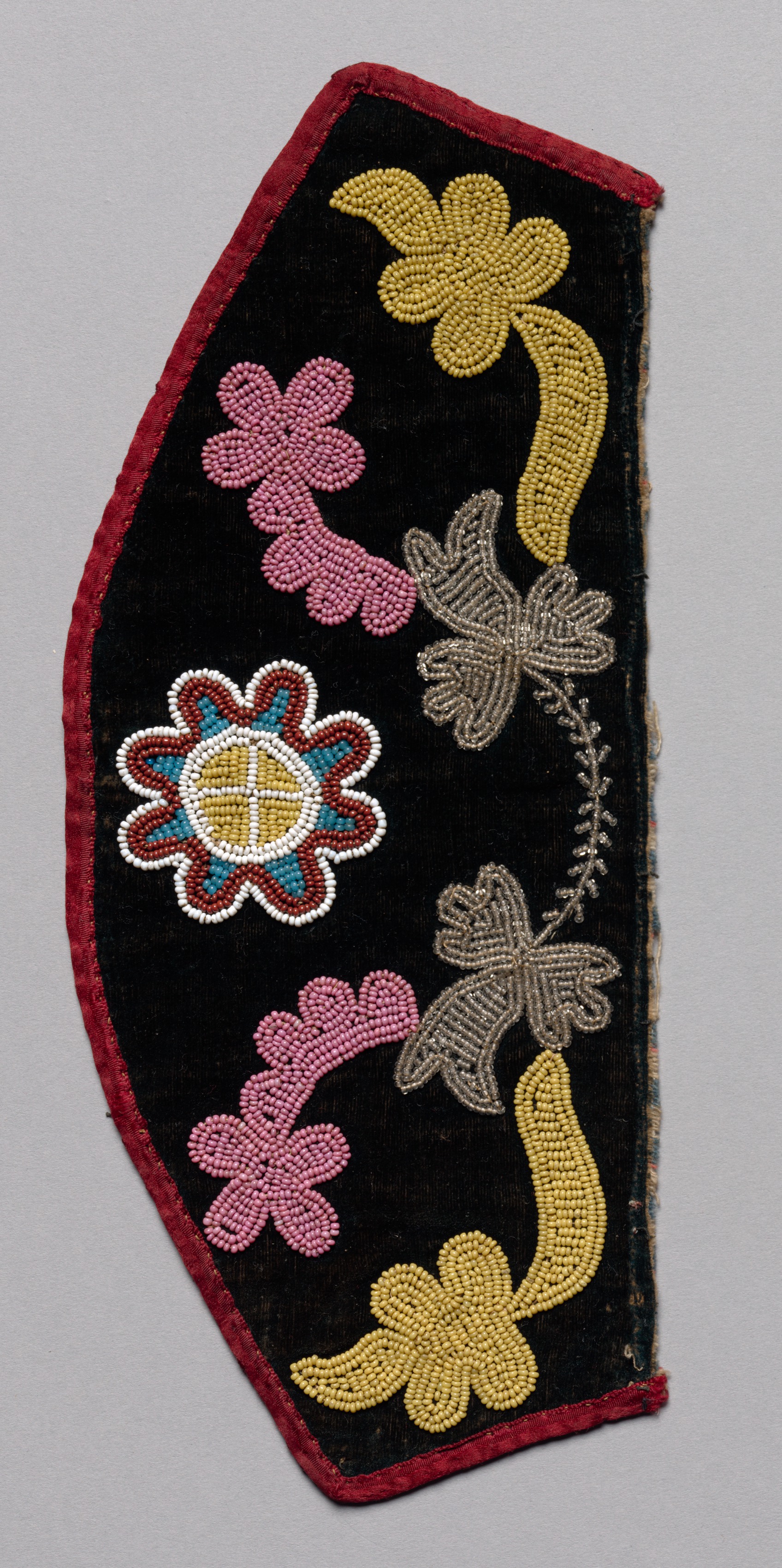
As Chief Fabric Deconstructionist for Zoey Fashion Lab, I am tasked with dismantling the conventional boundaries of garment analysis. The subject of this investigation—a cuff of potential Anishinaabe (Ojibwe) or Nehiyawak (Cree) origin—presents a profound opportunity to explore the intersection of ancestral craftsmanship, material science, and avant-garde design. This is not merely a decorative accessory; it is a coded artifact, a textile DNA strand that carries cultural memory, technical mastery, and a radical potential for reinterpretation. The cuff’s composite materials—velvet, satin, and glass beads—are not passive elements. They are active agents in a narrative that spans centuries, and our deconstruction will treat them as such, applying the lens of a New DNA Strand to unlock their avant-garde potential.
Material Provenance and Cultural Resonance
The foundational fabric of this cuff is a deep, rich velvet. In the context of the Northeast Woodlands and Great Lakes regions, velvet was a post-contact luxury material, often acquired through trade. Its adoption by Anishinaabe and Cree artisans was not a passive acceptance of colonial goods but a strategic re-appropriation. Velvet’s plush surface offers a tactile depth that contrasts sharply with the hard, reflective glass beads. This textural dialogue is the first point of deconstruction. The velvet acts as a dark, absorbent background—a night sky or a still lake—against which the beadwork will shine. For the avant-garde, this velvet is not a backdrop but a substrate of memory. It holds the impression of the maker’s hands, the pressure of the bead needle, and the ambient humidity of the Great Lakes region. Deconstructing this material means acknowledging its colonial trade history while celebrating its transformation into a canvas for Indigenous sovereignty and aesthetic expression.
The satin, likely used as a lining or accent, introduces a contrasting gloss. Satin’s weave structure—typically a float weave—creates a smooth, lustrous surface that catches light differently than velvet’s nap. In the original cuff, satin might have been used for the cuff’s inner facing, a hidden luxury against the skin. For our avant-garde analysis, we consider satin as the internal narrative—the unseen, intimate connection between the object and the wearer. This duality between the public, beaded exterior (velvet) and the private, smooth interior (satin) mirrors the layered identities of Indigenous peoples navigating modern and traditional worlds. The avant-garde designer might exploit this by reversing the cuff, exposing the satin as a primary surface, or by deconstructing the satin into frayed, unraveled strips that mimic the organic flow of a DNA helix.
The Beadwork as Genetic Code
The glass beads are the most potent carriers of meaning in this cuff. Imported from Europe, they became a primary medium for Indigenous artistic expression, evolving from trade goods to sacred materials. The specific colors, patterns, and stitching techniques (e.g., lane stitch, lazy stitch, or appliqué) are not arbitrary. They constitute a visual language—a New DNA Strand—encoding clan affiliations, personal histories, spiritual beliefs, and territorial markers. In the context of the Anishinaabe and Cree, floral or geometric motifs often reference the natural world: the sky world, the underwater world, and the plant beings. Each bead is a nucleotide base, and the pattern is the gene sequence.
For the Chief Fabric Deconstructionist, the beadwork is not a finished surface but a sequence to be read, fragmented, and recombined. An avant-garde approach would involve micro-deconstruction: isolating individual beads, mapping their color frequencies, and analyzing their placement as data points. We might create a spectral analysis of the bead colors, treating them as light wavelengths. We could then use this data to generate a new textile pattern—a digital weave that translates the beadwork’s rhythm into a contemporary, perhaps even bio-engineered, fabric. This process honors the original code while allowing it to mutate, just as DNA mutates over time. The cuff’s beadwork is not a static artifact; it is a living system that can be transcribed into new materials, such as 3D-printed polymers or conductive threads that light up in response to touch, creating a wearable, interactive genome.
Technical Deconstruction: The Stitch as a Structural Bond
The technical execution of the cuff reveals the maker’s mastery of tension and durability. The beads are sewn onto the velvet using a thread—likely sinew or modern nylon—that must withstand friction and weight. The stitch length, the angle of entry, and the density of beads per square inch are all parameters of a structural system. In an avant-garde context, we deconstruct this system by isolating the stitch itself. What if the thread were made of a biodegradable polymer that degrades over time, revealing a second layer of beadwork underneath? What if the beads were attached not with thread but with tiny, magnetic clasps, allowing the wearer to reconfigure the pattern at will?
This technical deconstruction also considers the cuff’s form. A cuff is a cylindrical, often rigid, structure that encircles the wrist. It is a boundary marker, defining the transition from hand to arm. In Indigenous regalia, cuffs might also serve as protective amulets or status indicators. For the avant-garde, we might explode this form. The cuff could be cut open and flattened into a rectangular panel, its beadwork becoming a tapestry or a wall-mounted genetic chart. Alternatively, it could be multiplied: a series of cuffs worn up the entire arm, each one a different segment of the same DNA strand, creating a continuous narrative from wrist to shoulder.
Avant-Garde Synthesis: The Cuff as a Living Artifact
The ultimate goal of this deconstruction is not to destroy the cuff but to synthesize a new understanding. The cuff is not an object of the past; it is a blueprint for the future. By treating its materials—velvet, satin, glass beads—as components of a genetic code, we can generate new forms that honor the original while pushing into uncharted aesthetic territory. Imagine a garment that grows: the velvet is a base layer, the satin is a lining that changes color with body heat, and the beads are living cells that pulse with bioluminescent light, their pattern shifting according to the wearer’s heartbeat or emotional state. This is the New DNA Strand—a fusion of ancestral knowledge and speculative design.
In conclusion, this cuff from the Northeast Woodlands, whether Anishinaabe or Cree, is a masterwork of material storytelling. Its velvet, satin, and glass beads are not mere components; they are a language, a technology, and a living code. As Chief Fabric Deconstructionist, I assert that the avant-garde’s role is not to appropriate but to translate. We must read the cuff’s DNA, understand its structure, and then recombine its elements into new, respectful, and radical forms. This is not deconstruction for its own sake; it is a process of regeneration, ensuring that the cultural and technical wisdom embedded in this cuff continues to evolve, to mutate, and to inspire. The cuff is not an end point—it is a beginning, a strand of genetic material waiting to be woven into the future of fashion.