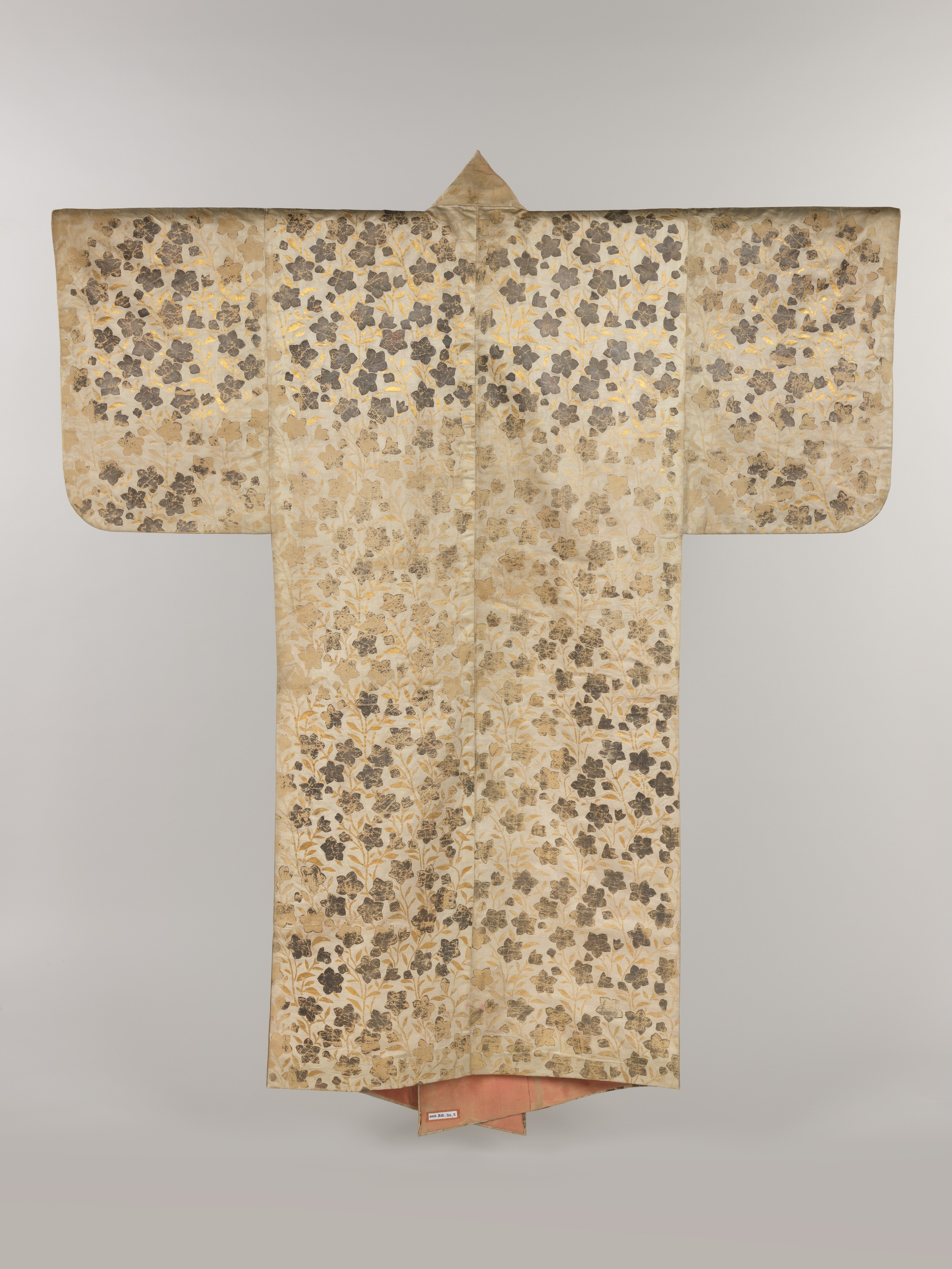
Deconstructive Alchemy: The Surihaku Noh Kimono as a Blueprint for SS26 Avant-Garde Architecture
The intersection of ritualistic garment construction and futuristic fashion design is a liminal space where time collapses, and materiality becomes a narrative of transcendence. At Zoey Fashion Laboratory, we dissect the Surihaku Noh costume—a ceremonial kimono adorned with Chinese bellflowers in gold and silver leaf on silk satin—as a radical prototype for Spring/Summer 2026. This is not a retrospective homage; it is a forensic study of structural innovation, where the static weight of tradition is re-engineered into a dynamic, kinetic silhouette for the post-human era. The Surihaku, with its embedded symbolism of fleeting beauty and celestial permanence, offers a lexicon of futuristic silhouettes that challenge the very definition of garment architecture.
I. The Grammar of Gold: Material as Structural Armature
The Surihaku technique—literally “sprinkled gold”—involves the meticulous application of cut gold and silver leaf onto a silk satin ground, creating a surface that is both reflective and absorbent. For SS26, this is not merely a decorative finish; it is a structural membrane. The metal leaf, when layered and bonded with contemporary thermoplastics, becomes a form of metallic exoskeleton. Imagine a silk base that is selectively stiffened by laser-sintered gold particles, creating zones of rigidity that articulate the body’s movement. The bellflowers, traditionally rendered as flat motifs, are reimagined as three-dimensional, inflatable pods that bloom and contract with the wearer’s respiration, powered by micro-pneumatic systems woven into the satin. This transforms the kimono from a two-dimensional canvas into a living, responsive architectural organism.
The gold and silver leaf are not applied uniformly. Instead, they are algorithmically distributed to create a gradient of opacity—from a dense, reflective carapace at the shoulders to a translucent, gossamer-like film at the hem. This gradient serves a dual purpose: it reduces weight where the garment must flow, and it increases structural integrity where the silhouette must hold its shape. The result is a garment that defies gravity, where the metal leaf becomes a load-bearing surface that eliminates the need for internal boning or corsetry. The satin, traditionally a fabric of drape and softness, is thus re-engineered into a composite material that can stand alone, like a bronze sculpture in motion.
II. The Bellflower Motif: From Emblem to Ergonomic Interface
Chinese bellflowers, or kikyo, in Noh costume symbolize constancy and the ephemeral nature of life—a duality that is central to the avant-garde ethos. For SS26, this motif is deconstructed and re-scaled to become an ergonomic interface. The five-petal flower is abstracted into a repeating geometric pattern that functions as a flexural joint. Each petal is a separate, articulated panel of silk satin, connected by micro-hinges of gold leaf. This allows the garment to fold and expand in precise, pre-determined ways, creating a transformable silhouette that can shift from a narrow, columnar form to a wide, fan-like structure with a single gesture.
The bellflower’s radial symmetry is exploited to create force-distribution pathways. When the wearer raises an arm, the petals along the shoulder blade open like a fan, redistributing the fabric’s weight and preventing drag. This is not a passive design; it is an active structural system that responds to biomechanical input. The gold leaf, applied in thin, overlapping layers, acts as a conductive circuit, allowing for the integration of haptic feedback sensors. As the bellflowers open, they trigger subtle vibrations in the fabric, creating a sensory dialogue between the garment and the wearer. The motif is thus liberated from its symbolic function and reborn as a functional, cybernetic appendage.
III. Silhouette as a Temporal Collapse: The Futuristic Kimono
The traditional Noh kimono is a garment of static majesty—its volume is fixed, its shape prescribed by centuries of ritual. In contrast, the SS26 Surihaku reimagines the silhouette as a temporal event. The garment is constructed from multiple, overlapping layers of silk satin that are not sewn but bonded at specific nodal points using a laser-welded gold leaf matrix. This creates a hierarchical structure where the outer layers can be peeled away, revealing inner layers with different degrees of opacity and stiffness. The wearer becomes a curator of their own silhouette, able to reconfigure the garment’s architecture throughout the day.
The silhouette itself is an asymmetric, gravity-defying form. The left shoulder is built up into a cantilevered peak, reminiscent of a Noh mask’s profile, while the right side cascades in a single, uninterrupted sweep to the floor. This imbalance is intentional; it creates dynamic tension that forces the eye to move around the garment. The bellflowers, now three-dimensional, are clustered at the hip and the nape, acting as counterweights that stabilize the silhouette. The overall shape is not human; it is post-human—a hybrid of armor, sculpture, and textile that suggests a body in constant flux.
IV. Structural Innovation: The Satin as Tensegrity System
The most radical innovation in this analysis is the re-conception of silk satin as a tensegrity system. Traditional tensegrity relies on a network of cables and struts; here, the gold and silver leaf act as the compression elements, while the silk satin serves as the tension membrane. The leaf is applied in a web-like pattern, with thicker strands running vertically along the spine and thinner, diagonal strands radiating outward. This creates a self-supporting structure that can hold its shape without internal scaffolding. The satin, normally prone to sagging, is held in a state of constant tension, similar to a drumhead.
This tensegrity system allows for unprecedented freedom of movement. The garment can be compressed into a small, flat package for storage, then expand into its full silhouette when released. The bellflowers, as previously noted, are the tension nodes—they can be tightened or loosened to adjust the overall stiffness of the garment. For SS26, this means a single garment can transition from a rigid, sculptural form for a runway presentation to a fluid, drapey form for a gallery installation. The material itself becomes a variable geometry, responding to the environment and the wearer’s intent.
V. Conclusion: The Surihaku as a Manifesto for SS26
The Surihaku Noh costume, with its gold and silver leaf on silk satin, is not a relic but a prophetic blueprint. By deconstructing its motifs, re-engineering its materials, and reimagining its silhouette, Zoey Fashion Laboratory presents a vision for SS26 that is both rooted in ritual and unbound by time. The bellflowers, once symbols of constancy, now become interfaces for transformation. The gold leaf, once a mark of status, now becomes a structural skeleton. The kimono, once a fixed form, now becomes a living architecture. This is the future of avant-garde couture: a garment that is not worn, but inhabited; not designed, but grown; not finished, but forever in the process of becoming.