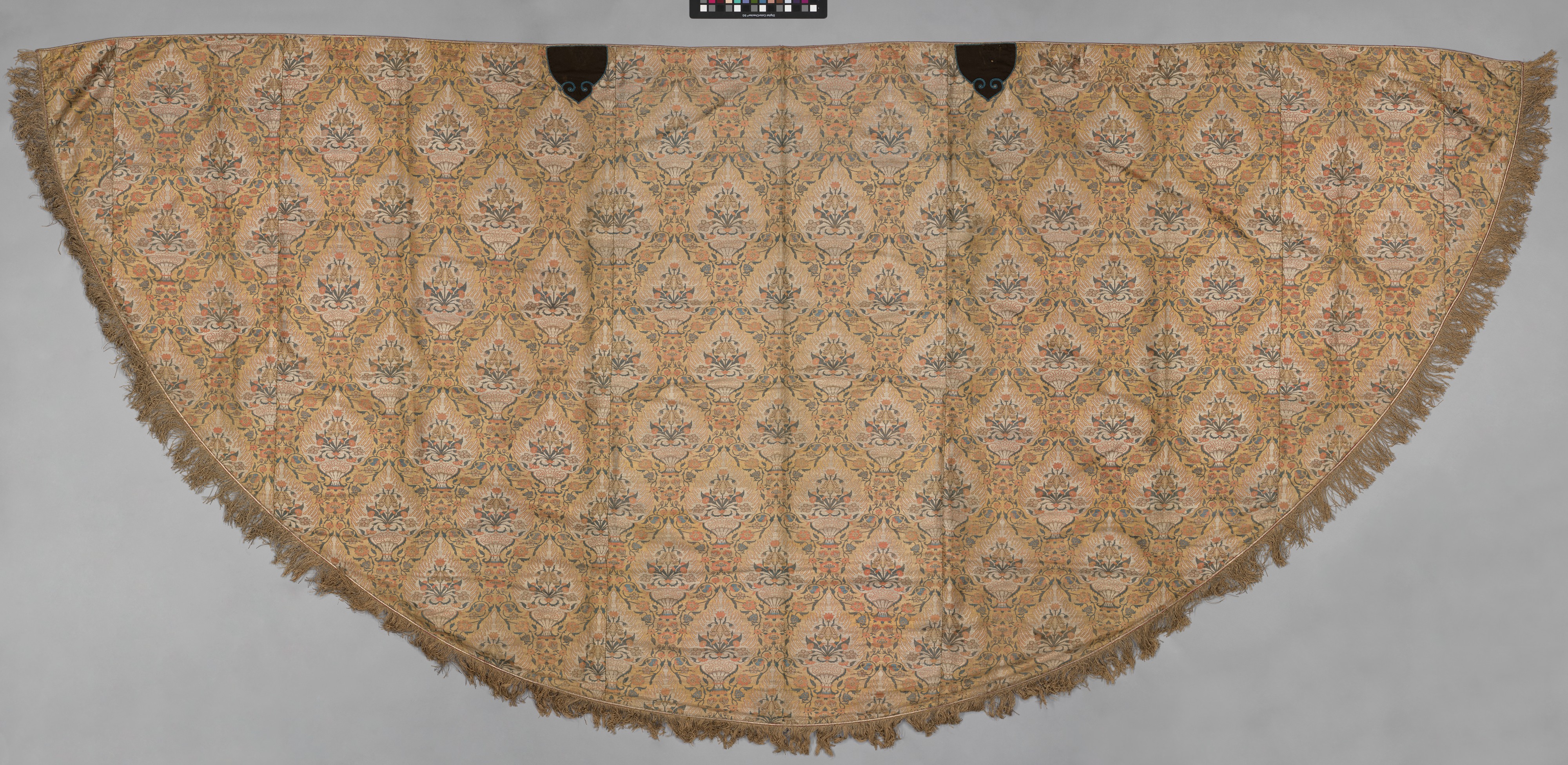
Deconstructing the Frontier: The Cope as Architectural Narrative for SS26
In the relentless pursuit of the new, the avant-garde often finds its most potent expression in the reimagining of the archetypal. For the SS26 season, Zoey Fashion Laboratory presents a definitive study of the Cope, not as a garment of mere historical reverence or ecclesiastical weight, but as a dynamic, structural manifesto. Originating from the conceptual Global Frontier—a liminal space where geopolitical boundaries dissolve into aesthetic possibility—this iteration of the cope transcends its drapery origins to become a wearable architectural organism. It is a standalone statement of deconstructive luxury, where the tension between the organic fluidity of silk and the rigid precision of metal-wrapped thread defines a new silhouette for the future.
Material Dialectics: Silk’s Fluid Memory vs. Metal’s Structural Logic
The materiality of this piece is its first, most critical narrative. The silk base is not a passive canvas; it is a living substrate, chosen for its ability to capture and distort light, its memory of movement, and its almost liquid drape. Yet, this softness is immediately contested by the intervention of metal-wrapped thread. This is not embroidery in the traditional sense; it is a form of tensile architecture. The threads are woven in a non-repeating, algorithmic grid that follows the body’s kinetic paths—shoulder blades, the curve of the spine, the flare of the hip. When static, the cope appears as a monolith of shimmering, fractured light. In motion, the metal threads act as exoskeletal joints, creating a series of controlled, pleated-like volumes that expand and contract with the wearer’s gesture. The result is a garment that breathes, that negotiates between the softness of the body and the hardness of the frontier.
Silhouette Innovation: The Inverted Canopy and the Asymmetric Plinth
The SS26 silhouette rejects the traditional cope’s symmetrical, bell-like form. Zoey Fashion Laboratory proposes a radical reconfiguration: the Inverted Canopy. The garment’s primary volume is shifted forward, creating a dramatic, shell-like hood that extends over the shoulders, forming an angular, almost aerodynamic visor. This is not a cowl; it is a protective, futuristic helm that frames the face in a cascade of silk and metallic tendrils. The back, conversely, is a study in controlled restraint. A single, asymmetrical seam, stitched with the metal thread, runs from the nape to the hem, creating a sharp, architectural pleat that falls in a rigid, plinth-like cascade. This juxtaposition—the front as a soft, enveloping canopy, the back as a hard, geometric plinth—defines the piece’s structural innovation. It is a garment that suggests both shelter and defense, a wearable fortress for the global citizen.
Deconstructive Closure: The Absence of Fasteners as a Political Statement
A hallmark of the avant-garde is the subversion of function. This cope features no visible buttons, zippers, or clasps. Instead, the closure is achieved through a system of internal, magnetic tension points embedded within the metal-wrapped thread structure. The garment is worn by a precise choreography of wrapping and locking, where the wearer’s own body completes the circuit. This absence of traditional fasteners is a deliberate deconstruction of the garment’s historical form—the cope was once a symbol of hierarchical, ecclesiastical order. Here, it becomes a symbol of autonomous, self-contained power. The closure is not a point of entry but a point of integration, a metaphor for the frontier as a place of self-definition rather than imposed boundary.
Global Frontier Aesthetics: A Cartography of Light and Shadow
The visual language of this piece is a direct response to its origin. The Global Frontier is not a single geography but a composite of digital, physical, and psychological landscapes. The metal-wrapped thread is woven in patterns that echo satellite imagery—grids, fault lines, and data streams. The silk, dyed in a gradient from a deep, interstellar black at the hem to a pale, lunar silver at the hood, suggests the passage from the earthbound to the cosmic. When the wearer moves, the interplay of light on the metallic threads creates a shifting topography, a map of constant flux. This is not decoration; it is a cartographic statement. The cope becomes a wearable document of the frontier, a garment that records the friction between the natural and the synthetic, the ancient and the hypermodern.
Structural Integrity and the Future of Wearable Architecture
From a technical standpoint, the piece achieves its structural innovation through a marriage of draping and pattern engineering. The silk is pre-stressed and cut in a series of compound curves, allowing the metal thread to act as a tensioning system. This creates a self-supporting volume that does not rely on internal padding or boning. The hood, for instance, holds its angular shape through the precise placement of the metallic threads, which form a lightweight, exoskeletal framework. This self-supporting structure is a breakthrough for the season, allowing for dramatic, architectural silhouettes that remain light and breathable—essential for the SS26 climate. The cope is not a costume; it is a functional, wearable system designed for the frontier’s unpredictable conditions, both literal and metaphorical.
Conclusion: The Cope as a New Canon
Zoey Fashion Laboratory’s SS26 Cope is not merely a garment; it is a provocation. It asks us to reconsider the role of the archetype in an age of fragmentation. By merging the historical weight of the cope with the speculative future of the Global Frontier, it creates a new canon of avant-garde design. The silk and metal thread are not just materials; they are agents of a dialectic between softness and hardness, tradition and revolution. The silhouette—an inverted canopy over an asymmetric plinth—is a blueprint for a new kind of wearable architecture, one that is responsive, self-contained, and defiantly autonomous. This is not fashion for the timid. It is a declaration of intent for the frontier, a garment that copes with the complexities of the future by embracing them, structurally and aesthetically, as its own.