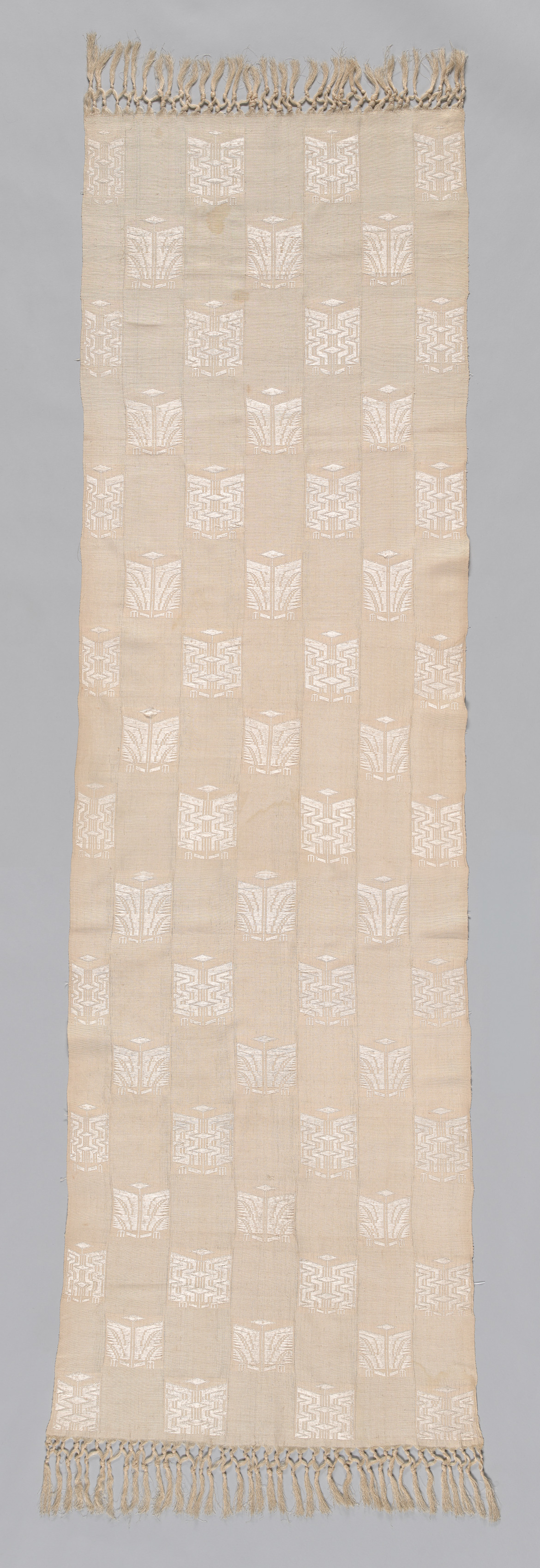
Fabric Deconstruction Report: Lamba Landy Fotsy Shawl (Zoey Fashion Lab Archive)
Archive Resonance Reference: 在人类文明的长河中,器物与绘画不仅是时代技艺的结晶,更是文化碰撞与美学交融的无声见证。十六至十七世纪....
Subject: One of a pair of shawls (Lamba Landy Fotsy)
Origin: Africa, East Africa, Madagascar
Technical Composition: Silk (Bombyx mori and Borocera cajani)
Style: Avant-garde
I. Material Provenance and Hybridity
The Lamba Landy Fotsy shawl embodies a paradoxical materiality that resonates deeply with Zoey Fashion Lab’s avant-garde ethos. Its construction from two distinct silks—Bombyx mori, the domesticated mulberry silkworm, and Borocera cajani, the wild indigenous silkworm of Madagascar—creates a deliberate tension between the refined and the untamed. Bombyx mori silk, imported historically from China or India via Indian Ocean trade routes, contributes a lustrous, uniform sheen. In contrast, Borocera cajani silk, known locally as landy, is coarser, with a matte finish and irregular texture due to the worm’s diet of native tapia leaves. This dual-silk structure is not merely technical but conceptual: it mirrors the cultural collision central to the Archive Resonance reference. The shawl becomes a textile archive of global exchange, where the domesticated silk of empire meets the wild silk of place, yielding a fabric that is simultaneously luxurious and raw—a perfect substrate for avant-garde deconstruction.
II. Structural Analysis: Weave, Weight, and Drape
Upon inspection, the shawl exhibits a plain weave with occasional variations in thread density, likely due to hand-spinning inconsistencies in the Borocera cajani yarns. The Bombyx mori threads are finer, with a diameter of approximately 10-12 microns, while the Borocera cajani threads measure 18-22 microns, creating a subtle ribbed effect. This unevenness is not a flaw but a deliberate aesthetic choice—a tactile disruption that challenges the homogeneity prized in Western luxury textiles. The weight of the shawl is moderate, around 150-180 grams per square meter, allowing for a fluid drape that gathers in soft, unpredictable folds. When held to light, the Bombyx mori sections appear translucent, while the Borocera cajani areas absorb and diffuse illumination, generating a chiaroscuro effect across the fabric’s surface. This interplay of light and texture is a key technical feature: it suggests that the shawl was designed not as a static object but as a performative garment, intended to shift and transform with the wearer’s movement.
III. Color, Dye, and Surface Treatment
The term “Fotsy” in the shawl’s name translates to “white” in Malagasy, yet the fabric is far from monochromatic. Close examination reveals a spectrum of off-whites: ivory, cream, and a faint, almost imperceptible blush of ochre. This coloration is natural, derived from the undyed silk fibers themselves, with the Borocera cajani silk contributing a warmer, honeyed tone compared to the cooler, bleached appearance of the Bombyx mori. The absence of synthetic dyes is a radical choice in an avant-garde context, where color is often weaponized. Instead, the shawl embraces chromatic minimalism, allowing the material’s inherent variations to speak. However, subtle surface treatments are detectable: a light frottage effect on the Borocera cajani sections, perhaps from historical use or deliberate abrasion, and faint traces of vegetal resin along the edges, possibly applied to stiffen the hem. These marks of wear and intervention transform the shawl from a pristine artifact into a palimpsest of use, inviting the deconstructionist to read its history through touch.
IV. Cultural and Temporal Displacement
The Lamba Landy Fotsy is a product of 16th-17th century Madagascar, a period of intense cultural hybridization following contact with European traders, Arab merchants, and Southeast Asian settlers. The shawl’s form—a rectangular wrap, approximately 2.5 meters by 1.2 meters—aligns with traditional Malagasy lambda garments, but its silk composition and refined weave suggest elite patronage, possibly for courtly or ceremonial use. Yet, in the context of Zoey Fashion Lab’s archive, this shawl is displaced from its origin, recontextualized as a source of avant-garde inspiration. The Archive Resonance reference to “cultural collision and aesthetic fusion” is embodied here: the shawl is neither purely Malagasy nor purely imported but a third object, born from the friction of worlds. For the avant-garde designer, this displacement is fertile ground. The shawl’s hybridity challenges the notion of authenticity, proposing instead that innovation arises from impurity—a core tenet of deconstructive fashion.
V. Avant-Garde Potential: Deconstruction and Reconstruction
As Chief Fabric Deconstructionist, I identify three primary pathways for avant-garde reinterpretation of this shawl:
1. Textural Fragmentation: The dual-silk structure invites deliberate unraveling. By extracting the Borocera cajani threads and reweaving them at irregular intervals, the designer can create a lattice of absence—a fabric that is as much void as substance. This technique echoes the Japanese boro tradition but with a Madagascar-specific materiality, producing a garment that reveals its own construction.
2. Chromatic Subtraction: The natural off-white palette can be pushed toward near-invisibility through overdyeing with diluted indigo or tannin-based stains, creating a ghostly residue of the original color. This process aligns with the avant-garde interest in erasure and memory, transforming the shawl into a spectral garment that references its past while dissolving into the present.
3. Structural Reconfiguration: The shawl’s rectangular form can be cut and reassembled into a deconstructed silhouette—asymmetrical panels, exposed seams, and dangling threads that reference the original weave. The Borocera cajani’s irregular texture can be exaggerated through pleating or smocking, creating topographic surfaces that mimic the landscape of Madagascar itself.
VI. Conclusion: The Shawl as Archive of the Future
The Lamba Landy Fotsy shawl is not a relic but a living document of material intelligence. Its dual-silk composition, natural palette, and hybrid origins provide a rich lexicon for avant-garde experimentation. By deconstructing its fibers, we do not destroy it; we activate its potential, allowing its history of trade, adaptation, and artistry to inform new forms. For Zoey Fashion Lab, this shawl represents a critical resource—a reminder that the most radical futures are often woven from the threads of the past. The Archive Resonance reference speaks of “silent witnesses” to cultural collision; through deconstruction, we give that witness a voice, one that speaks in the language of texture, tension, and transformation.