The Deconstructive Dialectic: Iron, Gold, and the Futurist Stirrup
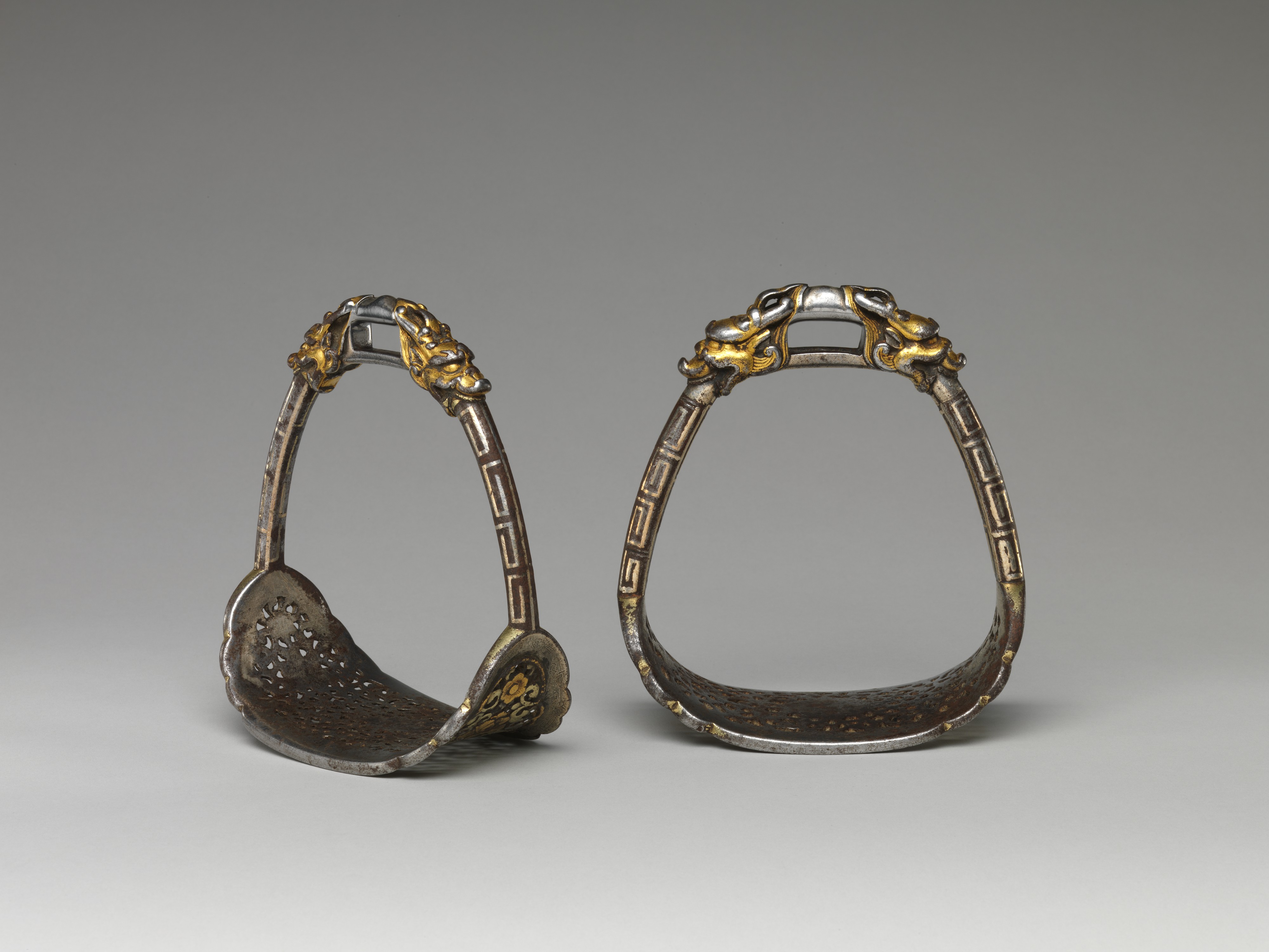
In the lexicon of Zoey Fashion Laboratory, the object is never merely functional. It is a catalyst for structural rebellion. The subject of this definitive avant-garde analysis—a pair of Mongolian or Tibetan stirrups, forged from iron, gold, and silver—presents a paradox of materiality and motion. For SS26, these artifacts are not historical relics but architectural blueprints for a new silhouette. Their weight, their asymmetry, and their metallic tension inform a collection that rejects softness in favor of a rigid, futuristic elegance. We dissect these stirrups not as equestrian tools, but as structural prototypes for the deconstructed human form.
Material Alchemy: From Battlefield to Bio-Architecture
The stirrup’s composition—iron for strength, gold for luminosity, silver for reflection—creates a tripartite dialogue. In the context of avant-garde couture, this is a study in gradient density. The iron base suggests a grounding, almost brutalist foundation; the gold inlay evokes a ceremonial, almost cyborgian augmentation; the silver accents introduce a fluid, reflective surface that catches light like a digital screen. For SS26, this material hierarchy translates into a garment architecture where weight is a design feature.
Imagine a gown where the lower torso is encased in a rigid, iron-toned exoskeleton—constructed from carbon-fiber-reinforced polymer and oxidized metal mesh—that mimics the stirrup’s structural integrity. This base is then overlaid with gold-leafed epoxy panels that appear to float, suspended by invisible microfilaments, creating a visual tension between the heavy and the weightless. The silver elements, perhaps as liquid-metal embroidery along the seams, act as conductors, catching the eye and leading it along the silhouette’s deconstructed lines. This is not ornamentation; it is material storytelling, where each metal tells a chapter of strength, opulence, and reflection.
Silhouette as Suspension: The Stirrup’s Kinetic Grammar
The stirrup’s primary function—to suspend the rider’s weight—becomes the central metaphor for SS26’s silhouette. We reject the static, gravity-bound form. Instead, we propose a suspended architecture where the garment does not rest on the body but rather hangs from it, as if the wearer is perpetually mid-stride. This is achieved through a radical reimagining of the shoulder and hip structures.
Consider a jacket where the shoulders are not padded but cantilevered outward using a hidden framework of titanium wire and tensioned fabric, reminiscent of the stirrup’s loop. The sleeves, detached at the bicep, are connected by a single, silver-plated chain that mimics the stirrup’s leather strap—a deliberate break from convention that forces the garment to perform as a kinetic sculpture. Similarly, trousers are re-engineered: they do not end at the ankle but extend into a rigid, stirrup-like loop that hooks under the foot, creating a continuous line from hip to toe. This is not a pant; it is a structural cage that defines the leg’s movement, echoing the stirrup’s role as a pivot point for action.
Deconstructive Layering: The Iron-Gold-Silver Gradient
The avant-garde imperative demands that we dismantle and reassemble. The stirrup’s three metals inspire a layering system based on opacity and reflection. The iron layer—the most opaque and heavy—serves as the foundation: think of a sculpted, high-neck vest made from laser-cut, oxidized steel plates, interlocked without stitching. This is the armor, the grounding element. The gold layer, semi-translucent, is overlaid as a floating second skin: a tulle-like mesh of gold-lame threads that billows away from the body, catching light like a gilded aura. The silver layer, the most reflective, is applied as a surface treatment—perhaps as a liquid-silver coating on the garment’s edges, or as a series of mirrored discs that rotate with movement, creating a fragmented, futuristic silhouette.
This gradient is not static. It shifts with the wearer’s motion, creating a dynamic visual rhythm. The iron anchors, the gold elevates, the silver dazzles. The garment becomes a living artifact, a wearable document of the stirrup’s material evolution.
Structural Innovation: The Stirrup as a Joining Mechanism
Beyond silhouette, the stirrup offers a revolutionary approach to garment construction. Its loop-and-strap system is a modular joining mechanism that can be translated into couture engineering. For SS26, we propose a series of detachable components connected by custom-designed, stirrup-inspired clasps. A skirt might be divided into three independent panels—front, back, and side—each attached to a central belt via a metal loop and tensioned cable. This allows the wearer to reconfigure the silhouette in real-time, from a narrow column to a flared, asymmetrical shape. The clasps themselves are functional jewelry, cast in iron with gold and silver accents, echoing the stirrup’s duality of utility and ornament.
Furthermore, the stirrup’s concave shape—where the foot rests—inspires a new form of negative-space tailoring. Imagine a bodice where the fabric is not draped over the bust but instead creates a void, a carefully engineered gap that is framed by a rigid, stirrup-like ring. This ring, made from polished iron, holds the fabric away from the body, creating a sculptural hollow that emphasizes the space between garment and skin. It is a deconstruction of the second skin, a deliberate alienation that speaks to the futuristic, post-human aesthetic.
Conclusion: The Stirrup as a Futurist Manifesto
These two stirrups, forged in the crucible of Mongolian or Tibetan craft, are not historical artifacts. They are prophetic tools for a fashion that privileges structure over drape, tension over flow, and material over trend. For Zoey Fashion Laboratory’s SS26 collection, the stirrup is a manifesto: it declares that the body is a platform for architectural experimentation, that weight is a design asset, and that the future of couture lies in the rigorous deconstruction of the past. The iron, gold, and silver are not mere metals—they are the chromatic syntax of a new avant-garde. The stirrup is no longer for the horse; it is for the human form, suspended in a state of perpetual, elegant tension. This is not fashion. This is structural poetry.