Deconstructing the Safavid Fragment: A Blueprint for Avant-Garde Textile Innovation
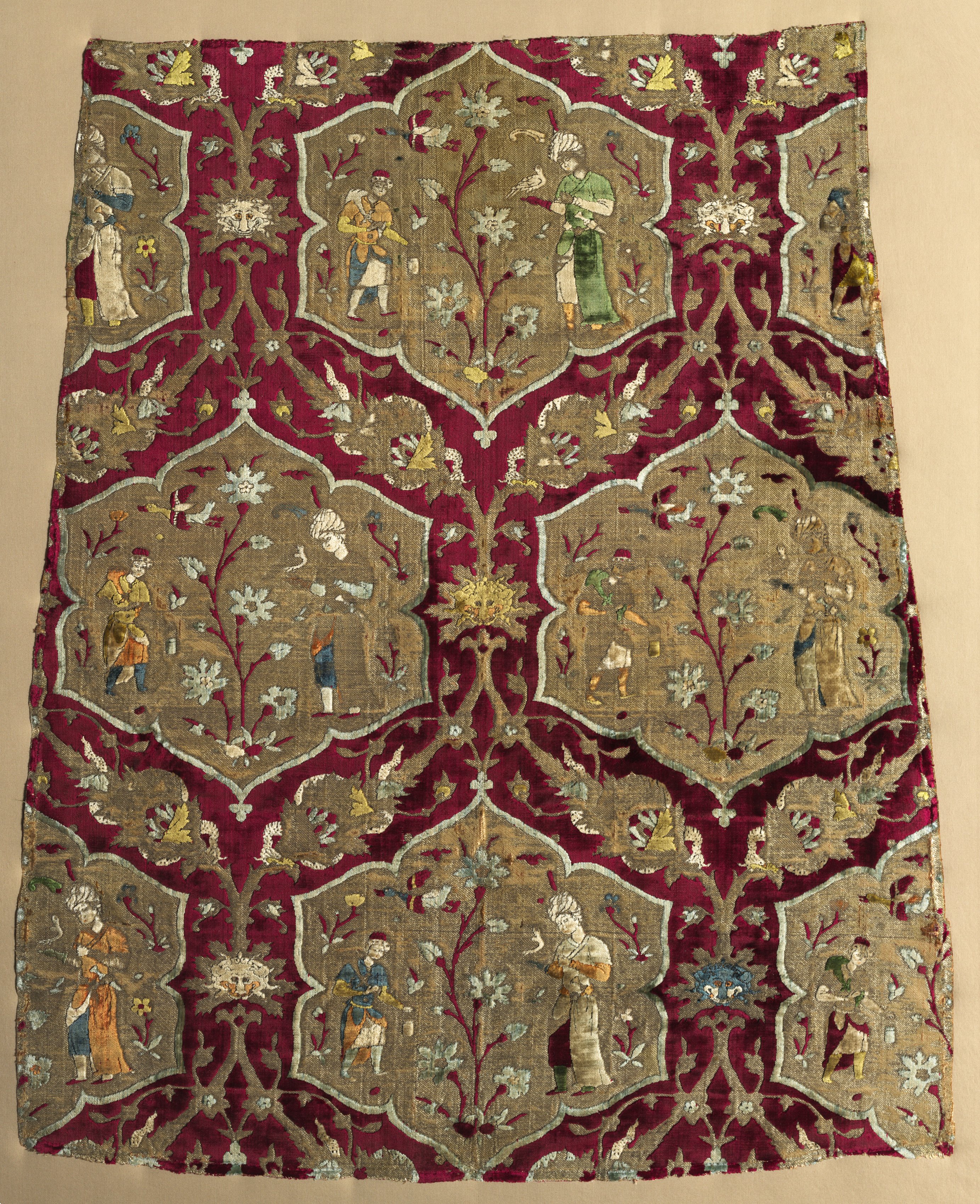
At Zoey Fashion Lab, our mission is to dissect historical textile masterpieces and extract their fundamental DNA—the structural, visual, and narrative elements—to inform cutting-edge, avant-garde design. The subject of this analysis is a fragment from a Safavid-period robe, originating from Kashan, Iran (circa 1501–1722). This piece, featuring a falconer and attendant within an animated lattice, is a technical marvel of silk velvet, brocading, pile-warp substitution, and gilt-metal thread. It is not merely a relic; it is a new DNA strand for fashion deconstruction. Below, we break down its core components and reinterpret them through an avant-garde lens.
1. Technical Foundation: Velvet, Brocading, and Pile-Warp Substitution
The fragment’s construction is a symphony of complexity. The base is a silk velvet, created through a cut-pile technique where loops of silk are sheared to produce a dense, plush surface. This is not a uniform pile; the design employs pile-warp substitution, where specific warp threads are selectively raised to create varying pile heights and textures. This allows the falconer’s robe, the attendant’s sash, and the lattice to emerge with distinct tactile gradients—some areas smooth, others raised like fur. The brocading adds another layer: supplementary weft threads of silk and gilt-metal are woven into the fabric, creating shimmering, metallic accents that catch light and motion.
Avant-Garde Application: For Zoey Fashion Lab, this technique translates into 3D-printed textile hybrids. Imagine a garment where pile-warp substitution is replicated using programmable fibers—areas of high pile for the falconer’s hood, low pile for the lattice, and metallic brocading achieved through embedded conductive threads that light up when touched. The fragment’s structure inspires a new category of responsive velvet: a fabric that changes texture based on environmental stimuli (heat, movement, or sound), echoing the original’s dynamic interplay of light and shadow.
2. Iconographic DNA: The Falconer and Attendant in Animated Lattice
The central motif—a falconer with his attendant—is framed by an animated lattice, a geometric pattern that appears to move as the eye traverses the fabric. The falconer, a symbol of nobility and mastery over nature, is shown with a bird of prey on his gloved hand. The attendant, slightly smaller, holds a leash or a lure, suggesting a narrative of training and partnership. The lattice, often a stylized vine or arabesque, is not static; its interlacing curves and nodes create a sense of rotation or expansion, as if the figures are caught in a perpetual dance. This is a visual narrative of hierarchy and motion, where the human and the natural are intertwined in a controlled, yet fluid, structure.
Avant-Garde Application: Deconstruct this narrative into wearable storytelling. The falconer and attendant become archetypes: the controller and the controlled, the master and the apprentice. In a Zoey Fashion Lab collection, this could manifest as a two-piece ensemble where one garment (the falconer) has rigid, structured shoulders and a high collar, while the other (the attendant) is fluid, with trailing panels that mimic the lattice’s movement. The animated lattice is reinterpreted as kinetic embroidery—threads that shift with the wearer’s motion, using micro-motors or magnetic fibers to create a living pattern. The lattice’s geometry becomes a parametric design, algorithmically generated to vary with each garment, ensuring no two pieces are identical.
3. Material Alchemy: Gilt-Metal Thread and Silk Velvet
The use of gilt-metal thread—thin strips of silver or gold gilded over silk or linen cores—is a hallmark of Safavid luxury. This thread is brocaded into the velvet, creating a contrast between the matte, deep pile of the silk and the reflective, sharp lines of the metal. The effect is opulent yet controlled; the metal does not overwhelm the velvet but rather punctuates it, drawing the eye to the falconer’s glove, the attendant’s belt, and the lattice’s nodes. The silk velvet itself, often dyed with natural pigments like cochineal red, indigo blue, or saffron yellow, provides a rich, saturated backdrop.
Avant-Garde Application: Subvert this opulence through sustainable deconstruction. Replace gilt-metal thread with recycled metallic yarns from electronic waste—copper from old cables, silver from circuit boards—creating a post-industrial brocade. The silk velvet is reimagined as bio-fabricated silk, grown in labs using yeast or bacteria, reducing environmental impact. The pile-warp substitution is mimicked with laser-cut felt or 3D-knitted structures, where the pile height is digitally controlled. The result: a garment that retains the Safavid fragment’s luxurious tactility but is rooted in circular design principles, challenging the original’s association with imperial wealth.
4. Structural Dynamics: The Animated Lattice as a Framework
The lattice is not merely decorative; it is a structural framework that organizes the composition. In the fragment, the lattice’s repeating geometric units (often hexagons or octagons) create a modular grid that contains the figures while allowing them to break free at certain points—the falconer’s arm extends beyond the lattice, the attendant’s foot overlaps a node. This tension between containment and release is a key design principle. The lattice’s animation is achieved through asymmetrical repetition and color shifts (e.g., a thread of gold that suddenly changes to silver), giving the illusion of rotation or expansion.
Avant-Garde Application: Translate this into modular garment construction. The lattice becomes a snap-together framework of panels that can be reconfigured by the wearer—a coat that transforms into a cape, a skirt that expands into a train. The figures (falconer and attendant) are printed or embroidered on removable patches, allowing the wearer to change the narrative. The lattice’s animation is replicated with optical illusion prints or moiré effects created by layering sheer fabrics. For a digital fashion context, the lattice could be rendered in augmented reality, where the pattern moves and shifts when viewed through a smartphone, echoing the fragment’s original kinetic quality.
5. Color Palette and Light Play
The fragment’s surviving colors—deep crimson, faded gold, and muted blue—are the result of aging, but their original vibrancy can be inferred. The red velvet, likely dyed with cochineal or madder, was a symbol of power. The gilt-metal thread, now tarnished, would have blazed against the dark pile. This contrast between light and shadow is central to the fragment’s visual impact. The pile-warp substitution creates deep shadows in the recessed areas, while the brocaded metal catches highlights, producing a chiaroscuro effect that is both dramatic and intimate.
Avant-Garde Application: Reimagine this palette through chromatic deconstruction. Use dichroic films and holographic threads that shift color based on viewing angle, mimicking the interplay of light on the original velvet and metal. The deep crimson is replaced with thermochromic dyes that turn from black to red when heated by body warmth, revealing the falconer motif. The lattice’s nodes are highlighted with phosphorescent pigments that glow in low light, creating a ghostly animation. This transforms the fragment’s static opulence into a living, interactive garment that responds to its environment.
Conclusion: From Fragment to Fashion DNA
The Safavid fragment is not a finished garment but a blueprint for innovation. Its technical complexity—pile-warp substitution, brocading, gilt-metal thread—offers a vocabulary for modern textile engineering. Its iconography—falconer, attendant, animated lattice—provides a narrative framework for wearable storytelling. Its materiality—silk and metal—challenges us to find sustainable, post-industrial equivalents. At Zoey Fashion Lab, we see this fragment as a new DNA strand: a genetic code that, when deconstructed and recombined, yields avant-garde designs that honor the past while propelling fashion into the future. The falconer’s gaze, the lattice’s motion, the velvet’s depth—all are reborn in our collections as responsive, modular, and ethically crafted pieces that redefine luxury for the 21st century.