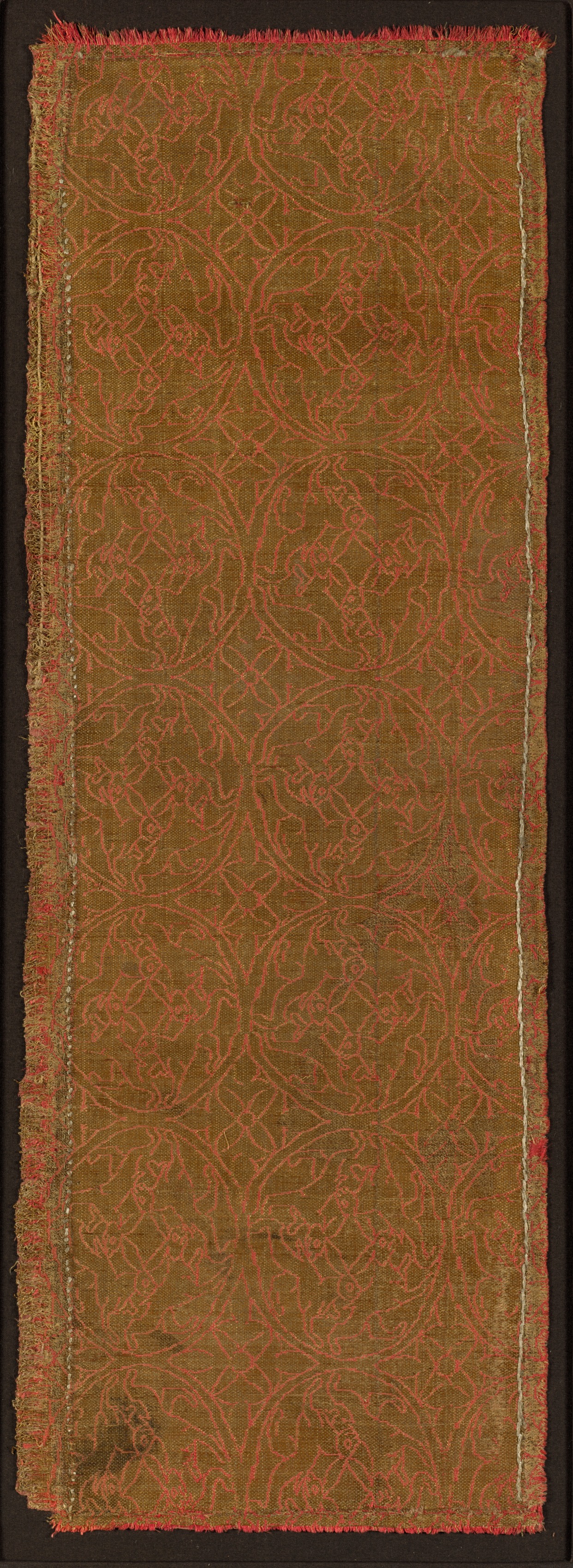
Deconstructing the Divine: An Avant-Garde Analysis of Zoey Fashion Lab's Cloth of Gold with Rabbit Wheels
At Zoey Fashion Lab, the role of the Chief Fabric Deconstructionist is not merely to analyze textile structure, but to dismantle the very narratives woven into its threads. Today, we examine a piece that defies temporal boundaries: Cloth of Gold with Rabbit Wheels. Originating from Eastern Iran, this artifact is composed of silk and gold thread in a lampas weave. Its reference, Archive Resonance: 一面是光洁银镜上以黄金镶嵌的纷繁棕叶纹,另一面是冰冷石棺板上以浮雕诉说的生命叙事——《Mirror with Split-Lea..., positions it as a dualistic object—half gleaming mirror, half cold sarcophagus. Our analysis will strip this fabric of its historical context and reassemble it through an avant-garde lens, revealing its radical potential as a garment of subversion, transformation, and existential commentary.
The Technical Foundation: Lampas as a Language of Power
The lampas weave, a complex structure where a pattern is created by supplementary wefts floating over a ground weave, is not merely a technical choice—it is a declaration of opulence. In this cloth, the silk ground provides a lustrous, almost liquid base, while the gold thread (likely gilded silver or gold leaf wrapped around a silk core) rises to the surface in intricate, discontinuous patterns. This technique allows for a duality of texture: the silk offers a soft, yielding touch, while the gold imposes a rigid, metallic brilliance. For the avant-garde designer, this is a tactile metaphor for the friction between the organic and the industrial, the spiritual and the material.
The gold thread, in particular, is not just a decorative element; it is a symbol of sovereignty and divinity in Eastern Iranian culture, often reserved for royal or religious garments. Yet, in our deconstruction, we see it as a tool of disruption. The gold’s reflective quality creates a surface that both invites and repels touch, a shimmering barrier that speaks to the modern obsession with surface over substance. When reimagined as a garment, this fabric could be used to create a deconstructed gown where the gold appears to “bleed” into the silk, suggesting a narrative of decay or transformation—a queen’s robe that is simultaneously a shroud.
The Motif: Rabbit Wheels and the Paradox of Movement
The motif of “Rabbit Wheels” is a striking departure from traditional Iranian iconography, which often features geometric patterns, arabesques, or figural elements like hunting scenes. Here, the rabbit—a creature of fertility, speed, and vulnerability—is paired with wheels, symbols of technology, progress, and cyclical time. This juxtaposition creates a paradox of movement: the rabbit is naturally swift but constrained by the wheel, a human invention that both enhances and limits motion. In an avant-garde context, this motif becomes a critique of modernity’s promise of freedom through mechanical means. The rabbit, endlessly running but never arriving, mirrors the contemporary human condition—trapped in a cycle of productivity and consumption.
From a design perspective, the wheels can be interpreted as circular forms that disrupt the linear flow of the lampas pattern. They could be abstracted into bold, oversized circles that break the fabric’s symmetry, creating a visual tension between the organic curves of the rabbit and the rigid geometry of the wheel. For a garment, this might translate into a corset-like structure with wheel-shaped boning that constrains the body, or a skirt with circular cutouts that reveal the wearer’s skin—a literal exposure of the self to the machinery of society. The rabbit, meanwhile, could be rendered as a shadow embroidery using black silk thread, barely visible against the gold, suggesting a hidden narrative of escape or surrender.
Archive Resonance: The Mirror and the Sarcophagus
The reference to Archive Resonance is the key to unlocking this fabric’s avant-garde potential. It describes two opposing surfaces: one a “smooth silver mirror inlaid with gold palm leaves,” the other a “cold stone sarcophagus with relief-carved life narratives.” This duality is the fabric’s core tension. The mirror represents vanity, illusion, and the present moment—a surface that reflects but does not hold. The sarcophagus represents death, memory, and the past—a container that preserves but does not live. The cloth, therefore, is a threshold object, existing between these two states. It is both a celebration of life (the gold palm leaves, symbols of victory and eternity) and a meditation on mortality (the stone-like rigidity of the gold thread).
In an avant-garde collection, this fabric could be used to create a transformative garment that changes with the viewer’s perspective. For instance, a reversible coat: one side features the mirror-like gold surface, polished and reflective, while the other side reveals the “sarcophagus” pattern—a dense, almost black silk with gold thread forming skeletal palm leaves. When worn, the garment becomes a performance of identity, allowing the wearer to choose between the public, glamorous self and the private, contemplative self. Alternatively, the fabric could be deconstructed into panels that are suspended from a metal frame, creating a wearable sculpture that echoes both a mirror’s frame and a tomb’s lid. The gold thread, when frayed, could be left to hang like tattered funeral ribbons, suggesting that even the most opulent beauty is subject to decay.
Avant-Garde Application: Subverting the Sacred
To fully realize the avant-garde potential of Cloth of Gold with Rabbit Wheels, we must subvert its sacred origins. This fabric was likely intended for a courtly or religious context, where its gold and silk signified divine favor. In a modern, subversive context, we can use it to critique power structures. Imagine a deconstructed suit made from this cloth, with the gold thread deliberately pulled loose to create a frayed, anarchic silhouette. The rabbit wheels could be embroidered in reverse, appearing as if they are spinning backward, suggesting a rejection of progress. The garment could be paired with industrial materials like rubber or steel, creating a clash between the ancient and the contemporary.
Another approach is to isolate the gold thread and use it as a structural element, weaving it into a cage-like form that encases the body. This cage could be asymmetrical, with one side open to reveal the silk, echoing the mirror-sarcophagus duality. The rabbit motif could be scaled up to monstrous proportions, its wheels becoming spoked circles that resemble prison bars. This garment would not be worn for comfort but for provocation, forcing the viewer to confront the tension between beauty and constraint, life and death.
Conclusion: A Fabric of Contradictions
Cloth of Gold with Rabbit Wheels is not a fabric to be revered; it is a fabric to be dismantled and reimagined. Its technical mastery—the lampas weave, the gold thread—speaks to a history of craftsmanship, but its motifs and archive resonance point to a deeper, more unsettling narrative. As an avant-garde designer, you are not bound by its original context. Instead, you are invited to weave new meanings from its threads, to create garments that challenge, provoke, and transform. Whether as a mirror of vanity or a sarcophagus of memory, this fabric holds the power to make the wearer a living paradox—a being caught between the golden glow of the present and the stone-cold weight of the past. At Zoey Fashion Lab, we do not preserve history; we deconstruct it, stitch by stitch, to reveal the radical truths hidden within.