Deconstructing the Canopy: Woodland Road as a Blueprint for SS26 Avant-Garde Couture
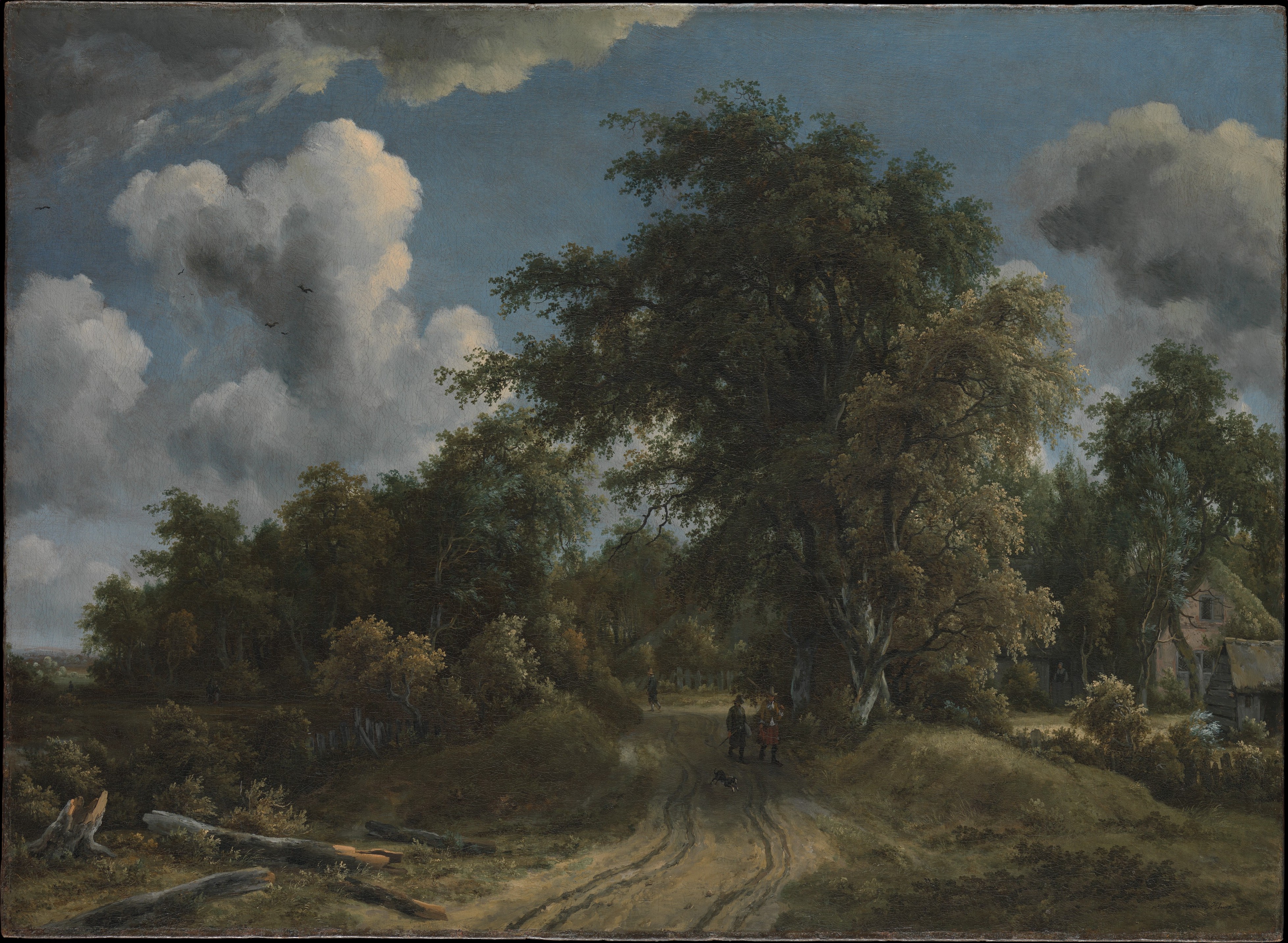
At Zoey Fashion Laboratory, the boundary between art and garment is not merely blurred—it is systematically dismantled and reimagined. The subject of this definitive avant-garde analysis is Woodland Road, a work originating from the Global Frontier, executed in oil on canvas. This is not a pastoral landscape, but a radical, standalone study of structural tension, organic entropy, and the future of silhouette. For SS26, we extract from this canvas a lexicon of deconstructive aesthetics, where the road itself becomes a seam, the woodland a complex lattice of support, and the oil a medium for both fluidity and rigidity. This is a manifesto for garments that are not worn, but inhabited—architectural, reactive, and deeply intellectual.
I. The Silhouette as a Fractured Topography
1.1 The Road as a Structural Seam
The central motif of Woodland Road is not a path of escape, but a line of force. In our SS26 collection, this translates into garments where the primary silhouette is defined by a single, sweeping asymmetrical seam that bisects the body. Imagine a double-faced wool coat, oil-treated to achieve a matte, almost liquid finish, where the right side cascades in a voluminous, sculpted bell shape, while the left side is sharply tailored to the torso. The seam—our “road”—is not hidden; it is raw, exposed, and reinforced with a thick, blackened thread reminiscent of tar. This creates a futuristic silhouette that is both grounded and dynamic, suggesting a body in motion, caught between two states of being.
1.2 Canopy Overlays and Negative Space
The woodland canopy, with its interplay of light and shadow, informs our use of negative space. We propose a series of outerwear pieces constructed from laser-cut panels of bonded leather and neoprene, mimicking the dappled effect of leaves. These panels are not sewn together in a traditional manner; instead, they are joined by floating, architectural hinges of polished aluminum, allowing the garment to shift and breathe. The resulting silhouette is a deconstructed exoskeleton, where the wearer’s form is both revealed and obscured. For SS26, we envision a long, floor-length duster coat with these cutouts, worn over a sheer, oil-stained silk slip. The visual effect is one of a body moving through a forest of its own making—a standalone statement of structural innovation.
II. Material Alchemy: Oil on Canvas as a Textile Philosophy
2.1 The Oil Treatment: From Paint to Protective Membrane
The material origin of Woodland Road—oil on canvas—is not a passive reference; it is a direct challenge to conventional textile production. We are developing a proprietary oil-infused finish for our SS26 fabrics, applied to organic cotton, hemp, and even recycled denim. This is not a simple coating; it is a chemical process that transforms the fabric’s molecular structure, creating a surface that is simultaneously water-resistant, stiff, and pliable. The result is a material that behaves like a second skin, capable of holding sharp pleats and dramatic folds while remaining breathable. For a standalone avant-garde study, we propose a sculpted bustier top, entirely constructed from this treated canvas, with a high, collared neckline that rises like a painter’s palette around the face. The oil gives it a lustrous, almost wet sheen, evoking the rich, viscous quality of the original medium.
2.2 The Canvas as a Foundation for Deconstruction
The canvas itself—raw, unprimed, and intentionally distressed—becomes a core component of our textile vocabulary. We are sourcing heavy-duty linen canvas from the Global Frontier, known for its irregular weave and organic imperfections. For SS26, these canvases are not dyed but left in their natural, earthy tones, then overlaid with hand-applied patches of oil paint in deep forest greens, burnt umber, and ochre. These patches are not decorative; they serve as structural reinforcements, stiffening specific areas of the garment to create volume and shape. Imagine a pair of wide-leg trousers, where the knees and hips are painted with thick, oil-based pigment, creating a sculpted, almost armor-like silhouette. The unpainted sections remain soft and fluid, offering a dialectic between rigidity and drape that is central to the woodland road aesthetic.
III. Structural Innovation: The Architecture of the Global Frontier
3.1 Modular Construction and Kinetic Elements
The Global Frontier context demands a design philosophy rooted in adaptability and movement. Our SS26 pieces are conceived as modular systems, where components can be detached, reattached, or reoriented. For example, a jacket inspired by the road’s winding path features a series of magnetic closures hidden within the seams, allowing the sleeves to be removed and worn as separate arm cuffs, or the collar to be transformed into a hood. This is not mere versatility; it is a form of kinetic architecture, where the garment evolves with the wearer’s environment. The oil-on-canvas treatment ensures these modular joints maintain their structural integrity, resisting fraying or deformation. This is a direct response to the standalone nature of the study—each piece must be a self-contained system of possibilities.
3.2 The Shoulder as a Landscape
No avant-garde analysis is complete without a radical rethinking of the shoulder line. From Woodland Road, we extract the concept of the horizon—the point where the road meets the sky. For SS26, we introduce the “Canopy Shoulder”, a structural innovation that extends the shoulder pad into a series of overlapping, cantilevered forms. These are crafted from molded, oil-treated canvas and bonded with a lightweight carbon fiber frame, creating a silhouette that is both formidable and ethereal. The pads are asymmetrical, with one side extending outward like a branch, while the other remains close to the body. This creates a futuristic silhouette that challenges the viewer’s perception of balance and weight, evoking the organic asymmetry of a forest canopy. The effect is amplified by the oil’s reflective quality, which catches light in unpredictable patterns.
IV. The Standalone Avant-Garde: A Conclusion in Three Movements
In synthesizing Woodland Road for SS26, Zoey Fashion Laboratory has not merely translated a painting into a collection; we have deconstructed the very act of seeing. The road is no longer a path but a seam; the canvas is no longer a surface but a structure; the oil is no longer a medium but a membrane. This is a standalone avant-garde study that rejects nostalgia in favor of a radical, forward-facing aesthetic. The garments we propose are not for the passive observer; they are for the active participant, the individual who understands that fashion is a form of environmental architecture.
The final piece in this analysis is a full-length, oil-on-canvas gown, a singular statement piece that encapsulates the entire woodland road ethos. The gown is constructed from a single, continuous piece of treated linen, folded and pleated to create a body-hugging bodice that transitions into a vast, train-like skirt. The pleats are not symmetrical; they mimic the undulations of a forest path, with raw, unpainted sections contrasting against areas of heavy oil application. The train is designed to be detachable, transforming the gown into a short, sculpted dress. A structural collar of molded, oil-stiffened canvas rises behind the neck like a tree trunk, framing the face in a halo of organic architecture. This is the definitive silhouette for SS26: a garment that is at once a painting, a sculpture, and a declaration of the future.