Deconstructing Heraldry: The Cartoon as Architectural Blueprint for SS26
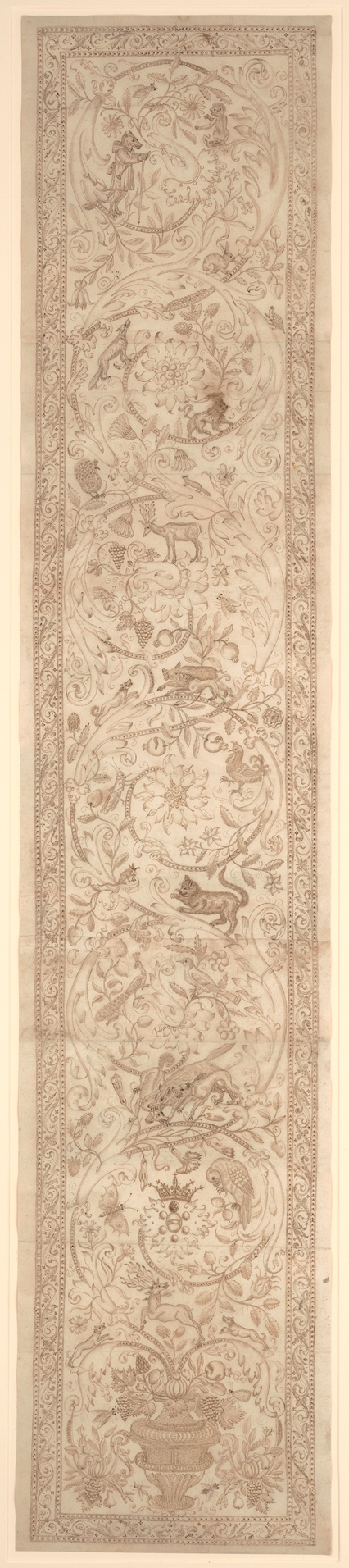
The recent acquisition of a pen-and-brown-ink cartoon—a preparatory study for an orphrey bearing the Medici arms impaled with those of the House of Austria—presents a radical departure from conventional archival reverence. For Zoey Fashion Laboratory’s SS26 collection, this is not a historical artifact to be replicated, but a genetic code for structural innovation. The cartoon’s inherent duality—a static, two-dimensional design intended for three-dimensional ecclesiastical embroidery—becomes a metaphor for the tension between planar construction and volumetric silhouette. We analyze this piece through the lens of futuristic couture, where the orphrey’s linear precision and heraldic geometry inform a new language of garment architecture.
The Orphrey as Exoskeletal Framework
Historically, the orphrey served as a rigid, ornamental band defining the liturgical vestment’s structure. In our SS26 reinterpretation, this band is deconstructed into an exoskeletal framework that extends beyond the garment’s surface. The pen-and-ink strokes—delicate yet deliberate—are translated into laser-cut, carbon-fiber-reinforced panels that articulate around the body like a second skeleton. The Medici palle (balls) and Austrian eagle motifs are not embroidered but etched into translucent, thermosensitive polymers that shift opacity under heat, creating a living heraldry. The cartoon’s two-dimensionality is thus exploded into a three-dimensional lattice, allowing the garment to breathe and morph with the wearer’s movement.
Futuristic Silhouettes: The Inverted Orphrey
The study’s vertical orientation—typical of an orphrey band—is inverted and reimagined as a radical shoulder-to-hem cascade. The silhouette for SS26 rejects traditional hourglass or A-line forms in favor of a geodesic asymmetry: the left shoulder bears a soaring, cantilevered structure mimicking the orphrey’s upward sweep, while the right side falls into a fluid, deconstructed train. This creates a visual tension between stability and collapse, echoing the historical weight of the Medici-Austria alliance and the fragility of its legacy. The pen-and-ink hatching becomes a textural guide for 3D-printed, bio-resin scales that overlap like armor, but are soft to the touch—a paradox of strength and vulnerability.
Structural Innovation: The Cartoon as Pattern
In traditional couture, a cartoon is a full-scale drawing for embroidery. For SS26, we treat the cartoon as a generative algorithm for pattern cutting. The brown ink’s varying densities—from fine lines to bold strokes—are decoded into a matrix of seamless, zero-waste construction. The Medici arms, with their six palle, become modular, circular inserts that can be reconfigured across different garments, while the Austrian eagle’s wings are abstracted into kinetic pleats that unfurl with the wearer’s stride. The result is a modular system where each garment is a standalone study, yet part of a larger, adaptive ecosystem.
Materiality: From Ink to Biopolymer
The cartoon’s materiality—pen and brown ink on aged paper—inspires a color palette of oxidized metals and organic decay. We translate the ink’s sepia tones into laminated silk organza dyed with iron-rich botanicals, while the paper’s texture is replicated through recycled cellulose nanofiber weaves. The orphrey’s embroidery is reimagined as conductive thread circuits that illuminate the heraldic motifs via low-voltage LEDs, powered by kinetic energy harvested from movement. This transforms the garment from a static symbol of power into a dynamic, interactive narrative.
Global Frontier: The Cartoon as Cultural Collision
The piece’s origin—Global Frontier—implies a borderless, post-geographical context. The Medici-Austria arms symbolize a historical alliance of European power, but in our hands, they become a hybrid emblem of transnational identity. The cartoon’s standalone nature—a study, not a finished work—mirrors the fragmentary, unfinished quality of contemporary identity. For SS26, we deconstruct the heraldic language into abstract glyphs that reference both Renaissance opulence and cyberpunk dystopia. The orphrey’s band is split into floating, magnetic modules that can be rearranged by the wearer, allowing for personalized heraldry that evolves with daily context.
Conclusion: The Cartoon as Provocation
This avant-garde analysis positions the Medici-Austria cartoon not as a relic, but as a blueprint for structural rebellion. By stripping the orphrey of its liturgical function and reimagining it through futuristic silhouettes, we challenge the very notion of heritage as static. The garment becomes a wearable manifesto—a dialogue between the ink’s permanence and the body’s transience, between historical weight and aerodynamic lightness. For Zoey Fashion Laboratory, SS26 is not about revival, but about deconstruction as genesis. The cartoon’s lines are not boundaries; they are launch points into a new dimension of couture where every stitch is a question, and every silhouette is an answer yet to be written.