Deconstructing the Monju with Five Hair Knots: An Avant-Garde Analysis for Zoey Fashion Lab
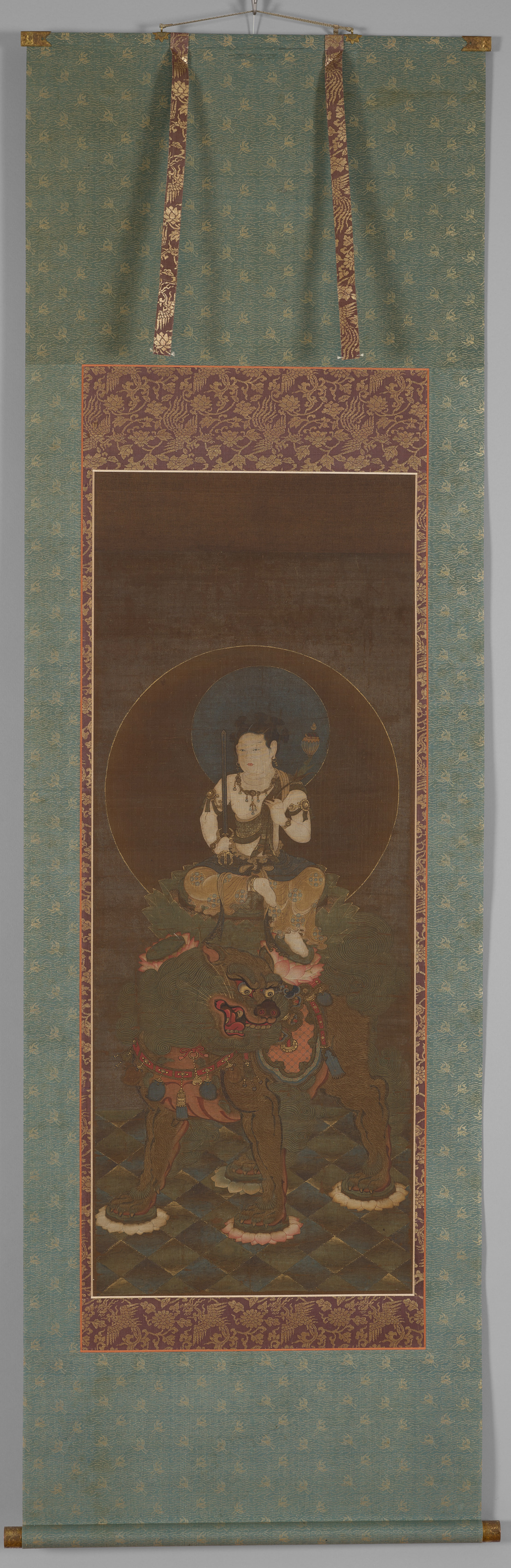
At Zoey Fashion Lab, our mission is to interrogate historical artifacts not as static relics, but as dynamic, living texts that can inform radical new design languages. The subject of this analysis—the Kamakura-period hanging scroll depicting Monju with Five Hair Knots (Monju Bosatsu, the Bodhisattva of Wisdom)—offers a profound case study. Created in Japan between 1185 and 1333, this work is executed in ink, color, gold, and cut gold on silk. However, we approach it not as a religious icon, but as a New DNA Strand for avant-garde fashion. By deconstructing its visual, material, and symbolic architecture, we can extract a blueprint for garments that challenge perception, embody contradiction, and redefine the relationship between body, ornament, and meaning.
I. The Visual Grammar of Wisdom and Power
The scroll depicts Monju, often shown seated on a lion, but here the focus is on the figure’s distinctive coiffure: five hair knots rising like a crown. In Buddhist iconography, these knots symbolize the five wisdoms of the Buddha—a cosmic intelligence. For Zoey Fashion Lab, this is not mere hair styling; it is a topographic sculpture that transforms the human head into a landscape of authority. The avant-garde designer can reinterpret this as a structural headpiece or a series of volumetric forms that ascend from the body, creating a silhouette that defies gravity and convention. The knots are not symmetrical; they possess a dynamic, almost chaotic order, suggesting that wisdom is not static but a living, evolving force. This asymmetry is a key principle: in our deconstruction, we propose garments that feature unbalanced volumes—a single exaggerated shoulder, a cascading train that twists like a knot unspooling—to evoke intellectual restlessness.
The use of cut gold (kirikane) on silk is particularly significant. This technique involves cutting gold leaf into fine strips and applying them to create geometric patterns, often resembling flames or lotus petals. In the scroll, the gold catches light, creating a shimmering, otherworldly aura around Monju. For fashion, this translates into light-reactive surfaces: metallic threads, laser-cut foil appliqués, or even programmable LED textiles that pulse with a golden glow. The gold is not merely decorative; it is a narrative device that signals the divine. In an avant-garde context, such materials can be used to mark zones of power on the body—the shoulders, the crown, the spine—transforming the wearer into a living icon.
II. Material Alchemy: Ink, Color, and the Silk Substrate
The scroll’s medium—ink, color, gold, and cut gold on silk—offers a rich palette for material exploration. Silk, as a substrate, is both delicate and strong, a paradox that the Kamakura artisans exploited. The ink outlines are bold and calligraphic, while the colors (vermillion, indigo, malachite green) are applied in translucent washes. This layering creates depth without opacity. For Zoey Fashion Lab, this suggests a deconstructed layering system: garments that combine sheer silks with opaque, hand-painted panels, where the underlying fabric remains visible through washes of color. The ink lines can be reinterpreted as structural seams that guide the eye across the body, mimicking the flowing lines of Monju’s robes.
The cut gold is applied in precise, repetitive motifs—often tiny squares or triangles. This is a precursor to modern digital pixelation. In an avant-garde collection, we might use micro-sequins or metallic embroidery to replicate this effect, creating surfaces that shift and shimmer with movement. The gold also serves as a signifier of the sacred, but in fashion, it can be subverted: applied to unexpected areas like the interior of a collar or the hem of a skirt, visible only in motion. This hidden luxury aligns with the avant-garde ethos of disrupting expectations.
III. Symbolic Architecture: The Body as a Mandala
The composition of the scroll is not realistic but symbolic. Monju’s body is elongated, his proportions idealized. The five knots are not just hair; they are a mandala—a geometric diagram of the universe. For fashion, this implies that the garment itself can be a spiritual diagram. We propose a design where the five knots are translated into five key structural elements: a high collar, exaggerated sleeves, a trailing back panel, a cinched waist, and a floating hem. Each element corresponds to a wisdom: the collar as the wisdom of reality, the sleeves as the wisdom of equality, and so on. The wearer becomes a walking meditation, their silhouette a map of enlightenment.
The lion mount, often present in Monju imagery, is absent in this scroll, but its energy is implied through the dynamic folds of the robe. These folds are not naturalistic; they are abstract calligraphy. For the lab, this suggests kinetic draping—fabric that is pleated, twisted, or folded in ways that create tension and release. The folds can be frozen in place using heat-set techniques or left fluid to respond to the wearer’s movement. This duality—static yet dynamic—is central to the avant-garde approach.
IV. The New DNA Strand: A Blueprint for Deconstruction
Viewing the scroll as a New DNA Strand means extracting its core genetic code: the interplay of order and chaos, light and shadow, symbol and material. For Zoey Fashion Lab, this translates into a collection that is both architectural and organic. The five knots become a motif repeated across garments—as fabric manipulation, as print, as structural padding. The gold cutwork inspires a technique we call “gilded deconstruction”: garments are assembled from panels that are partially cut away, revealing layers of gold beneath, like the scroll’s gold peeking through the silk.
The color palette is drawn directly from the scroll: indigo, vermillion, malachite, and gold, but used in unexpected combinations—a vermillion coat with indigo lining, or a malachite dress with gold seams. The avant-garde twist is to apply these colors in asymmetric blocks or gradient washes, mimicking the scroll’s translucent layering. The ink outlines become topstitching in black or gold thread, tracing the body’s contours like a calligraphic map.
V. Avant-Garde Applications: From Scroll to Runway
Consider a prototype: a deconstructed kimono in silk charmeuse, hand-painted with indigo and vermillion washes. The sleeves are exaggerated, but one sleeve is completely detached, held in place by a single gold chain. The back features a five-knot motif created from padded silk circles, each knot outlined in cut-gold embroidery. The garment is asymmetrical, with a high collar on one side and a deep V on the other. When the model moves, the detached sleeve swings, revealing a lining of gold leaf. This piece is not a costume; it is a wearable philosophy—a statement that wisdom is not a fixed state but a dynamic, often unbalanced journey.
Another application: a headpiece inspired by the five knots, constructed from lightweight resin and gold leaf, worn as a crown. It is not a hat but a sculpture that frames the face, its asymmetry challenging traditional notions of beauty. The headpiece can be attached to a sheer hood that cascades down the back, printed with a digital reproduction of the scroll’s ink lines. This piece references the divine aura of Monju while subverting it into a contemporary accessory.
VI. Conclusion: The Living Artifact
The Monju with Five Hair Knots is not a relic to be preserved in glass; it is a living artifact that continues to generate meaning. For Zoey Fashion Lab, its value lies in its ability to inspire a new grammar of dress—one that prioritizes symbolism over utility, asymmetry over balance, and material alchemy over conventional beauty. By deconstructing its visual and material DNA, we can create garments that are not merely worn but inhabited, transforming the wearer into a vessel for wisdom, power, and avant-garde expression. This is not fashion as decoration; it is fashion as sacred technology.