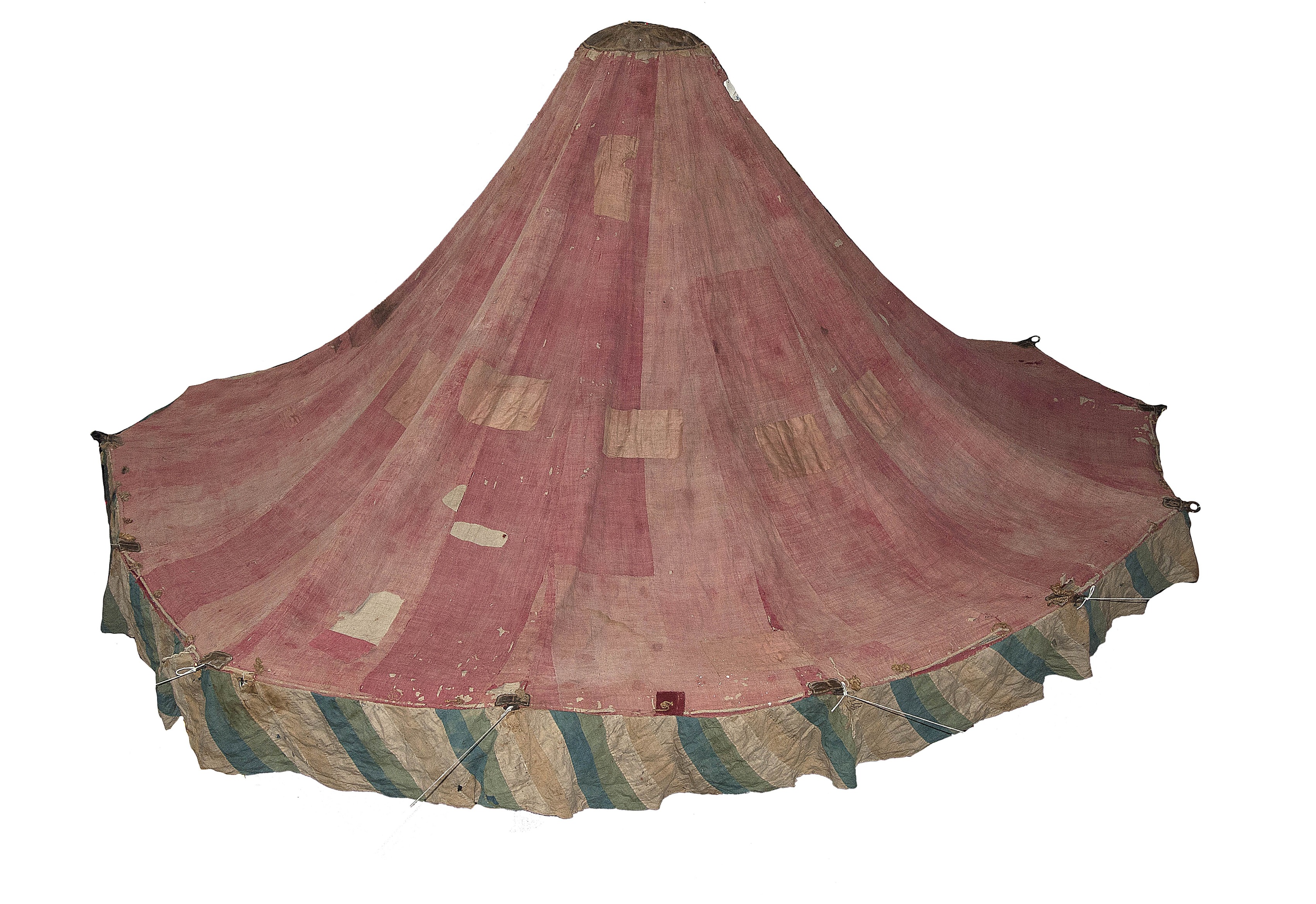
Deconstructing the Regal Canopy: The Royal Round Tent of Muhammad Shah as Avant-Garde Textile Architecture
At Zoey Fashion Lab, we approach historical artifacts not as relics to be preserved in amber, but as living documents of material intelligence. The Royal Round Tent, created for Muhammad Shah during the Qajar period in Rasht, Iran (1779-1925), is a profound example of how functional architecture can become a canvas for cultural narrative. Our deconstruction focuses on its technical composition—a sophisticated interplay of wool, silk, leather, cotton, rope, and iron—to reveal its potential as an avant-garde blueprint for contemporary textile design. This analysis will dissect the tent’s interior and exterior systems, reframing its traditional craftsmanship as a radical, pre-industrial manifesto for modularity, structural tension, and hybrid materiality.
Interior Matrix: The Embodied Narrative of Wool and Silk
The interior of the tent is a masterclass in textural and chromatic orchestration. The primary structure is a wool plain weave, a foundation that speaks to durability and thermal regulation. However, the avant-garde reading begins with the inlaid work—a technique where contrasting materials are set into the weave. This is not mere decoration; it is a proto-modular system. The wool base acts as a ground, while the inlaid elements create a dynamic surface that disrupts the uniformity of the weave. For Zoey Fashion Lab, this suggests a design philosophy where the ground fabric is not passive but actively participates in the visual and tactile dialogue. The inlaid work introduces a rhythm of interruption, a principle we can apply to contemporary garments where structural seams become expressive, non-linear elements.
The silk embroidery in chain stitch elevates this interior from shelter to spectacle. Silk, a protein fiber with natural luster, is applied here not as a backing but as a topographical feature. The chain stitch, a looped technique that creates a raised, linear texture, is used to articulate intricate motifs—likely floral or geometric patterns resonant with Qajar aesthetics. In an avant-garde context, this embroidery functions as tactile calligraphy. It transforms the tent’s interior into a sensory environment where light and shadow play across the raised silk threads. The chain stitch’s inherent flexibility allows it to follow complex curves, making it a precursor to modern digital embroidery. We interpret this as a call to reintegrate hand-embodied precision into high-tech textile production, where the stitch becomes a deliberate mark of authorship rather than a mechanical afterthought.
The inclusion of tape and leather as secondary interior materials is critical. Tape, likely woven cotton or silk, serves as a binding and reinforcing element, creating crisp, linear boundaries between embroidered sections. Leather, applied at stress points or as decorative patching, introduces a third texture—one of animal origin, contrasting with the plant-based fibers. This hybrid materiality is profoundly avant-garde. It anticipates the contemporary fascination with mixed-media textiles where leather is laser-cut, bonded, or woven into non-traditional substrates. The tent’s interior thus becomes a collage of tactility: the soft, matte wool; the glossy, raised silk; the smooth, rigid leather; the structured tape. For Zoey Fashion Lab, this is a direct challenge to the monotony of single-fabric construction. We advocate for garments that are composite landscapes, where each material zone serves a distinct aesthetic and functional purpose.
Exterior Shell: Structural Pragmatism as Aesthetic Provocation
Turning to the exterior, we find a system of pure, unadorned functionality that is equally radical. The outer layer is composed of cotton and wool in plain weave. This is not the opulent interior; it is a protective membrane. The cotton provides breathability and lightness, while the wool adds insulation and weather resistance. The plain weave—the most fundamental interlacing of warp and weft—is here used with utilitarian honesty. In an avant-garde lens, this is a precursor to brutalist textile design, where structure is exposed and celebrated. The tent’s exterior does not hide its construction; it presents the weave as a functional grid. This resonates with contemporary trends in deconstructed fashion, where seams, raw edges, and unlined surfaces are deliberately visible. The tent’s exterior teaches us that function can be the highest form of aesthetic.
The integration of rope and iron ring is the most compelling avant-garde element. The rope, likely natural fiber (hemp or jute), is not merely a fastening; it is a tensile system that defines the tent’s geometry. The iron ring acts as a central anchor, distributing load and creating a focal point for the structural network. This is a pre-industrial hardware system that anticipates modern tensile architecture, from suspension bridges to contemporary fabric structures. For Zoey Fashion Lab, the rope and ring represent a paradigm of adjustable, modular design. Imagine a garment where the silhouette is not fixed by seams but by external tension systems—ropes laced through rings that can be tightened or loosened to alter shape. This is the tent’s legacy: a wearable architecture where the user becomes an active participant in the form. The iron ring, in particular, is a statement piece—a raw, industrial object that contrasts with the soft textiles. It is an early example of hardware as ornament, a concept we see in contemporary avant-garde fashion where metal grommets, chains, and rings are central to the design narrative.
Avant-Garde Synthesis: From Shelter to Second Skin
The Royal Round Tent, when deconstructed, reveals a blueprint for a new textile paradigm. Its interior/exterior dichotomy—opulent narrative versus structural pragmatism—challenges the binary of fashion versus function. The Qajar artisans, through their mastery of materials, created an object that is simultaneously a portable palace and a tensile machine. For Zoey Fashion Lab, this informs our design ethos: we seek to create pieces that are both armor and ornament, where the construction method is the decoration.
The inlaid wool and chain-stitched silk of the interior inspire a technique we call "embedded narrative"—where surface embellishment is not applied but integrated into the structural weave. This could manifest as garments with woven-in patterns that change based on tension or wear, or as tactile maps where embroidered lines guide the eye and hand across the body. The leather and tape elements suggest a patchwork methodology, where disparate materials are joined not to hide but to celebrate their differences. This is a direct response to the homogenization of fast fashion.
The exterior’s plain weave, rope, and iron ring lead us to a concept of adjustable architecture. Garments can be designed with integrated tension systems—ropes, cords, or straps—that allow the wearer to modify silhouette, volume, and drape in real time. The iron ring becomes a hardware signature, a functional jewel that grounds the textile in industrial reality. This approach rejects the static garment in favor of a dynamic, interactive second skin.
Finally, the tent’s origin in the Qajar period—a time of cultural flux and artistic synthesis—resonates with our contemporary moment. The tent is a hybrid object, combining Persian, Central Asian, and possibly European influences. For Zoey Fashion Lab, this validates our commitment to cross-cultural deconstruction. We do not borrow motifs; we borrow structural logic. The Royal Round Tent is not a costume to be replicated; it is a system to be re-coded. Its wool, silk, leather, cotton, rope, and iron are not materials of the past; they are the vocabulary for a future textile language—one that is honest, modular, and profoundly human.
In conclusion, this artifact from Rasht is a testament to the enduring power of material intelligence. By deconstructing its interior and exterior systems, Zoey Fashion Lab finds a radical blueprint for avant-garde fashion: a fusion of shelter and skin, narrative and structure, tradition and disruption. The tent is not a roof; it is a manifesto in fiber and metal.