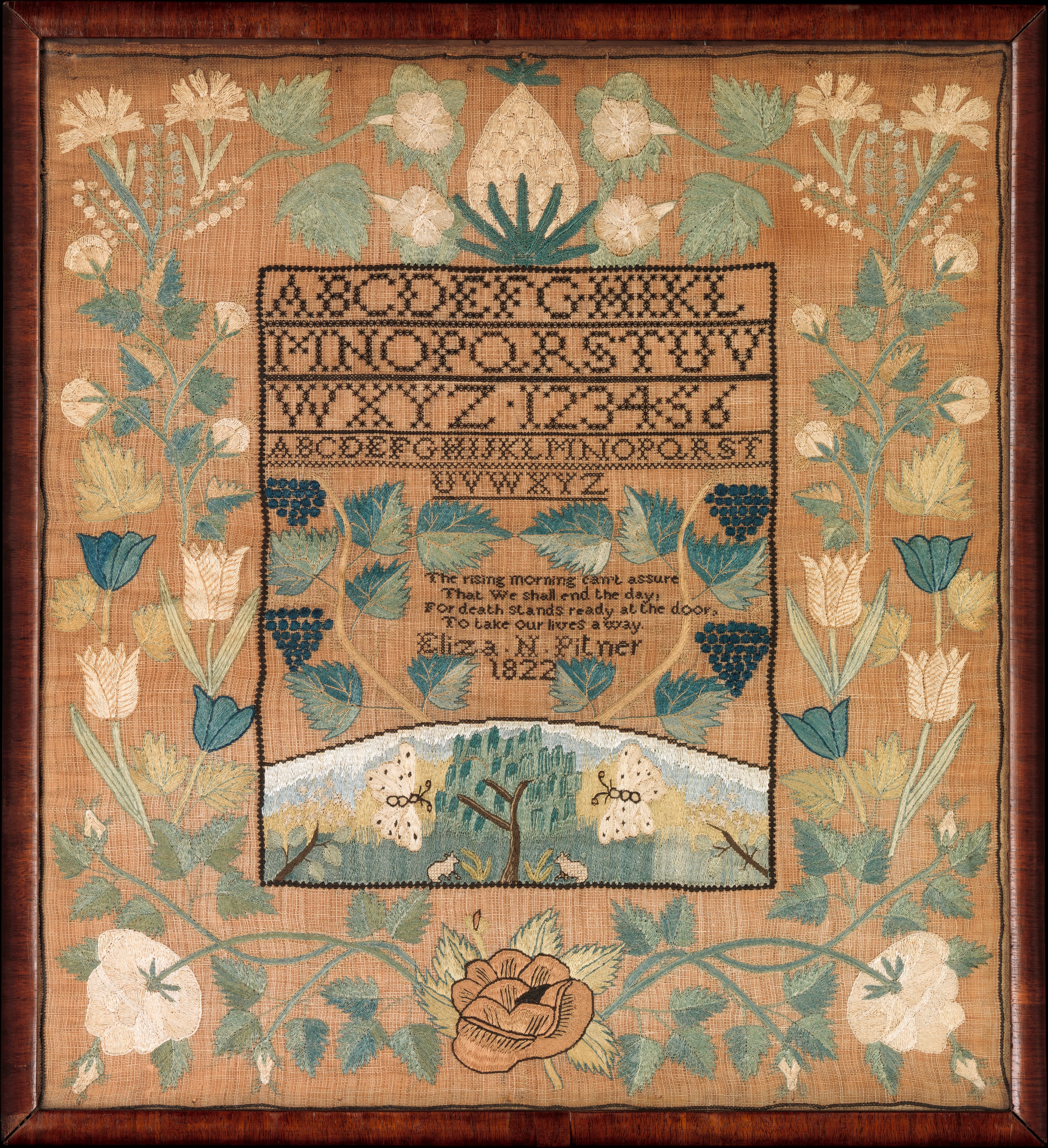
The Sampler Unbound: Deconstructing Archival Embroidery for SS26
In the relentless pursuit of the new, Zoey Fashion Laboratory often excavates the forgotten, the domestic, and the overtly sentimental. For the SS26 avant-garde study, we turn our attention to a singular, potent artifact: the American sampler. Historically relegated to the realm of juvenile instruction and feminine piety, this textile—a panel of silk embroidery on linen—is far from a quaint heirloom. It is, in its very construction, a proto-parametric diagram of order, repetition, and structural tension. Our analysis re-codes this artifact not as a relic of the past, but as a blueprint for a futuristic silhouette, a manifesto of deconstructive couture where every stitch is a structural seam and every motif a potential joint.
I. The Sampler as Architectural Blueprint: From Domestic Geometry to Wearable Structure
At first glance, the sampler presents a rigid, two-dimensional grid of alphabets, numerals, and moralizing verses. But within this apparent stasis lies a radical potential for futuristic silhouettes. The traditional cross-stitch and satin stitch are not merely decorative; they are systems of tensile strength and compression. For SS26, we propose a structural innovation that liberates these stitches from their flat plane. Imagine a garment where the linen ground is selectively dissolved or chemically treated to create negative space, leaving only the silk embroidery as a floating, three-dimensional lattice. The alphabet becomes a structural exoskeleton—a corset of letterforms that wraps the torso, its serifs and descenders forming articulated joints at the shoulders and hips. The sampler’s rigid geometry, once a symbol of control, is re-imagined as a biomimetic exoskeleton, where the repetition of motifs generates a flexible, armor-like silhouette that is both protective and fluid.
This is not a literal reproduction. We are not printing a sampler onto silk. Instead, we are extrapolating its construction logic. The sampler’s grid becomes a digital wireframe. The silk embroidery, traditionally worked in a single plane, is re-engineered as a series of tensioned panels. Using a technique of selective warp-and-weft removal, the linen background is eroded to reveal the embroidery as a suspended, almost holographic structure. The resulting silhouette is a study in negative space architecture—a dress that is both present and absent, defined by the voids between its stitched lines. The shoulder line, for instance, might be formed by a single, continuous alphabetic sequence that arcs over the deltoid, its letters graded in size to create a sculptural, asymmetric shoulder. This is deconstructive aesthetics at its most rigorous: the destruction of the sampler’s planar integrity to birth a new, volumetric form.
II. Material Alchemy: Silk Embroidery as a Futuristic Substrate
The materiality of the sampler—silk on linen—is a dialogue between the precious and the humble. Silk, with its lustrous, proteinaceous fiber, offers a unique structural potential when subjected to tension and heat. For SS26, we propose a thermoforming process where the silk embroidery is treated with a resin that, when heated, allows the thread to be permanently set into sculptural, three-dimensional curves. The linen ground, conversely, is treated as a sacrificial layer. After the silk motifs are thermoset into their new, volumetric configuration, the linen is dissolved using a cellulose-specific enzyme bath. What remains is a free-standing, thread-based sculpture—a garment that is literally woven air, its silhouette defined by the memory of the embroidery’s original placement.
This process yields a futuristic material state: a textile that is no longer a cloth but a three-dimensional mesh of silk. The traditional sampler’s colors—faded indigos, madder reds, and ochre yellows—are preserved but become translucent as they are suspended in space. The result is a garment that appears to be digitally rendered yet is entirely handcrafted. The silhouette is both rigid and ethereal—a paradox of strength and fragility. The shoulder, for example, might be a cantilevered arc of alphabet, each letter a load-bearing element, while the hem dissolves into a cascade of unanchored, floating stitches. This is not a dress that clings; it is a dress that occupies space as a distinct architectural volume.
III. The Deconstructive Silhouette: Asymmetry, Dissolution, and the Re-Coded Body
The structural innovation of the sampler study culminates in a silhouette that rejects the conventional body envelope. The sampler’s inherent bilateral symmetry—a hallmark of its instructional origin—is deliberately fractured. We propose a radical asymmetry where one half of the garment is a dense, almost opaque field of embroidery (the “archive”), while the other half is a near-complete dissolution of the linen, leaving only a few floating threads (the “erasure”). This creates a silhouette that is half-solid, half-ghost, a visual representation of memory and loss. The waist is not cinched but implied by a diagonal band of numerals that spiral around the torso, their increasing scale creating a forced perspective that elongates the form.
The sleeves, if they can be called that, are exoskeletal appendages. Using the sampler’s alphabetic sequences as a guide, we construct a sleeve that is a continuous, spiraling ribbon of silk thread, beginning at the shoulder and ending in a free-floating, calligraphic flourish at the wrist. This is a futuristic silhouette that references both medieval armor and digital wireframe modeling. The garment does not follow the body; it re-defines the body’s boundaries. The neckline is a negative space collar formed by a ring of letterforms that float a centimeter away from the skin, creating a halo of text. This is deconstructive aesthetics as a form of cyborgian re-coding—the body is not nude but is instead inscribed by the garment’s structural logic.
IV. Contextualizing the Standalone Study: A New Lexicon for Couture
This analysis of the American sampler is not a nostalgic exercise. It is a declaration of method. By treating a domestic artifact as a structural prototype, Zoey Fashion Laboratory establishes a new design vocabulary for SS26. The futuristic silhouettes we propose are not derived from science fiction but from the latent potential of historical craft. The structural innovation lies in the re-contextualization of stitch as joint, grid as exoskeleton, and thread as architectural member. This is avant-garde couture that operates at the intersection of archival preservation and radical destruction, where the sampler is both the source material and the sacrificial substrate for a new form of wearable architecture.
The result is a collection that is both deeply intellectual and viscerally physical. It challenges the wearer to inhabit a garment that is less a covering and more a habitable structure. The sampler, once a symbol of feminine domesticity, is reborn as a cyborgian interface between the body and the future. This is the definitive statement for SS26: a future built not on forgetting the past, but on deconstructing it to its molecular essence and re-assembling it into a new, unapologetically avant-garde form. The sampler is no longer a lesson in patience; it is a lesson in structural possibility.