Deconstructing the Tiraz: A Technical and Conceptual Analysis for Zoey Fashion Lab
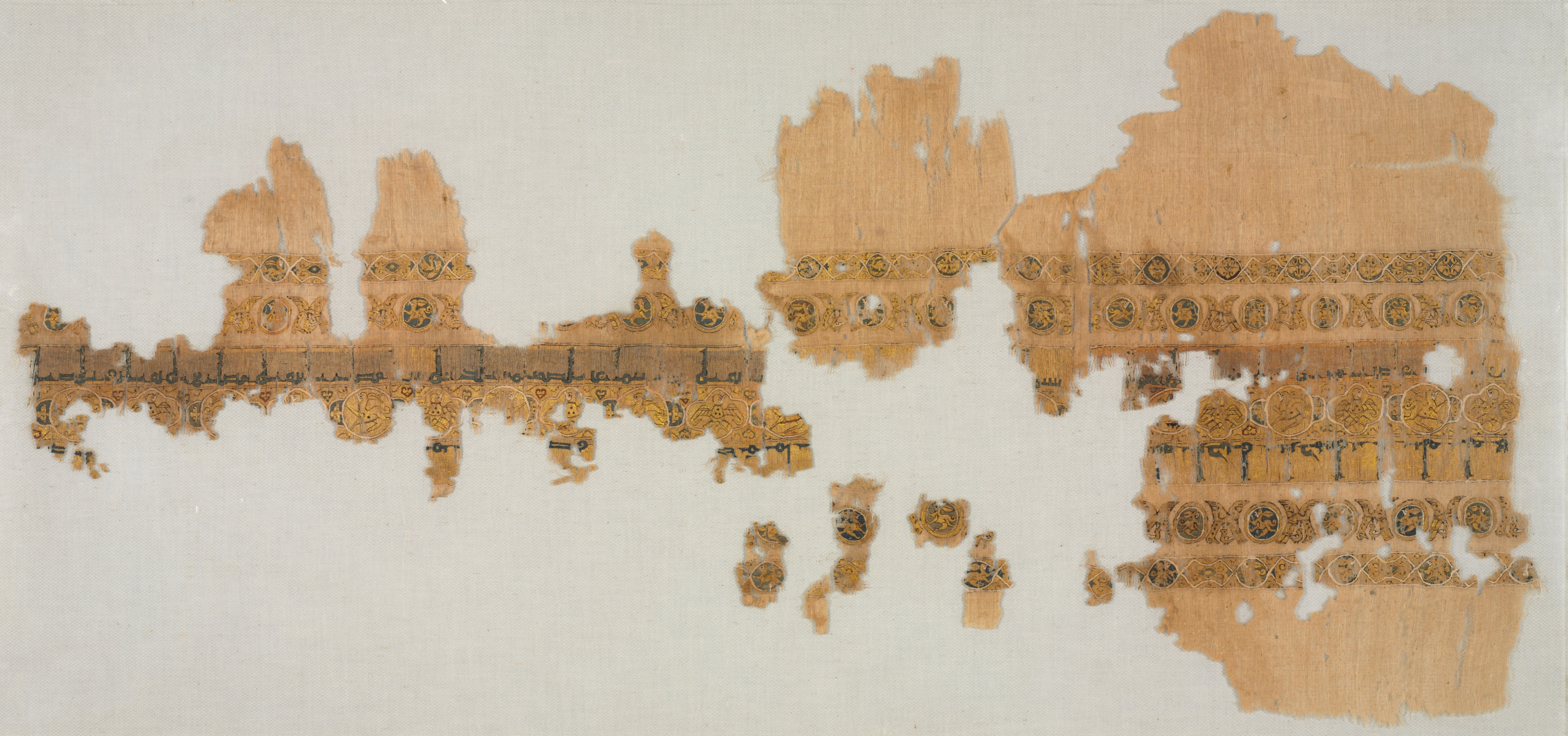
At Zoey Fashion Lab, we do not merely observe historical artifacts; we interrogate them, dismantling their material and symbolic structures to forge new avant-garde narratives. The subject of this analysis—a Tiraz textile fragment from the Fatimid period, specifically the reign of Caliph al-Musta‘lī (1094–1101), originating in Egypt—presents a profound case study. Its technical composition of plain weave linen interwoven with tapestry-woven silk and gold filé is not a static relic but a dynamic blueprint for deconstruction. This report will dissect the Tiraz’s materiality, its resonance with the provided reference—a mirror of gold-inlaid palmettes and a stone sarcophagus of narrative relief—and propose a radical, avant-garde reinterpretation for the Lab’s future collections.
Material Archaeology: The Tiraz as a Contradiction in Weave
The Tiraz is a fabric of deliberate dualities. The plain weave linen ground speaks to a foundational, utilitarian structure—the humble, undyed warp and weft of daily life in Fatimid Egypt. Yet, upon this stark field, the weaver introduced a violent luxury: tapestry-woven bands of silk, often in vibrant blues, reds, and greens, and the audacious inclusion of gold filé—a thread of fine gold strip wound around a silk core. This is not a gradual transition but a sharp, material rupture. The gold does not blend; it asserts itself, catching light and creating a shimmering, almost sculptural relief against the matte linen.
This technical contradiction mirrors the reference’s first image: “一面是光洁银镜上以黄金镶嵌的纷繁棕叶纹” (“on one side, a polished silver mirror with intricate palm leaf patterns inlaid in gold”). The Tiraz’s gold filé functions as that inlay, a precious intrusion into a reflective, yet unadorned, surface. The linen is the silver mirror—neutral, receptive, and capable of reflection only when disrupted. The tapestry-woven motifs, typically epigraphic bands of caliphal names or blessings, along with stylized palmettes and vegetal scrolls, become the “纷繁棕叶纹” (intricate palm leaf patterns). The Tiraz is not a fabric; it is a wearable mirror, a surface that declares power through the strategic placement of precious material. For Zoey Fashion Lab, this suggests a deconstructive technique: weaving gold into a base fabric not as ornament, but as a structural interruption. We can imagine a garment where the gold filé is left unbound at the edges, fraying into the linen, creating a literal deconstruction of the pattern’s integrity.
Narrative Threads: The Sarcophagus of the Fabric
The Tiraz’s second layer of meaning emerges from its historical function. These textiles were not merely decorative; they were khil‘a—robes of honor bestowed by the caliph. Wearing the Tiraz meant wearing the caliph’s authority, his name woven into the very fabric of your identity. This transforms the textile into a document of power, a woven decree. The reference’s second image—“另一面是冰冷石棺板上以浮雕诉说的生命叙事” (“on the other side, a life narrative told in relief on a cold stone sarcophagus”)—is a perfect parallel. The Tiraz is a fabric sarcophagus. It embalms the caliph’s legitimacy, his reign, and his political theology within its threads. The tapestry-woven inscriptions are the relief carvings, telling a story of divine right and earthly dominion. The “cold stone” is the linen ground, the immutable, silent support upon which this narrative is etched.
However, the Tiraz is a sarcophagus that was meant to be worn, to be animated by the living body. This creates a powerful tension: the static, commemorative weight of the inscription versus the dynamic, fleeting life of the wearer. For the avant-garde, this is a rich seam to mine. We can deconstruct the “life narrative” by fragmenting the inscription. Instead of a continuous band, the caliphal name can be broken, misaligned, or woven in reverse, suggesting a narrative that is not linear but fractured, a memory being erased or rewritten. The gold filé, once a symbol of eternal power, can be tarnished, oxidized, or woven in such a way that it appears to be bleeding into the linen, a metallic wound on the fabric’s surface. This is not disrespect to history but a rigorous engagement with its material consequences.
Avant-Garde Application: The Deconstructed Tiraz Collection
Zoey Fashion Lab’s interpretation of this Tiraz must reject mere historical reproduction. We propose a collection titled “Al-Musta‘lī’s Shroud.” The core concept is the fabric as a contested surface, a site where power, luxury, and decay coexist.
Technique 1: The Incomplete Inlay. Garments will be constructed from a base of raw, unbleached linen—the “silver mirror.” The gold filé will be applied not as perfect tapestry bands, but as “incomplete inlays.” Using a technique inspired by cutwork and burnout, sections of the linen will be removed, and the gold filé will be woven into the resulting voids, but left with loose, dangling ends. This mimics the reference’s “gold inlay” but introduces a sense of fragility and impermanence. The “intricate palm leaf patterns” will be suggested, not fully rendered, leaving the viewer to complete the motif in their mind.
Technique 2: The Fractured Narrative. The caliphal inscription will be deconstructed into a typographic error. Using a jacquard or hand-manipulated weave, the silk threads carrying the inscription will be broken, twisted, or woven in a contrasting direction. The text will become illegible, a visual noise that speaks to the erosion of absolute power. This is the “relief on a cold stone sarcophagus” that has been weathered by time. The garment will look as though it has been excavated, the narrative partially erased by the centuries.
Technique 3: The Gold as Wound. The gold filé will be treated as a material of violence. In certain sections, the gold thread will be woven so densely that it creates a stiff, almost metallic plate—a “gold scab” on the soft linen. This references the Tiraz’s dual nature as both honor and control. The garment will feel heavy, uneven, and uncomfortable, forcing the wearer to acknowledge the weight of the history they are carrying. The “polished silver mirror” is thus scarred, its reflective surface compromised by the very gold that was meant to embellish it.
Conclusion: Resonance and Rupture
The Fatimid Tiraz with gold is not a dead artifact. It is a resonant field, vibrating with the tensions of its creation: utility versus luxury, text versus texture, power versus decay. The reference provided—the mirror of gold inlay and the sarcophagus of narrative relief—is not a comparison but a conceptual key. It unlocks the Tiraz’s potential as a source for avant-garde deconstruction. Zoey Fashion Lab will not replicate the Tiraz; we will rupture it. We will take its plain weave and make it unplain, take its gold and make it bleed, take its narrative and make it scream. The final garment will be a wearable ruin, a testament to the fact that even the most powerful narratives are woven on a fragile ground, and that true luxury lies not in preservation, but in the courage to deconstruct.