Deconstructing the Goryeo Chrysanthemum: An Avant-Garde Analysis of a Celadon Bottle
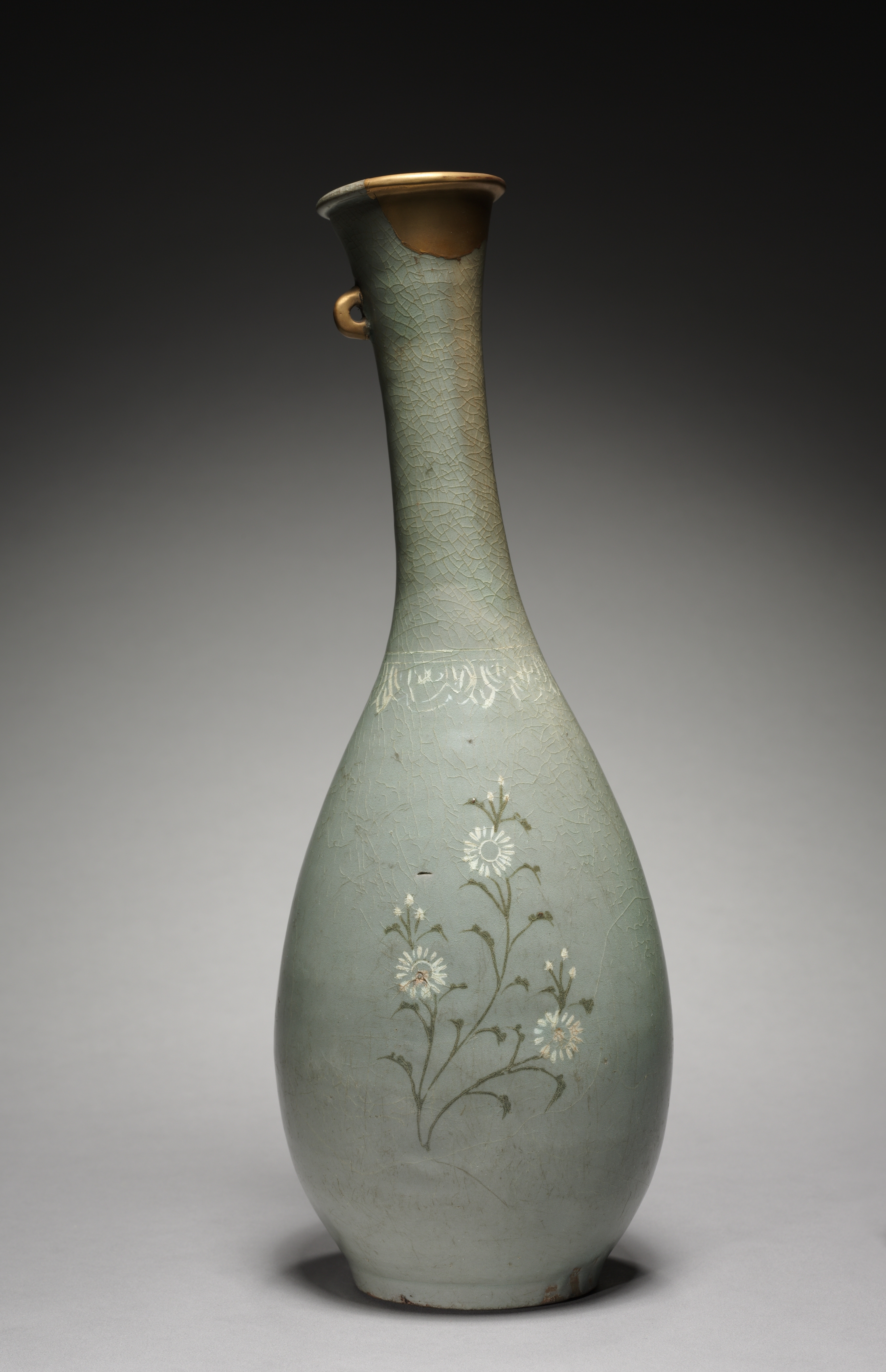
At Zoey Fashion Lab, we operate on the principle that historical artifacts are not relics to be preserved in amber, but rather resonant archives of material intelligence. The subject of this analysis—a bottle from Korea’s Goryeo dynasty (918–1392), rendered in celadon ware with inlaid white and black slip decoration and featuring a chrysanthemum design—is no exception. While conventional art history might classify this piece as a pinnacle of Korean ceramic refinement, our deconstructionist lens views it as a precocious avant-garde manifesto. The bottle’s technical execution, symbolic language, and material presence anticipate radical design principles that would not be articulated in the West for centuries. We will dissect this object through three primary vectors: the inlay as a subversive surface strategy, the chrysanthemum as a temporal signifier, and the celadon glaze as a liminal medium.
The Inlay as Subversive Surface: A Proto-Graphic Intervention
The technical hallmark of this Goryeo bottle is its sanggam inlay technique—white and black slip meticulously carved into the clay body before glazing. To the uninitiated, this appears as delicate ornamentation. To the Chief Fabric Deconstructionist, it is a violent yet precise act of surface rewriting. The inlay does not merely decorate; it cuts into the ceramic flesh, creating a permanent scar that is then healed by the translucent glaze. This is not additive decoration, but subtractive and then additive—a process of removal and replacement that mirrors the deconstruction of a garment’s original textile to reveal the structural bones beneath.
Consider the avant-garde parallel: In fashion, the 1990s Belgian deconstructionists (Martin Margiela, Ann Demeulemeester) used exposed seams, raw hems, and inverted linings to reveal the construction process. The Goryeo inlay does the same, but in ceramic. The black and white slip acts as a graphic inscription on a monochrome field, a proto-typographic gesture that predates modern graphic design by centuries. The chrysanthemum motif is not painted on the surface; it is embedded within the material itself. This is a radical statement: the design is not a superficial layer that can be removed, but an integral part of the object’s DNA. For Zoey Fashion Lab, this inspires a philosophy of embedded ornament—where pattern is not applied to fabric but woven into its very structure, like a jacquard that reveals its logic only upon close examination.
The Chrysanthemum as Temporal Signifier: A Poetics of Decay and Resilience
In the Goryeo context, the chrysanthemum is a symbol of longevity, autumn, and scholarly retreat. But our avant-garde reading subverts this. The chrysanthemum, with its complex, layered petals, is a visual representation of entropy. It is a flower that blooms late, often in the face of frost, and its intricate geometry suggests both order and chaotic proliferation. On this bottle, the inlaid chrysanthemum is not a static image; it is a frozen moment of becoming. The white slip petals curl and overlap, creating a dense, almost fractal pattern that resists easy reading. This is not a flower to be admired, but a system to be decoded.
Referencing the Archive Resonance note—"一面是光洁银镜上以黄金镶嵌的纷繁棕叶纹,另一面是冰冷石棺板上以浮雕诉说的生命叙事" (one side a smooth silver mirror with intricate palm leaf patterns inlaid in gold, the other a cold stone coffin board telling a life narrative in relief)—we see a parallel dualism. The Goryeo bottle’s chrysanthemum is both the mirror of beauty and the coffin of time. Its inlay is a form of fossilization, preserving a living form in a state of permanent aesthetic arrest. For a fashion lab, this suggests a design strategy where motifs are not merely decorative but act as memento mori. A garment might feature a chrysanthemum pattern that, upon closer inspection, reveals itself to be a diagram of decay—petals that morph into skeletal structures, or a print that fades from full bloom to wilted form as it travels across the fabric. This is narrative wear, where the garment tells a story of time passing, not just of static beauty.
Celadon Glaze as Liminal Medium: The Skin Between Worlds
The celadon glaze of this bottle is not a mere coating; it is a liminal membrane. Its characteristic jade-green hue, achieved through iron oxide reduction in a kiln atmosphere, is a chemical accident turned aesthetic triumph. The glaze is translucent, allowing the inlaid slip to show through, but it also distorts and softens the design, creating a visual depth that shifts with light and angle. This is the skin of the object, a living surface that breathes with the viewer’s movement.
In avant-garde fashion, the analogous concept is the transparent or semi-transparent layer—sheer organza, layered mesh, or resin-coated textiles. The celadon glaze performs the same function: it mediates between the viewer and the underlying structure. It is both a reveal and a conceal. The chrysanthemum is visible, but never fully; it is always seen through the filter of the glaze’s color and texture. This creates a haptic visuality—the viewer is compelled to touch, to look closer, to understand the depth. For Zoey Fashion Lab, this inspires a design language of veils and thresholds. A garment might have an outer layer of translucent material that partially obscures a dense, inlaid pattern beneath, forcing the wearer and observer to engage in a dialogue of discovery. The surface is never final; it is always a negotiation between the seen and the unseen.
Synthesis: The Bottle as Avant-Garde Prototype
To conclude, this Goryeo celadon bottle is not a historical artifact; it is a prototype for a design philosophy that Zoey Fashion Lab seeks to amplify. Its embedded graphic inlay prefigures modern textile construction techniques that integrate pattern into structure. Its chrysanthemum as a temporal signifier challenges us to design garments that acknowledge decay and narrative. Its celadon glaze as a liminal medium pushes us toward surfaces that are interactive, translucent, and depth-creating.
In deconstructing this bottle, we have not destroyed it. We have unlocked its resonance. It speaks to us across centuries, not as a relic of a past golden age, but as a contemporary voice in the ongoing conversation about material, surface, and time. The bottle is a mirror—not of the Goryeo court, but of our own avant-garde ambitions. It is a cold stone coffin that tells a life narrative, but that narrative is still being written, in the fabric of our future collections. The chrysanthemum is not dead; it is inlaid into our design DNA, waiting to bloom again.