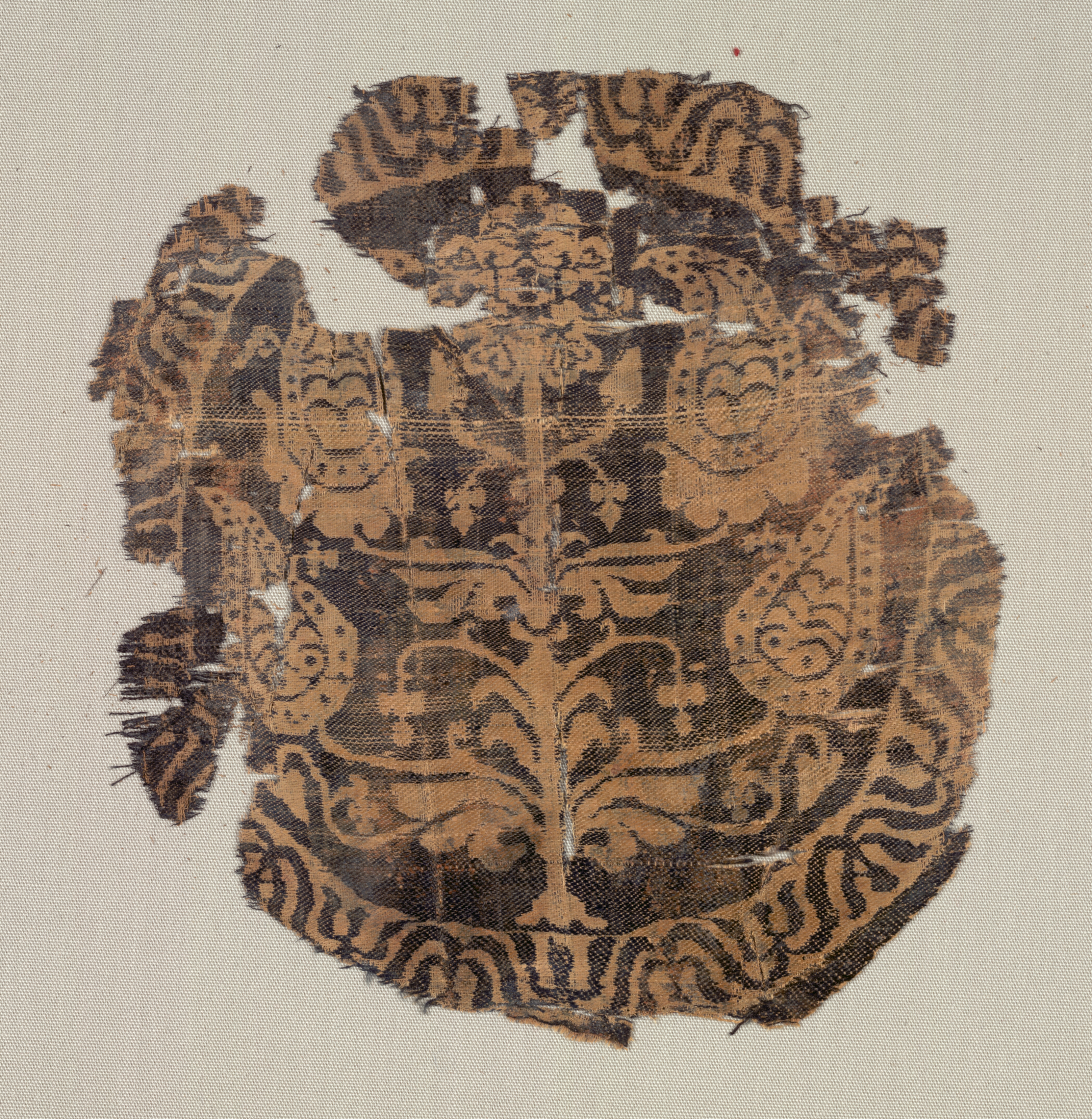
Deconstructing the Sacred Geometry: The Roundel with Curvilinear Palmette Tree as an Avant-Garde Catalyst
At Zoey Fashion Lab, we view historical textiles not as relics to be preserved under glass, but as blueprints for rebellion. The subject of this analysis—a silk roundel featuring a curvilinear palmette tree, woven in a complementary weft-faced twill with inner warps (samite), and attributed to 16th–17th century Egypt or Syria—presents a profound opportunity for deconstruction. This object, a fragment of a tunic, embodies a moment of intense cultural synthesis. Its technical mastery, symbolic density, and geometric precision are precisely the elements we seek to shatter and reassemble through an avant-garde lens. By dissecting its materiality, its structural logic, and its historical resonance, we can extract a lexicon of forms and techniques that challenge contemporary fashion’s obsession with flatness and speed.
Material Memory: The Politics of Samite and Silk
The choice of silk as the primary fiber is not merely a matter of luxury; it is a statement of global connectivity. In the 16th–17th centuries, silk was the currency of empires, traveling from China through the Safavid and Ottoman domains into Mamluk Egypt and Syria. For our avant-garde practice, silk becomes a medium of tension. Its natural luster and drape are often associated with femininity and delicacy, yet the samite weave—a compound structure with inner warps that create a dense, almost rigid fabric—subverts this expectation. The fabric is armor-like, a protective shell for the body, while simultaneously being supple enough to follow the contours of a tunic.
The technique of complementary weft-faced twill with inner warps is a marvel of pre-industrial engineering. It allows for intricate, polychrome patterns without the constraints of a simple warp-faced weave. The wefts, often of different colors, are floated across the surface, while the inner warps remain hidden, providing structural integrity. This is a hierarchical system: the visible wefts are the stars, the inner warps the silent laborers. In our avant-garde deconstruction, we would invert this hierarchy. Imagine exposing those inner warps, deliberately cutting the wefts to create frayed, linear scars that reveal the fabric’s internal skeleton. This act of exposure transforms a finished object into a process, a diagram of its own making.
Geometry of the Sacred: The Curvilinear Palmette Tree
The roundel’s central motif—a curvilinear palmette tree—is a symbol of eternal life, fertility, and paradise, common to Persian, Byzantine, and Islamic art. The palmette, a stylized fan-shaped leaf, is combined with a tree form, creating a microcosm of the universe. The curvilinear lines are not arbitrary; they follow a strict geometric logic, often based on a hidden grid of circles and intersecting arcs. This is sacred geometry, a visual language that speaks of cosmic order.
For Zoey Fashion Lab, this geometry is a constraint to be broken. The roundel’s perfect circularity—a closed, self-contained universe—is antithetical to the avant-garde’s embrace of the fragmentary and the incomplete. We would cut the roundel, not along its edges, but through its center, creating a spiral or a radial explosion. The curvilinear palmette tree would be abstracted into its constituent lines—the arcs, the lobes, the stems—and these lines would become appliquéd tendons or embroidered scars on a garment. The tree, once a symbol of rootedness, becomes a symbol of rootlessness, of migration and hybridity.
Cultural Collision: The Archive Resonance
The “Archive Resonance” note situates this object in the 16th–17th centuries, a period of intense cultural collision between the Islamic world, the European Renaissance, and the expanding Ottoman Empire. The tunic from which this roundel came was likely worn by a person of high status, perhaps a courtier or a religious figure. The silk itself may have been woven in one city, the roundel embroidered or applied in another, and the garment assembled in a third. This is a global object before globalization.
Our avant-garde interpretation must honor this hybridity. We reject the notion of cultural purity. Instead, we see the roundel as a node in a network of exchange. The curvilinear palmette tree, for instance, can be traced back to the ancient Assyrian tree of life, then through Sasanian Persia, into Umayyad and Abbasid art, and finally into Mamluk and Ottoman textiles. Each iteration adds a layer of meaning. For our design, we would layer multiple roundels of different scales and origins—some intact, some fragmented—on a single garment, creating a palimpsest of histories. The tunic itself would be constructed from a patchwork of silks, each with its own story, stitched together with visible, contrasting threads.
Deconstructive Techniques: From Samite to Skin
The technical specifics of the samite weave offer a rich vocabulary for avant-garde manipulation. The complementary weft-faced structure means that the pattern is created by the wefts, not the warps. This is a surface-oriented technique. To deconstruct it, we would reverse the figure-ground relationship. Instead of the palmette tree being the positive space, we would cut away the background wefts, leaving the tree as a floating, skeletal lattice. The inner warps, now exposed, would become a grid of fine lines, reminiscent of a digital pixelation or a scientific diagram.
Furthermore, the curvilinear nature of the palmette tree is a challenge to the straight lines of modern tailoring. We would use this to create asymmetric draping, where the garment’s seams follow the curves of the original motif. A sleeve might be cut to mimic the lobe of a palmette, or a collar might spiral outward like a vine. The body becomes the canvas for this geometry, not a passive mannequin but an active participant in the design’s unfolding.
Avant-Garde Manifesto: The Roundel as Rupture
In conclusion, the roundel with curvilinear palmette tree is not a finished object but a starting point for rupture. Zoey Fashion Lab’s methodology is to treat every historical artifact as a set of instructions for its own destruction and rebirth. The silk’s luster becomes a metaphor for illusion; the samite’s density becomes a metaphor for resistance; the palmette tree’s symmetry becomes a metaphor for order to be disrupted.
Our final garment would be a tunic that is not a tunic—a deconstructed, asymmetrical piece that exposes its own construction. The roundel would be present not as a whole but as a series of fragments: a piece here, a thread there, a ghost of a pattern in a sheer layer. The curvilinear lines would be echoed in the cut, the weave, the embroidery. This is not appropriation; it is dialogue. We speak to the 16th-century weaver through the language of the 21st-century avant-garde, acknowledging that the sacred and the profane, the geometric and the organic, the historical and the futuristic, are all part of the same continuous, unfinished fabric.