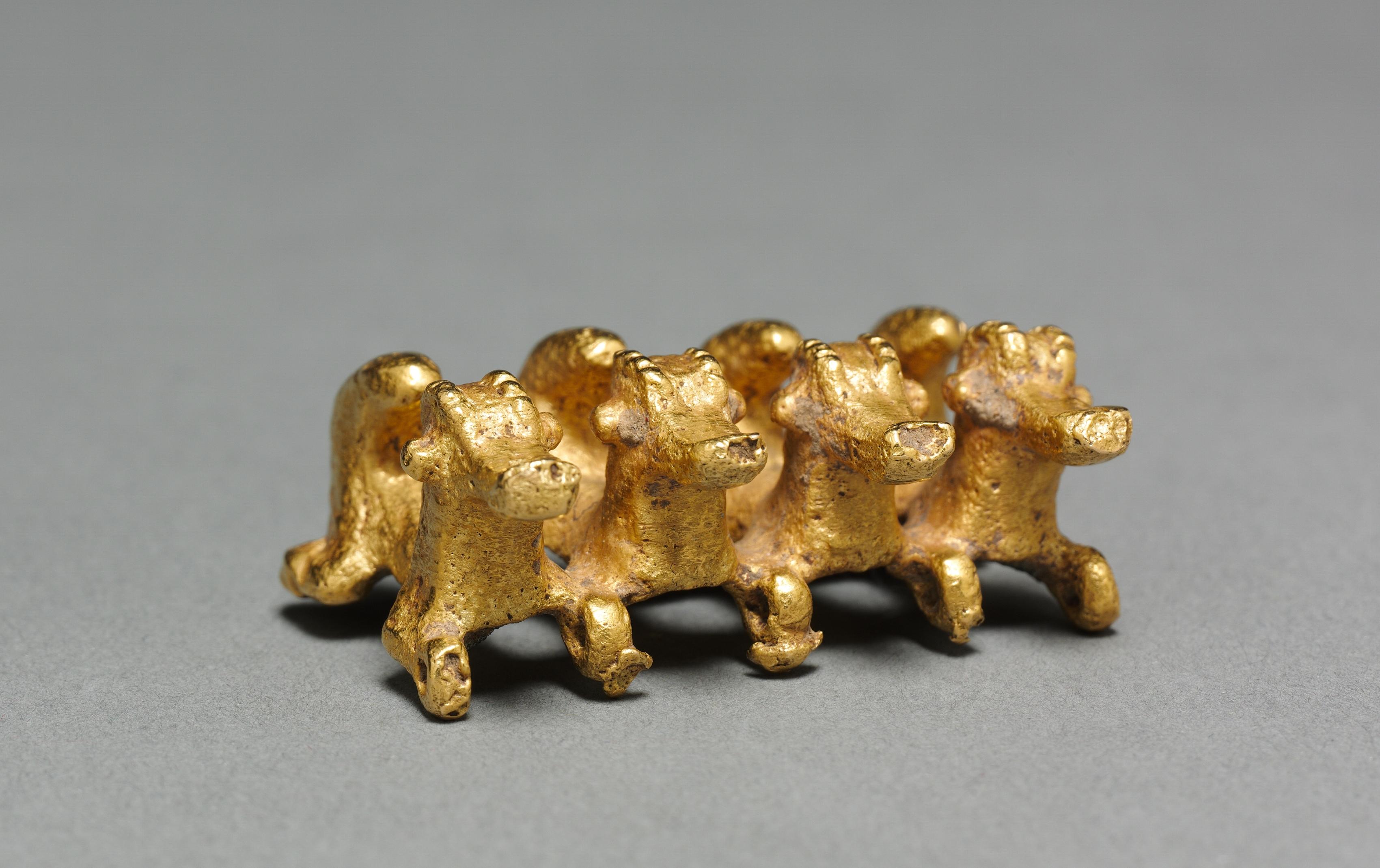
Executive Analysis: Curly-Tailed Animal Pendant
Subject: Curly-Tailed Animal Pendant
Origin & Initial Style: Panama, Pre-Columbian (likely Coclé or Veraguas region, 8th-10th century CE)
Technical: Hammered and cast tumbaga (gold-copper alloy), with potential lost-wax casting elements.
Reference Resonance: Archive Object: Mirror with Split-Leaf Design – Juxtaposition of reflective adornment (gold on silver) and mortal narrative (relief on stone).
Proposed Style Direction: Avant-Garde
1. Origin Deconstruction: The Duality of Panamanian Gold
The artifact’s Panamanian origin is not merely a point of provenance but a foundational narrative of duality. In the pre-Columbian societies of the Isthmus, gold (tumbaga) was never purely decorative; it was a substance of transformative power. Worn by elite warriors and shamans, it served as a brilliant, solar mirror to the spiritual world, while simultaneously signifying temporal authority and martial prowess. The "curly-tailed animal"—likely an opossum, a coati, or a stylized saurian—exists within this dual state. It is both a naturalistic representation from a biodiverse region and a mythological psychopomp, a creature guiding souls between worlds. The pendant, therefore, is an object of journey and transition, its form caught between the terrestrial and the celestial, much like the referenced mirror’s duality of surface reflection and subterranean narrative.
2. Technical & Material Deconstruction: The Alchemy of Tumbaga
The specification "gold" is technically precise yet materially reductive. The medium is almost certainly tumbaga, a gold-copper alloy prized for its malleability and its capacity for mise-en-couleur—a depletion gilding process where the surface copper is oxidized and removed, leaving a pure, porous gold layer that can be burnished to a high sheen. This technical process is a profound metaphor. The core material is a hybrid, a fusion. The finished surface is a brilliant, deceptive façade masking a tougher, more resilient interior. This directly mirrors the Archive Resonance: a "gilded mirror" versus a "cold stone sarcophagus." The pendant’s form, achieved through hammering and likely complex lost-wax casting for details, encapsulates a hidden strength beneath a radiant skin. The curl of the tail is not merely decorative; it is a testament to the artisan’s understanding of tensile form and structural integrity in a malleable medium.
3. Narrative Resonance & Symbolic Architecture
The pendant’s power lies in its condensed narrative. The animal’s posture—often in a curled, self-contained, yet dynamic loop—speaks of protection, cyclicality, and eternal return. The tail, specifically, is a focal point of energy, a coiled spring of potential motion. This creates a narrative of contained force. When viewed through the lens of the Archive reference, we can deconstruct its symbolic architecture into two faces:
Face A (The Gilded Mirror): The burnished, depleted-gilded surface. This is public-facing brilliance, status, and solar reflection. It is about perception, light, and the visible world. The intricate patterns possibly etched or embossed on the animal’s form (suggested by "纷繁棕叶纹" or intricate frond patterns) act as a dazzling, hypnotic text.
Face B (The Stone Sarcophagus): The underside, the form itself, the cold weight of the alloy. This is the mortal narrative: the animal as guardian of death, the journey through the underworld, the raw, un-gilded truth of materiality and function. The "relief" is the three-dimensional sculpture of the creature, its story told not in reflected light but in shadow, volume, and tactile presence.
4. Avant-Garde Style Synthesis: The Zoey Fashion Lab Proposition
Translating this artifact into an avant-garde context requires moving beyond literal replication. We must synthesize its core dualities into a contemporary idiom. The Avant-Garde direction is not "tribal chic"; it is archaeological futurism.
Proposed Design Manifesto:
1. Material Dialectics: Juxtapose high-polish, mirror-finish gold (or recycled stainless steel with PVD gold coating) against matte, textured, "cold" materials: sintered titanium, basalt-infused resin, or recycled carbon fiber. Each piece should have a "Face A" and a "Face B," literally or metaphorically. A pendant might be smooth gold on one side and intricately laser-etched, stone-like texture on the reverse.
2. Form as Narrative: The "curly-tailed" form should be abstracted into a topology of protection and energy. Think not of an animal, but of a möbius strip of bestial energy, a coiled, asymmetric form that seems to turn in on itself. Use parametric modeling to create forms that appear woven or grown, referencing both organic life and digital genesis.
3. Wearable Archaeology: Incorporate the concept of mise-en-couleur into the finishing process. Patinas could be selectively applied and removed, revealing glimpses of underlying material, creating a "stratigraphy" on the object’s surface. Pieces could be modular, allowing the wearer to "assemble" their narrative—attaching or detaching tail curls, altering the play of light and shadow.
4. Contextual Dissonance: Style these pieces not with raw linen and leather, but with hyper-synthetic fabrics—liquid-effect metallics, molded neoprene, or 3D-knitted textiles. The contrast echoes the original dissonance between a living, breathing shaman in a humid jungle wearing a blinding, solar metal. The modern analogue is the human body amidst the digital and concrete landscape, adorned with fragments of re-contextualized ancient power.
Conclusion: From Artifact to Archetype
The Curly-Tailed Animal Pendant is a seed. Its Panamanian origin provides the genetic code of duality—life/death, light/stone, surface/depth. The technical mastery of tumbaga work offers a philosophy of transformative materiality. For Zoey Fashion Lab, the avant-garde path forward is to perform a conceptual depletion gilding on the artifact itself. Strip away the literal historicity to reveal the porous, potent archetype beneath: the Guardian Form, the Coiled Narrative, the Duality Object. The final collection should feel like excavated artifacts from a future anthropology, where ancient symbolic resonance has been fused with post-human materiality, creating talismans for a world that is itself split between the mirrored surface of the digital and the cold, hard substrate of the real.