Deconstructing the Vessel: The Vase en tour as a Blueprint for SS26 Structural Innovation
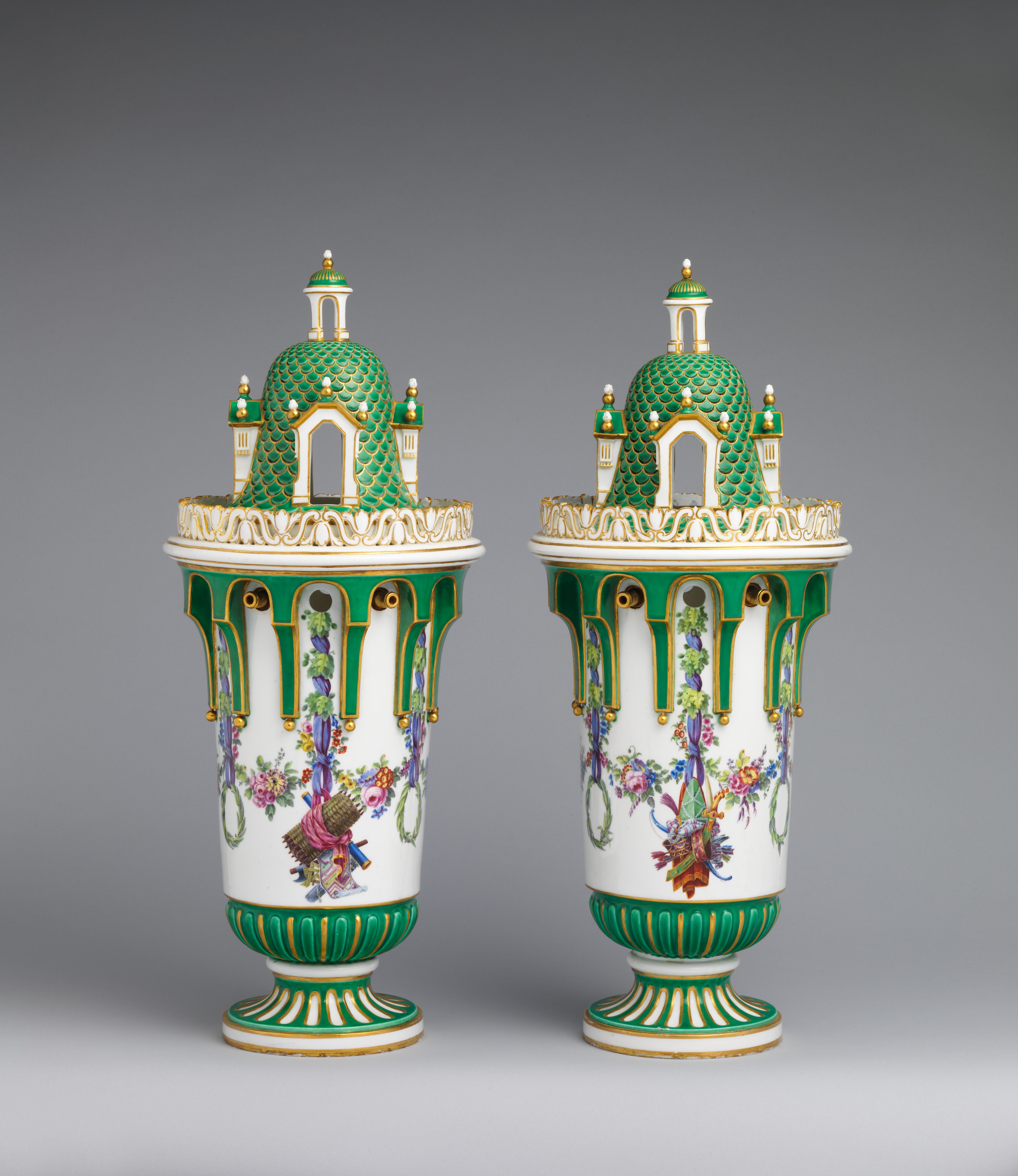
In the crucible of contemporary fashion, where the boundaries between art, architecture, and apparel dissolve, the Vase with cover (Vase en tour) emerges as an unlikely yet profoundly resonant artifact. At first glance, this soft-paste porcelain object—a relic of decorative opulence—appears antithetical to the kinetic, deconstructive ethos of Zoey Fashion Laboratory. Yet, upon deeper analysis, the vase’s formal vocabulary—its polychrome enamels, gilded contours, and volumetric tension—offers a radical lexicon for SS26. This is not a study in nostalgia; it is a manifesto for a future where the body becomes a living vessel, and the garment, a mutable architecture of porcelain-like precision.
Soft-Paste Porcelain as a Metaphor for Structural Fluidity
The materiality of soft-paste porcelain—fragile yet deliberate, luminous yet opaque—serves as the foundational allegory for our SS26 design philosophy. Unlike hard-paste porcelain, which is rigid and brittle, soft-paste porcelain possesses a latent pliability during its formation, a quality that mirrors the avant-garde pursuit of garments that are both structured and yielding. For the Zoey Fashion Laboratory, the vase’s surface, decorated in polychrome enamels, becomes a canvas for chromatic tension. The interplay of gold accents against the white body suggests a future where garments are not merely colored but enameled—where pigment is fused into the textile’s molecular structure, creating a luminescent, almost ceramic finish. This technique, when translated into high-tech fabrics like thermochromic polyesters or laser-sintered nylon, allows for a dynamic color palette that shifts with body heat and ambient light, echoing the vase’s original decorative intent while subverting its static nature.
Futuristic Silhouettes: The Vessel as Wearable Architecture
The Vase en tour’s silhouette—a tapered, swelling form with a distinct neck and a domed cover—directly informs our proposal for modular, volumetric garments. The vase’s negative space, the void within its walls, becomes a critical design element. In SS26, we envision a collection of inflatable, pneumatically structured coats that mimic the vase’s curvilinear profile. These garments, constructed from ultra-lightweight, air-woven composites, can be inflated to create dramatic, sculptural shoulders and torsos, then deflated for flat-pack transport. The cover, or lid, is reinterpreted as a detachable headpiece—a translucent, domed visor that refracts light through embedded micro-LEDs, referencing the gilded detailing of the original. The resulting silhouette is both protective and theatrical, a wearable vessel that shelters the wearer while announcing their presence as a living artifact.
Deconstructive Aesthetics: Fracturing the Porcelain Ideal
True avant-garde practice demands a rupture with the original object’s integrity. The Vase en tour, with its perfect, symmetrical form, is a tyranny of finish that must be deconstructed. We propose a series of garments where the porcelain surface is shattered and reassembled through laser-cut seams and exposed zippers. The polychrome enamels are fragmented into geometric patches of iridescent organza and metallic foil, applied asymmetrically across a base of bias-cut silk. The gold is not painted but embroidered in conductive threads, creating circuits that power embedded sensors. This is not a literal reproduction; it is a recontextualization where the vase’s decorative excess becomes a critique of luxury itself. The garment’s interior, often hidden, is revealed through transparent panels of recycled polycarbonate, exposing the structural seams and fastenings—a nod to the vase’s internal void and the honesty of construction that defines Zoey’s ethos.
Structural Innovation: From Ceramic Cast to Digital Knit
The Vase en tour’s manufacturing process—casting, firing, glazing—offers a blueprint for additive and subtractive fabrication in fashion. For SS26, we introduce a 3D-knitted textile system that replicates the vase’s graduated thickness. Using a multi-gauge digital knitting machine, we create zones of varying density: a dense, porcelain-like weave at the shoulders and hips, transitioning to a gauzy, open-knit structure at the waist and neck. This gradient not only mimics the vase’s swelling form but also allows for thermoregulation, where the open knit releases heat while the dense areas provide structure. The gold accents are electroless-plated onto the yarn, creating a metallic sheen that is both durable and flexible. The cover is reimagined as a magnetic, modular hood that can be attached to any garment in the collection, its dome shape realized through a molded, bio-resin composite that is both lightweight and shatter-resistant. This is structural innovation that honors the vase’s original craftsmanship while propelling it into a circular, tech-enabled future.
Chromatics of the Global Frontier: Polychrome in Motion
The Vase en tour’s polychrome palette—a symphony of cobalt, ochre, and emerald against a white ground—is not static. In our SS26 vision, these colors are kinetic. We employ embedded piezoelectric fibers that respond to movement, shifting the garment’s hue as the wearer walks. A slow, deliberate motion yields a deep cobalt; a rapid turn produces a flash of gold. This is a chromatic dialogue between the wearer and the environment, a living enamel that refuses to be fixed. The white ground of the vase is reinterpreted as a photoluminescent base layer that glows in low light, referencing the porcelain’s luminosity. The gold, traditionally a symbol of opulence, is democratized through recycled metallic microfibers that catch light without the weight of actual metal. The result is a polychromatic performance where the garment is never the same twice, echoing the vase’s original function as a vessel for display but now, for self-expression.
Conclusion: The Vessel Reborn
The Vase with cover (Vase en tour) is, in its original context, a symbol of static beauty—a decorative object meant to be admired from a distance. For Zoey Fashion Laboratory’s SS26 collection, it becomes a generative template for a new kind of wearable sculpture. By deconstructing its form, fracturing its surface, and re-engineering its materials, we transform the vase from a relic of the past into a prototype for the future. The garment is no longer a second skin; it is a living vessel that contains, protects, and reveals. The polychrome enamels are not merely decorative; they are responsive interfaces. The gold is not a signifier of wealth but of technological precision. In this analysis, the Vase en tour ceases to be a historical artifact and becomes a manifesto for structural innovation—a testament to the avant-garde’s power to find the future in the most unexpected of forms. The Global Frontier is not a place; it is a method. And the vase, now shattered and reassembled, is its most potent symbol.