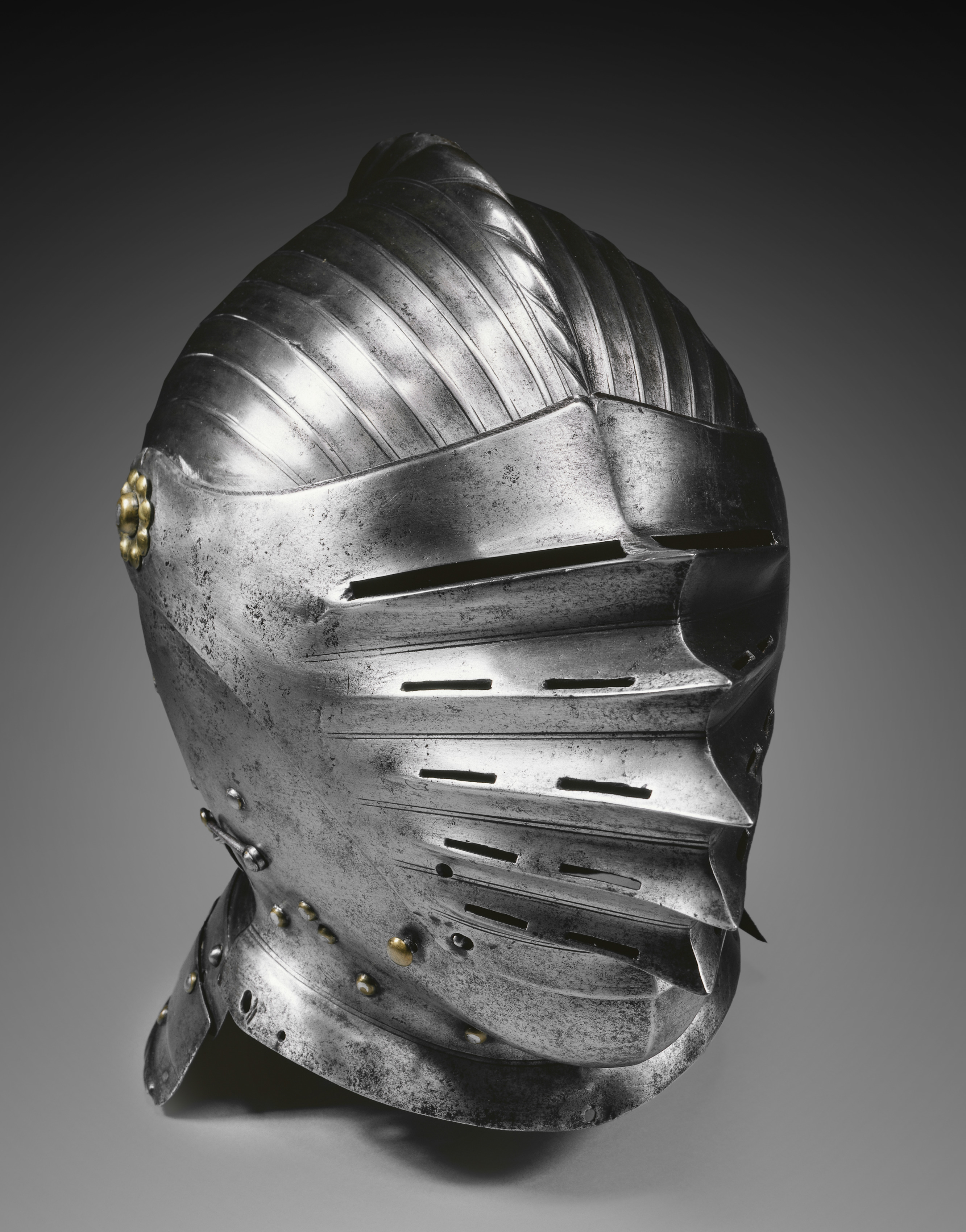
Deconstructing the Maximilian Close Helmet: An Avant-Garde DNA Analysis for Zoey Fashion Lab
At Zoey Fashion Lab, the act of deconstruction is not merely an analytical process; it is a re-codification of historical artifacts into new, living languages of style. The object under our microscope today is the Close Helmet in Maximilian Style, a masterpiece of German metallurgy from the early 16th century. Crafted from steel and brass, this object is far more than a piece of armor. It is a fossilized gesture of power, a sculptural treatise on protection, and a silent narrative of a warrior’s psyche. For the avant-garde designer, this helmet is not a relic; it is a New DNA Strand—a genetic blueprint for a future where fashion is both armor and art.
I. The Anatomical Blueprint: Steel, Brass, and the Architecture of the Self
The Maximilian style, named after the Holy Roman Emperor, is characterized by its distinctive fluting and rounded contours, designed to deflect blows while mimicking the idealized human form. The primary material, steel, represents absolute rigidity, resilience, and a cold, unyielding surface. The secondary material, brass, appears as an accent—typically on the borders, rivets, and visor hinges—introducing a warm, reflective contrast. In our deconstruction, this is not a simple metal pairing; it is a binary code: steel as the structure, brass as the signal.
From an avant-garde perspective, this helmet’s anatomy offers a radical proposition: the body is a fortress to be adorned, not hidden. The steel’s fluting is not merely functional; it is a rhythmic, sculptural pattern that prefigures modern pleating and structural seaming. The brass accents, often gilded, are early examples of metallic embroidery—a pre-industrial form of high-tech embellishment. For Zoey Fashion Lab, we see a direct lineage to contemporary armored dresses and utility vests, where hardware is not an afterthought but the foundational stitch. The helmet’s visor, with its horizontal slit, offers a terrifyingly beautiful abstraction of the human face—a mask for the digital age, where identity is both shielded and projected.
II. The New DNA Strand: Re-coding Historical Armor into Avant-Garde Textiles
The concept of a New DNA Strand is central to our methodology. We do not replicate; we transcribe. The Maximilian helmet’s DNA is composed of three core sequences: Rigidity (Steel), Reflectivity (Brass), and Rhythm (Fluting). Our task is to mutate these sequences into a contemporary fashion lexicon.
Rigidity becomes structural exoskeletons. Imagine a jacket where the shoulders are not padded but articulated with laser-cut stainless steel scales, echoing the helmet’s overlapping plates. The silhouette is sharp, unyielding, yet moves with the wearer—a paradox of hardness and fluidity. This is not a costume of a knight; it is a second skeleton for the modern warrior navigating urban landscapes.
Reflectivity evolves into dynamic light play. The brass accents, once static, are reimagined as electro-chromatic panels or iridescent polymer coatings. A dress that changes color in response to movement or ambient light pays homage to the helmet’s original function: to dazzle and intimidate on the battlefield. The brass’s warm glow becomes a biometric signature—a wearable interface that communicates status, mood, or intent.
Rhythm is transcribed into digital pleating and 3D-printed lattice structures. The helmet’s fluting is a repetitive, mathematical pattern. In our lab, this translates to algorithmic textile design. A skirt or a bodice can be constructed from thousands of micro-flutes, each one a node in a flexible, breathable mesh. The result is a fabric that holds its shape like armor but drapes like silk—a hybrid material that defies categorization.
III. The Avant-Garde Dialectic: Protection, Performance, and Provocation
In the avant-garde, fashion is never passive. The Maximilian helmet was designed for one purpose: to protect the wearer in combat. In our recontextualization, this protection is psychological, social, and digital. The helmet’s visor, which obscures the face, becomes a wearable privacy shield—a hood or a mask that filters both light and data. The brass rivets, which held the helmet together, become sensors and fasteners that connect the garment to a network, turning the wearer into a node of a collective consciousness.
This dialectic also explores the tension between the historical and the futuristic. The Maximilian style is deeply rooted in a specific time and place—the Holy Roman Empire, circa 1500. Yet its forms are timeless: the dome, the curve, the line. By extracting these forms and re-synthesizing them with cutting-edge materials (carbon fiber, memory alloys, bio-fabrics), we create a garment that is anachronistic in the best sense—it belongs to no single era but speaks to all. The result is a fashion that is performative armor, designed for the catwalk as a battlefield of ideas.
IV. Material Alchemy: From Forge to Fabrication
The technical process of creating this DNA strand requires a new kind of alchemy. The steel of the helmet is heavy, rigid, and unforgiving. Our avant-garde translation uses lightweight alloys and composite materials that mimic the visual weight of steel without the literal burden. The brass is replaced with gold-toned titanium or anodized aluminum, offering the same lustrous finish but with greater malleability and reduced mass.
The fluting, originally hammered into hot metal, is now achieved through 3D knitting or robotic folding. A single garment can incorporate hundreds of precisely calculated folds, each one a structural element that distributes tension and creates a dynamic silhouette. The helmet’s articulation—the way its visor pivots and its gorget moves—is translated into modular joinery. A sleeve can be detached, a collar can be raised, a skirt can be transformed from a stiff shell to a flowing train. This is fashion as transformative architecture.
V. Conclusion: The Helmet as a Mirror of the Future
The Close Helmet in Maximilian Style is a profound artifact. It speaks of a world where craftsmanship was the highest form of technology, where the body was a sacred vessel to be armored, and where war and art were inseparable. For Zoey Fashion Lab, this object is a Rosetta Stone—a key to unlocking a new language of fashion that is both protective and expressive, historical and hyper-modern.
As we continue our work of deconstruction and re-synthesis, we remind ourselves that the New DNA Strand is not a copy. It is a mutation. It takes the best of the past—its structural genius, its material poetry, its narrative power—and injects it into the future. The result is a garment that is not just worn but inhabited. It is a second skin for the 21st-century warrior: the artist, the activist, the innovator. The Maximilian helmet, stripped of its original context, becomes a blueprint for a new kind of armor—one that protects not just the body, but the spirit. This is the essence of our avant-garde vision at Zoey Fashion Lab: to find the future in the past, and to wear it with audacity.