Introduction: The Deconstructionist’s Mandate
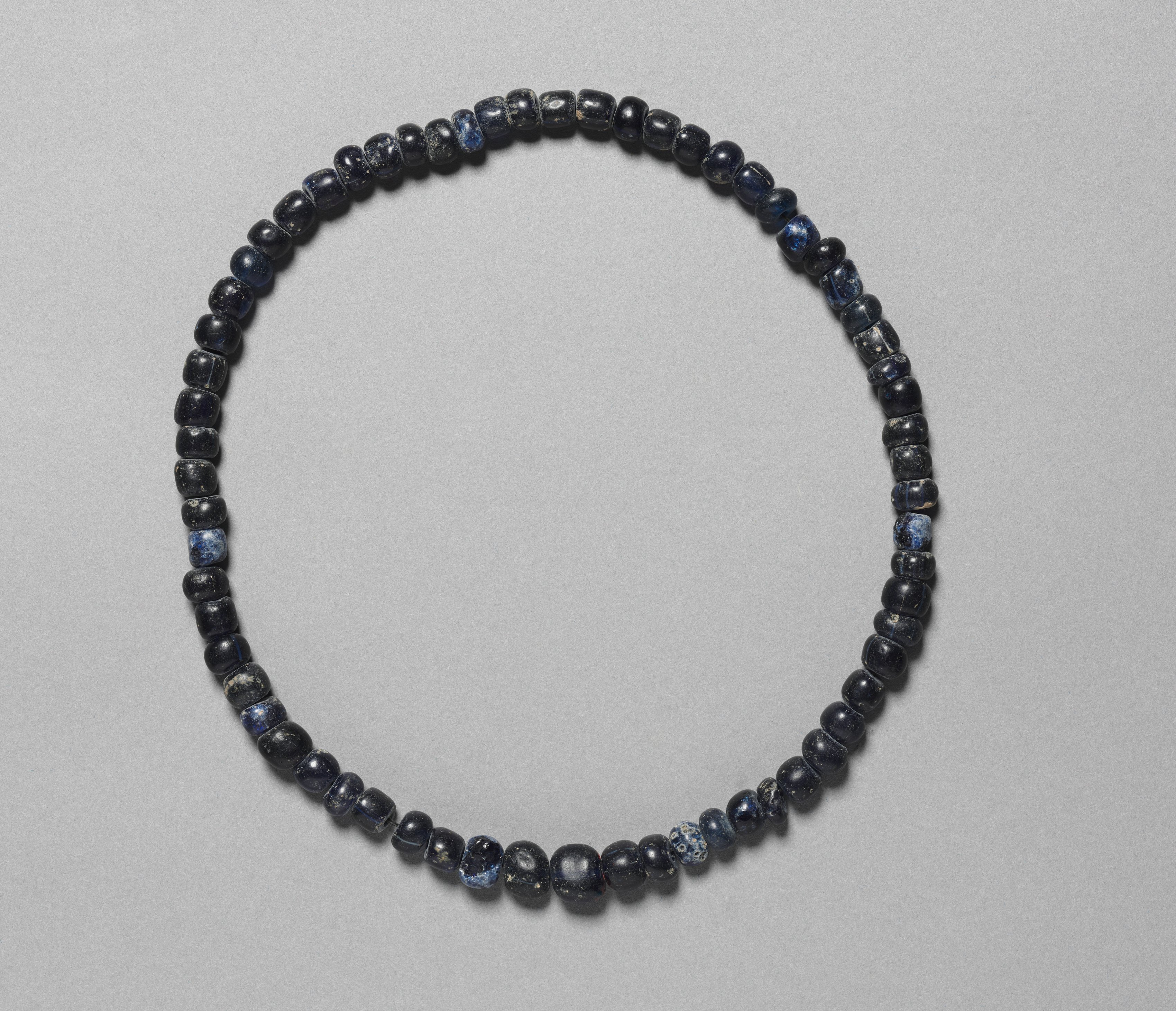
As Chief Fabric Deconstructionist for Zoey Fashion Lab, my role is to dismantle historical artifacts not merely as objects of antiquity but as living lexicons of material intelligence. The subject of this analysis—a String of Glass Beads from Korea’s Three Kingdoms period (57 BCE–668 CE)—presents a unique challenge. At first glance, it is a humble ornament: a sequence of vitreous spheres, strung on a now-fragile cord, bearing the patina of centuries. Yet, when viewed through the lens of avant-garde design, this artifact transcends its archaeological context. It becomes a New DNA Strand—a genetic blueprint for future fashion. This report dissects the bead string’s technical, symbolic, and structural properties, proposing how its essence can be re-coded into radical, contemporary textiles and silhouettes.
Technical Deconstruction: Glass as a Material Code
Chemical Composition and Manufacturing
The glass beads of the Three Kingdoms period were typically soda-lime-silicate, imported or locally produced using core-forming or winding techniques. Unlike modern machine-cut crystal, these beads exhibit irregular facets, trapped air bubbles, and subtle color variations—flaws that are, in fact, signatures of human touch. For the avant-garde designer, these imperfections are not defects but data points. They suggest a material language of controlled chaos, where each bead is a unique node in a larger network. In Zoey Fashion Lab’s vocabulary, this translates to a rejection of mass-produced uniformity. We propose developing a new composite material—a bio-glass polymer—that mimics the bead’s translucency and fragility but is engineered for flexibility. This “DNA strand” would be extruded into filament-thin, bead-like nodules that can be woven, knitted, or fused into garment structures.
Structural Logic: The String as a Nervous System
The original string, now degraded, once held the beads in a linear sequence. But in deconstructionist terms, this string is not merely a connector—it is a nervous system. Each bead’s position relative to others creates a spatial rhythm, a pulse of light and shadow. The avant-garde interpretation abandons linearity. Instead, we envision a garment where hundreds of these bead-filaments are randomly distributed across a sheer, biodegradable substrate, creating a constellation-like pattern. The beads would be anchored at varying depths, some floating on the surface, others embedded within the fabric’s matrix. This creates a three-dimensional, interactive textile that responds to movement—each shift in the wearer’s body alters the light refraction, mimicking the way ancient beads caught torchlight during ritual dances.
Symbolic Deconstruction: The Bead as a Gene of Identity
Cultural and Spiritual Significance
In the Three Kingdoms period, glass beads were not mere adornment. They were talismans of status, trade, and spiritual protection. Often buried with the dead, they symbolized continuity between life and the afterlife. This duality—beauty and mortality—is a potent theme for avant-garde fashion. The New DNA Strand concept reinterprets the bead as a genetic marker of identity. Each bead in our proposed collection would be embedded with a micro-engraved code—invisible to the naked eye but readable under UV light—representing the wearer’s personal history or a fictional lineage. This turns the garment into a wearable archive, a living document that blurs the line between ornament and information.
Color and Light as Narrative
The original beads were predominantly blue, green, and amber—colors derived from metal oxides (cobalt, copper, iron). In deconstructionist practice, color is not decorative but narrative. We propose a chromatic inversion: instead of opaque beads, we use hollow, iridescent glass spheres filled with liquid crystal or thermochromic pigments. These beads would shift color in response to body heat or ambient light, creating a garment that “speaks” in real-time. For example, a bead near the heart might pulse red during excitement, while those along the spine cool to blue in stillness. This transforms the static necklace into a dynamic, bio-responsive interface—a literal DNA strand reacting to its environment.
Avant-Garde Application: From Artifact to Action
Garment Architecture: The Bead as Structural Node
Traditional beadwork is decorative, applied to existing fabric. Zoey Fashion Lab’s methodology treats the bead as a load-bearing element. We propose a garment constructed entirely from interlocking glass bead modules, connected by flexible, transparent polymer joints. This creates a chainmail-like exoskeleton that is both rigid and fluid. The beads would be arranged in fractal patterns, echoing the irregularity of the original string but scaled to human proportions. The result is a second skin—a wearable sculpture that challenges the boundary between jewelry and apparel. The weight and distribution of beads would be calculated using parametric design software, ensuring comfort while maintaining the visual impact of a cascading, liquid-glass surface.
Deconstruction of the String: The New Loom
The original string is a linear thread. Our deconstruction replaces it with a multi-directional web. Using 3D-printed, biodegradable thread infused with glass microspheres, we create a fabric that resembles a spider’s web studded with dew. This “string” is not a single line but a network of intersecting filaments, each terminating in a bead. The wearer can reconfigure the garment by snapping beads onto different nodes, allowing for modular customization. This echoes the ancient practice of re-stringing beads for different rituals, but now it is a real-time, user-driven design process. The garment becomes a living system, not a fixed object.
Conclusion: The Bead as a Blueprint for Tomorrow
The String of Glass Beads from Korea’s Three Kingdoms period is not a relic to be preserved behind glass. It is a provocation—a call to rethink how materials carry memory, identity, and function. By deconstructing its technical and symbolic DNA, Zoey Fashion Lab transforms a simple ornament into a New DNA Strand for avant-garde fashion. We propose garments that are not worn but inhabited; textiles that are not static but responsive; and a design philosophy that sees every imperfection as a design opportunity. The bead string, in its ancient simplicity, teaches us that the most radical future often lies hidden in the past. Our task is to unstring it, re-code it, and weave it into the fabric of what comes next.