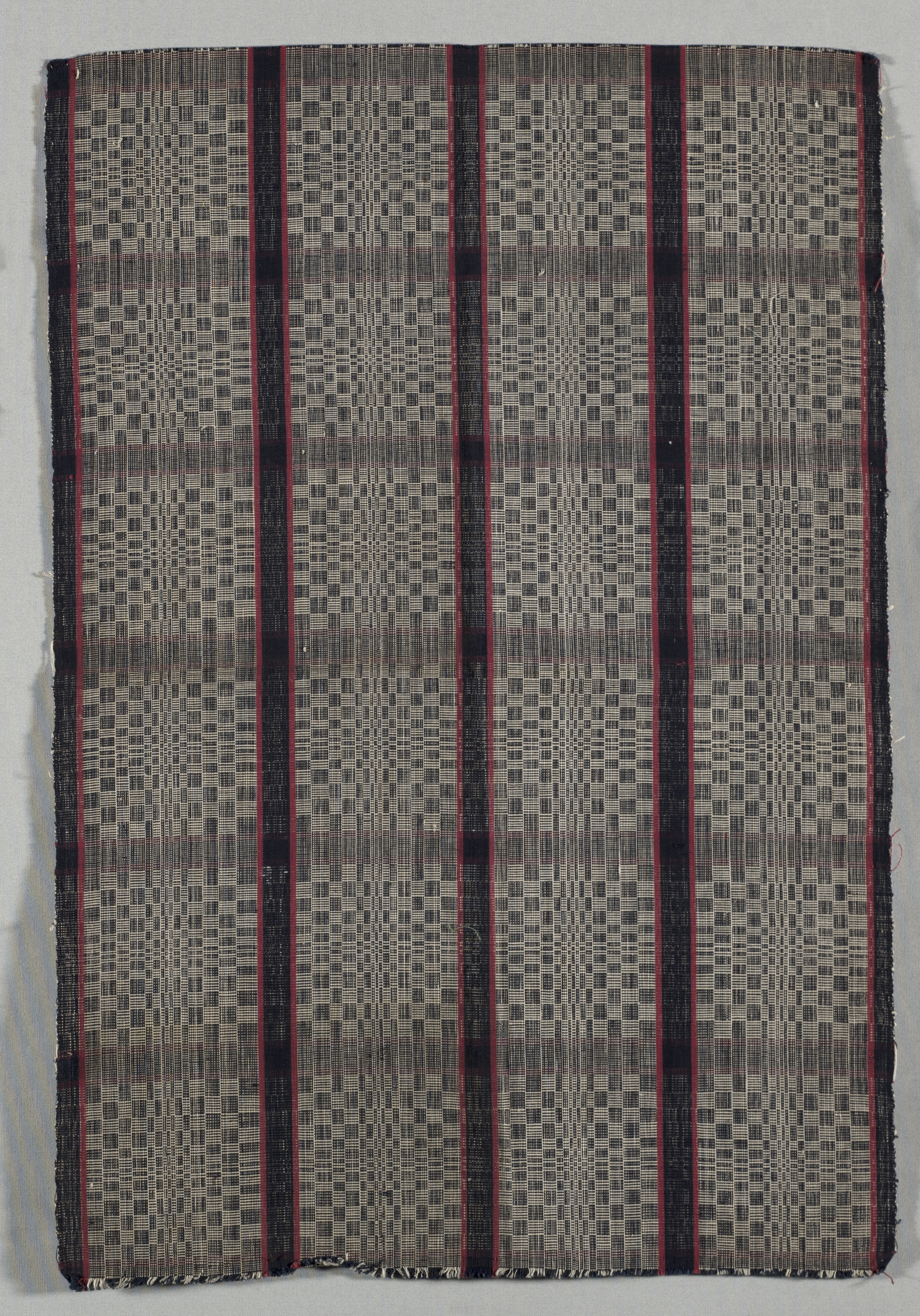
Deconstructing the Loom: An Avant-Garde Analysis of the Binakol Textile Fragment
At Zoey Fashion Lab, our mandate is to interrogate the very fabric of fashion—to pull at the threads of history, culture, and technique until they reveal the radical potential within. The textile fragment under analysis, a Binakol from the Ilokos Norte Province of Luzon, Philippines (circa 20th century), is not merely a historical artifact. It is a cryptographic text, woven in extended tabby weave on a backstrap loom, encoding centuries of cultural resilience, optical complexity, and a preternatural understanding of visual rhythm. For the avant-garde designer, this fragment is not a relic to be preserved under glass; it is a blueprint for subversion.
Technical Precision: The Extended Tabby as a Structural Revolution
The extended tabby weave is the first point of departure from the mundane. Unlike a standard tabby (plain weave), where weft threads pass over and under alternate warp threads in a simple, grid-like pattern, the extended tabby introduces a deliberate disruption. In the Binakol, this manifests as a system of floating threads—where certain weft threads skip over multiple warps before interlacing. This creates a subtle, raised texture and a surface that is not flat but topographically complex.
From a structural engineering perspective, the extended tabby is a micro-architecture of tension and release. The floating threads produce small, raised "windows" of negative space, which in turn manipulate how light interacts with the fabric. This is not a passive surface; it is a dynamic, light-responsive field. For the avant-garde, this translates into a material that can be used to create optical illusions of depth and movement without the need for printing or dyeing. Imagine a garment that shifts its visual density as the wearer moves, where the fabric itself performs a choreography of light and shadow.
Cultural Resonance: The Weave as a Counter-Narrative
The Archive Resonance reference situates this textile within the "silent witness" of cultural collision between the 16th and 17th centuries—a period of intense Spanish colonization in the Philippines. The Binakol, however, is not a passive witness. It is an act of resistance through pattern. The geometric, often dizzying, optical effects of the Binakol (from the Ilokano word binakol, meaning "to spin" or "to turn") are believed to have been used to confuse and ward off evil spirits. In a colonial context, this protective function takes on a deeper meaning: the weaver, working on a backstrap loom (a technology that predates Spanish contact), was encoding a form of cultural encryption into the very structure of the cloth.
For the avant-garde fashion lab, this is a profound lesson in design as defiance. The Binakol teaches us that pattern is not merely decorative; it can be a weapon, a shield, and a secret language. The repetitive, hypnotic geometry—often featuring squares, crosses, and zigzag lines—is a visual mantra of identity. When we deconstruct this fragment, we are not just analyzing threads; we are decoding a survival strategy. The extended tabby weave, with its deliberate irregularities, becomes a metaphor for the fractured yet resilient self in the face of external pressure.
Avant-Garde Application: From Fragment to Future Silhouette
How does Zoey Fashion Lab translate this analysis into a radical garment? The Binakol’s optical properties and structural logic suggest three distinct pathways for avant-garde creation:
1. Kinetic Surfaces and Deconstructed Geometry
The extended tabby’s floating threads create a natural moiré effect when the fabric is draped or folded. We can amplify this by laser-cutting the Binakol-inspired pattern into multiple layers of sheer, non-woven textiles (e.g., nylon organza or recycled PET mesh). By layering these cutouts, we create a garment that shifts and shimmers with every step, mimicking the Binakol’s original optical disorientation. The silhouette should be asymmetrical and fragmented—perhaps a single-sleeved, cape-like form that wraps around the body like a protective talisman. The hems should be raw, left unfinished, to emphasize the woven edge as a site of potential, not termination.
2. The Backstrap Loom as Wearable Technology
The backstrap loom is a body-integrated tool—the weaver’s own tension creates the fabric. For an avant-garde interpretation, we can reverse this relationship: design a garment that incorporates tension-adjustable straps (like a modern harness) that allow the wearer to physically alter the garment’s silhouette. The fabric itself could be a hybrid of traditional Binakol cotton and conductive threads, turning the garment into a responsive surface. When the wearer pulls a strap (mimicking the weaver’s movement), the fabric could change opacity or color via embedded thermochromic pigments. This is not costume; it is interactive armor for the contemporary self.
3. Optical Distortion and the Deconstructed Body
The Binakol’s geometric patterns are inherently disorienting. We can push this to its logical extreme by printing the Binakol grid onto a stretchable, semi-transparent latex or silicone base. The grid would be deliberately misaligned at the seams, creating visual breaks that fragment the wearer’s silhouette. The garment could take the form of a second skin—a full-body catsuit with cutouts at the joints, revealing the body beneath as a collage of flesh and pattern. This challenges the viewer’s perception of where the body ends and the garment begins, echoing the Binakol’s original function of confounding the gaze.
Conclusion: The Fragment as a Generative Force
The Binakol textile fragment is not a historical endpoint. It is a generative code—a set of instructions for how to weave complexity, resistance, and optical magic into cloth. For Zoey Fashion Lab, the deconstruction of this fragment reveals that the most radical fashion is not about new materials or technologies alone, but about recontextualizing ancient knowledge. The extended tabby weave, the backstrap loom, the hypnotic geometry—these are not limitations. They are provocations.
Our final design proposal is a collection titled "The Unseen Warp", where each garment is a woven manifesto. The Binakol fragment teaches us that the most powerful designs are those that protect, confuse, and empower simultaneously. In an age of digital surveillance and cultural homogenization, the Binakol’s ancient optical trick becomes a radical act of visibility and invisibility. The wearer is not just a consumer of fashion; they are a weaver of their own reality. And at Zoey Fashion Lab, that is the only thread worth pulling.