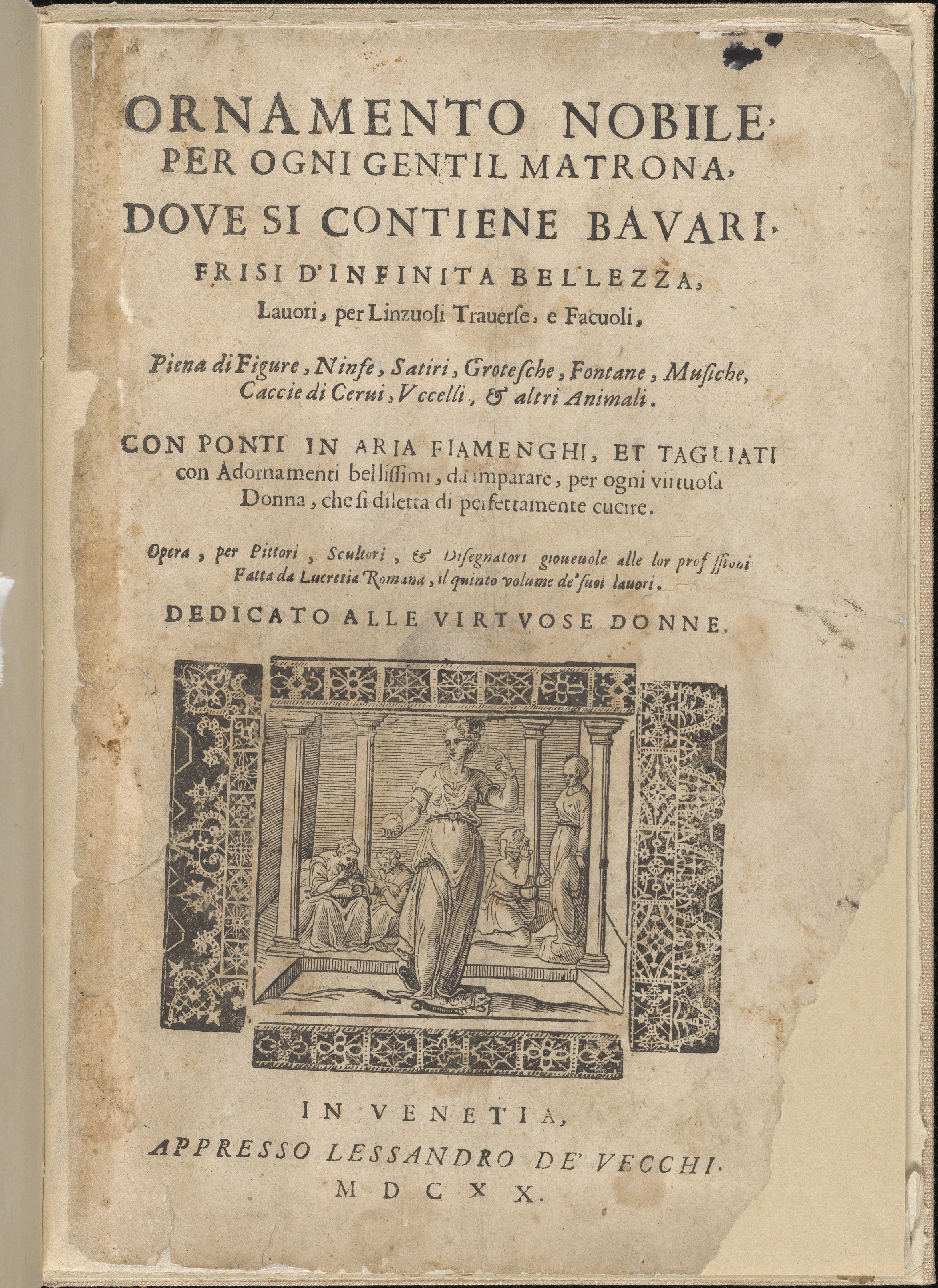
The Noble Ornament: Deconstructing Lucretia Romana’s Libro V for SS26
In the relentless pursuit of fashion’s next frontier, the avant-garde curator must look beyond the fabric and into the very essence of structural poetry. Zoey Fashion Laboratory’s latest standalone study, Ornamento nobile...Fatta da Lucretia Romana (Libro V of the Corona), sourced from the Global Frontier, presents a radical departure from textile-driven design. This woodcut—a relic of Renaissance craftsmanship—is not merely a historical artifact but a blueprint for a new sartorial lexicon. For SS26, we dissect its rigid geometries, its noble ornamentation, and its profound implications for futuristic silhouettes and structural innovation. The woodcut’s stark, linear precision offers a counter-narrative to the fluidity of contemporary fashion, proposing a world where garment architecture is carved, not draped.
Deconstructing the Woodcut: From Print to Prototype
The woodcut’s essence lies in its materiality: a carved surface where every line is a deliberate act of removal. In the context of Libro V, the nobile ornamento—the noble ornament—is not decorative excess but a structural necessity. Each incision defines negative space, creating a lattice of light and shadow that mirrors the human form’s potential. For SS26, we reinterpret this as a framework for deconstructive silhouettes: garments that are built from interlocking panels, cut with the precision of a woodblock. The woodcut’s static nature challenges us to imagine movement within rigidity—a paradox that becomes the collection’s core tension. Imagine a jacket where shoulder seams are replaced by carved, angular joints, allowing the fabric to fold like paper origami. The woodcut’s geometric motifs—circles, diamonds, and fragmented arcs—are translated into laser-cut leather or rigid organza, forming a second skin that is both armor and art.
Futuristic Silhouettes: The Architecture of the Body
The Global Frontier origin of this woodcut implies a synthesis of cultural and temporal boundaries. Lucretia Romana’s work, rooted in Renaissance humanism, now speaks to a future where the body is a canvas for structural experimentation. For SS26, we propose silhouettes that defy anthropomorphic norms: exaggerated shoulders that extend into cantilevered forms, reminiscent of architectural buttresses; asymmetrical hemlines that mimic the woodcut’s uneven edges; and corseted torsos that are not restrictive but liberating, built from articulated wooden or resin segments. The woodcut’s linearity inspires a verticality in design—elongated panels that draw the eye upward, creating a sense of ascension. This is not clothing for the passive observer; it is a declaration of intent, a futurist armor that celebrates the wearer’s agency. The silhouette becomes a dialogue between the rigid and the fluid, where a single garment can transition from a sculptural shell to a flowing cape through hidden mechanisms—a nod to the woodcut’s dual nature as both image and object.
Structural Innovation: Materiality Beyond Fabric
The woodcut’s material—wood—forces a rethinking of what constitutes a garment. In Libro V, the ornament is carved from a single block, emphasizing monolithic construction. For SS26, Zoey Fashion Laboratory explores composite materials that mimic this unity: bio-resins, recycled thermoplastics, and carbon-fiber-infused textiles. These materials allow for negative-space construction, where the garment’s structure is defined by what is removed rather than what is added. Consider a dress where the bodice is a single piece of molded polymer, with cutouts that align with the woodcut’s patterns, creating a lattice of exposure. The sleeves, detached and reattached via magnetic joints, echo the woodcut’s modularity. The innovation lies in tension systems: internal cables or elastic webbing that distribute stress across the garment, allowing for dynamic movement without compromising form. This is not mere clothing but wearable engineering, where each seam is a calculated risk, and each fold a testament to material science.
The Noble Ornament as Conceptual Framework
Lucretia Romana’s nobile ornamento is not an afterthought; it is the thesis. In the woodcut, ornamentation is integral to the structure—a truth often lost in contemporary fashion’s obsession with minimalism. For SS26, we reclaim ornament as a functional element: carved ridges that guide the eye, embossed patterns that provide grip, or perforations that allow airflow. The ornament becomes a language, communicating the garment’s narrative through its geometry. Each motif from Libro V—a laurel wreath, a geometric star, a fragmented column—is abstracted into a modular component, attachable to a base garment via clips or magnets. This allows for customization, turning the wearer into a co-creator. The nobility of this ornament lies in its refusal to be mere decoration; it is a structural necessity, a visual anchor in a sea of chaos.
Contextualizing for the Global Frontier
The Global Frontier origin of this woodcut implies a world without borders, where historical techniques merge with futuristic visions. For SS26, this translates into a sartorial hybridity: garments that reference Renaissance symmetry but are disrupted by asymmetrical, algorithmic cuts. The woodcut’s black-and-white starkness is translated into a monochrome palette, punctuated by metallic accents—silver, chrome, and iridescent finishes—that catch light like carved wood. The collection is not for the faint of heart; it demands a wearer who embraces contradiction: the antique and the avant-garde, the rigid and the fluid, the ornamental and the minimal. This is fashion as intellectual property, a study in how history can be weaponized for the future.
Conclusion: The Woodcut as Manifesto
Ornamento nobile...Fatta da Lucretia Romana (Libro V of the Corona) is more than a source of inspiration; it is a manifesto for SS26. Zoey Fashion Laboratory’s analysis reveals that the woodcut’s structural logic—its carved lines, its negative spaces, its noble ornament—offers a blueprint for a new sartorial architecture. The futuristic silhouettes are not mere fantasy; they are prototypes for a world where clothing is built, not sewn. The structural innovations—composite materials, tension systems, modular components—are not gimmicks but necessities in an era of sustainability and personalization. As we stand on the Global Frontier, this woodcut reminds us that the most radical futures are often carved from the past. The noble ornament, in its purest form, is not decoration—it is destiny.