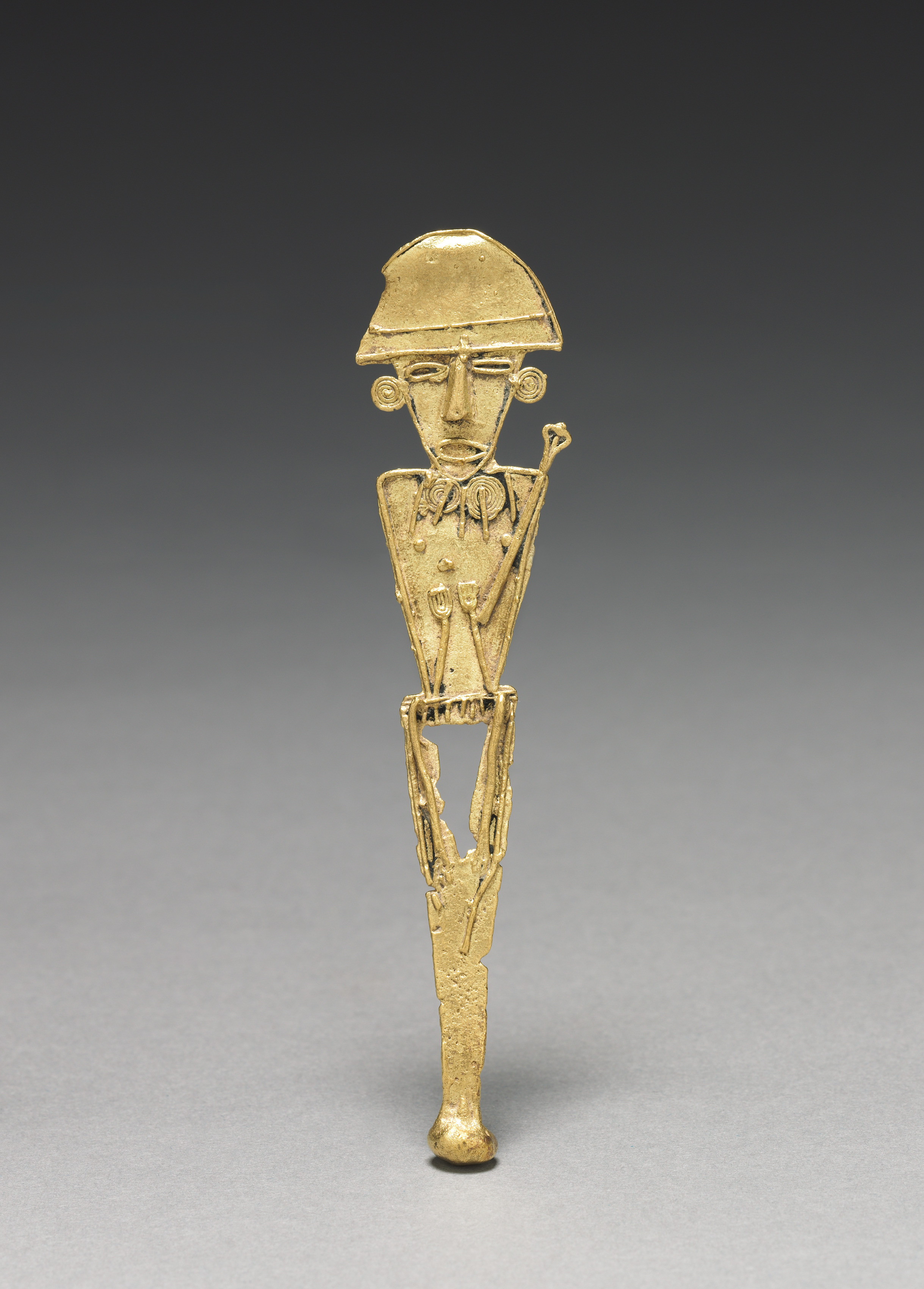
Deconstructing the Votive: A Technical and Conceptual Analysis of the Tunjos Figurine
At Zoey Fashion Lab, our mission is to unearth the latent narratives within historical artifacts and translate them into avant-garde design language. The subject of this analysis—a Muisca-style Tunjos votive offering figurine from Colombia, cast in gold—presents a profound opportunity for deconstruction. This small, seemingly static object is, in fact, a dynamic archive of ritual, power, and material transformation. Our analysis, guided by the Archive Resonance of a mirror with split-leaf patterns on one side and a sarcophagus relief on the other, will dissect the Tunjos not as a finished artwork, but as a set of design principles, a technical challenge, and a conceptual springboard for our next collection.
I. Materiality and Technique: The Alchemy of Gold and Casting
The Tunjos is first and foremost a testament to lost-wax casting, a technique that imbues the object with a paradox: it is both mass-produced in concept and utterly singular in execution. The Muisca people, lacking large-scale metallurgy, achieved remarkable precision by carving a wax model around a clay core, encasing it in clay, and then melting out the wax to create a void for molten gold. This process inherently leaves traces—the subtle texture of the wax, the slight variations in thickness, the occasional bubble or seam. For the avant-garde designer, these are not flaws but signatures of process.
The gold itself is not pure; it is a tumbaga alloy, typically a mix of gold, copper, and silver. This deliberate choice alters the color, hardness, and, crucially, the surface tension during casting. The copper gives the gold a reddish, earthy warmth, while the silver imparts a cool, reflective quality. This dual nature—the warmth of ritual and the coldness of precious metal—is the first point of resonance with our Archive Resonance prompt. The Tunjos, like the mirror, has two faces: one is the sacred, votive offering; the other is the object of economic and symbolic value.
From a technical standpoint, the casting process also dictates the formal language of the figurine. The Muisca style is characterized by flat, planar forms, simplified anatomy, and a focus on profile or frontal views. This is not a failure of realism but a strategic simplification driven by the limitations of the mold. The wax modeler worked in two dimensions, building up layers of wax to create depth. The resulting figurine is a relief in the round—a three-dimensional object that reads best from a single, direct angle. For Zoey Fashion Lab, this suggests a design approach that privileges silhouette and surface pattern over volumetric complexity. We can translate this into laser-cut leathers, embossed metallic foils, and structured, flat-pattern garments that mimic the Tunjos’ planar aesthetic.
II. Form and Function: The Votive as a Wearable Narrative
The Tunjos was not an ornament for the living; it was a votive offering, a physical plea to the gods for fertility, success in warfare, or safe passage to the afterlife. They were often placed in sacred lakes, like the legendary Lake Guatavita, or buried with the dead. This transitional function—from the hands of the living to the realm of the dead—is a powerful design concept. The figurine becomes a threshold object, a mediator between worlds.
In the context of our Archive Resonance, the Tunjos embodies the duality of the mirror and the sarcophagus. The mirror’s split-leaf pattern suggests a fractured, organic surface, while the sarcophagus relief tells a linear, narrative story. The Tunjos, with its simplified human or animal form, is a hybrid of both. Its surface is a field for symbolic ornament—geometric patterns, headdresses, staffs—that function as a visual code. The flat planes of the body become a canvas for gold filigree, granulation, or incised lines, much like the split-leaf pattern on the mirror. At the same time, the overall form—a warrior, a priest, a llama—tells a story of ritual action, akin to the sarcophagus relief.
For an avant-garde collection, this suggests a garment that functions as both surface and narrative. We can imagine a structured cape that, when flat, displays a gold-embossed pattern of split leaves and geometric Muisca motifs. When worn, the cape’s silhouette—sharp shoulders, a rigid back—evokes the hieratic posture of the Tunjos figurine. The garment becomes a portable altar, a wearable votive offering that transforms the wearer into a living effigy.
III. Symbolism and Context: The Muisca Cosmology as Design Language
The Muisca people inhabited the highlands of the Eastern Cordillera of Colombia, a landscape of lakes, mountains, and sacred sites. Their cosmology was deeply tied to water, fertility, and the cycle of life and death. The Tunjos often depict chieftains (zipas) adorned with elaborate headdresses, nose rings, and ear spools, signaling their divine status. The staff of office is a common attribute, a symbol of authority and a conduit for spiritual power. The figurines are not realistic portraits but archetypes—the ideal ruler, the ideal warrior, the ideal offering.
This archetypal abstraction is a key design principle. The Tunjos reduces the human figure to its essential elements: head, torso, limbs, and attributes. The head is often enlarged, emphasizing the seat of intellect and spirit. The limbs are simplified, often depicted as flat, paddle-like forms. The headdress becomes a crown of gold, a sunburst of radiating lines. This is not primitive art; it is a sophisticated system of visual shorthand that communicates power and divinity through geometric abstraction.
From this, Zoey Fashion Lab can derive a new design lexicon. The enlarged head suggests oversized hoods or architectural headpieces that frame the face. The flat, paddle-like limbs translate into broad, sculptural sleeves or asymmetrical hemlines. The staff of office becomes a structural element in the garment—a metallic rod that runs through a seam, a chain that drapes from shoulder to hip, or a corset-like frame that imposes a rigid posture. The gold itself is not just a color but a material metaphor for the sacred and the imperishable. We can achieve this through gold-plated hardware, metallic thread embroidery, and liquid gold finishes on leather or synthetic fabrics.
IV. The Avant-Garde Translation: From Votive to Vanguard
Our final analysis synthesizes the Tunjos’ technical, formal, and symbolic dimensions into a coherent avant-garde vision. The Archive Resonance of the mirror and sarcophagus suggests a garment that is both reflective and narrative. The front of the garment, like the mirror’s split-leaf pattern, can be a field of gold-embossed, fractal-like motifs that catch the light and fragment the wearer’s silhouette. The back, like the sarcophagus relief, can be a narrative tableau—a gold-thread embroidery of a Tunjos-like figure, its staff and headdress rendered in raised, sculptural stitches.
The garment itself must embody the Tunjos’ threshold function. It is not a casual piece but a ritual garment for the modern age—a ceremonial coat, a vestment of power. The materials should reflect the tumbaga duality: a base of deep, earthy copper-toned wool (the copper) overlaid with silver-threaded organza (the silver). The gold accents—cast metal buttons, appliquéd gold lamé—serve as the sacred element, the votive offering embedded in the garment itself.
Finally, the silhouette must be archetypal. A sharp, squared shoulder evokes the Tunjos’ flat, planar form. A high, structured collar frames the head like a Muisca headdress. The length is asymmetrical, one side falling to the knee (the mirror), the other to the floor (the sarcophagus). The garment is both a shield and a story, a votive offering to the future that carries the weight of the past. In this way, the Tunjos is not merely deconstructed; it is resurrected into a new form, a wearable archive that resonates with the power of ritual, material, and transformation.