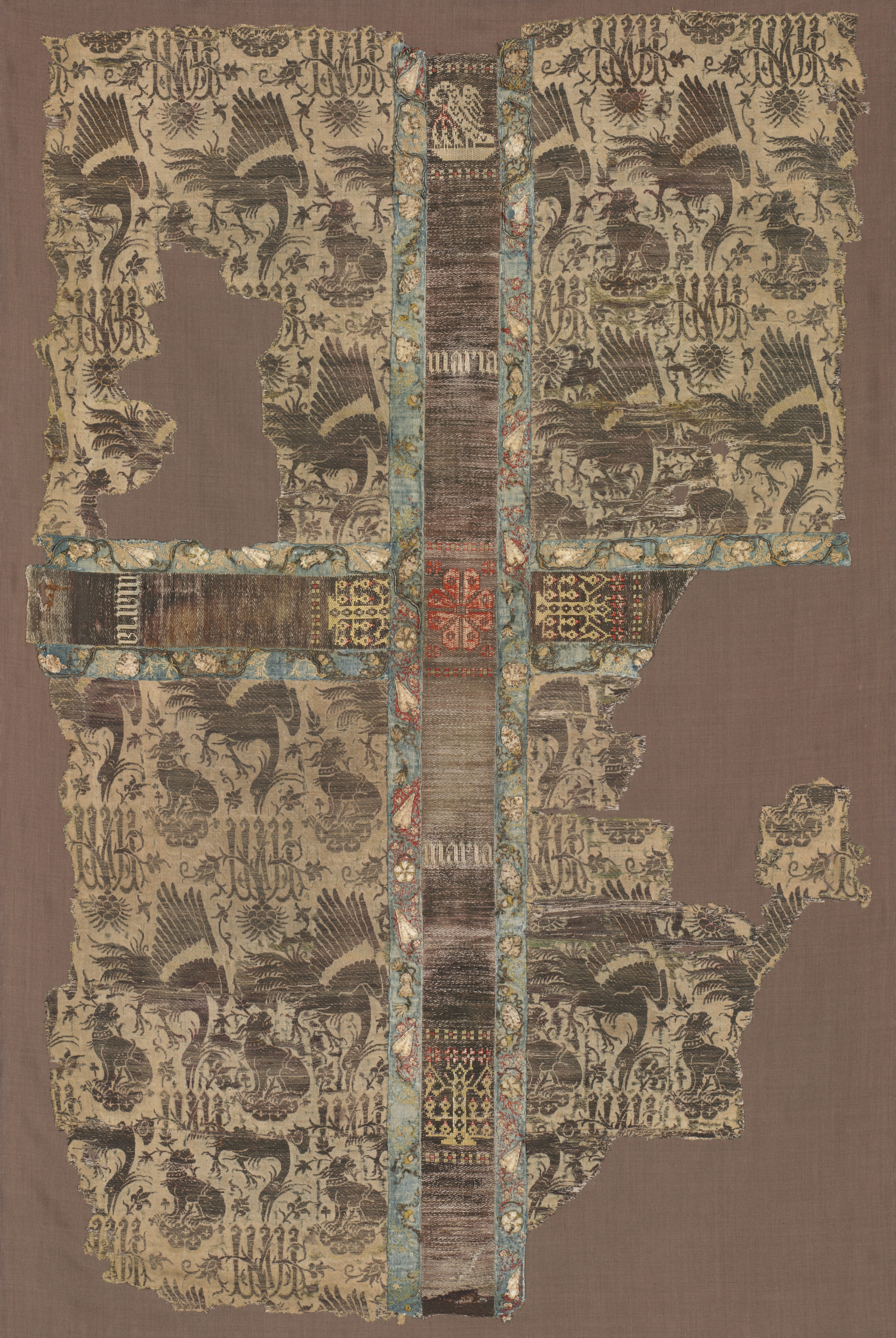
Deconstructing the Fragmentary Chasuble: A Study in Temporal Dislocation
As Chief Fabric Deconstructionist for Zoey Fashion Lab, I am tasked with dissecting not merely the physical threads of historical garments, but the cultural and aesthetic tensions they encode. The subject of this analysis—a Fragmentary Chasuble with Woven Orphrey Band, originating from Italy (the chasuble itself) and Germany (the orphrey band), dating to the 16th–17th centuries—presents a profound case study in temporal dislocation. This garment is not a cohesive whole; it is a palimpsest of opposing forces. The Italian silk lampas weave, with its rich gold thread, speaks of Renaissance humanism, liturgical grandeur, and the Mediterranean trade routes. The German embroidered orphrey band, however, introduces a contrasting northern Gothic sensibility—a more linear, narrative, and perhaps even folk-inflected aesthetic. To the avant-garde eye, this chasuble is not a relic to be revered but a source code for radical re-assembly. It is a fragment that demands we question the very nature of unity, authenticity, and the sacred in fashion.
Technical Dialectics: Lampas vs. Embroidery
The chasuble’s body, a lampas weave of silk and gold thread, represents the pinnacle of Italian Renaissance textile technology. Lampas is a compound weave where a pattern is created by an additional warp and weft, allowing for intricate, shimmering designs that seem to float on the fabric’s surface. The gold thread—likely a gilt membrane wrapped around a silk core—catches light, creating a dynamic, almost liquid field of sacred geometry. This is a fabric of controlled opulence, designed to reflect the divine light of the altar. The pattern, though fragmentary, suggests a repeat of pomegranates or stylized floral motifs—symbols of resurrection and eternal life, rendered in a language of mathematical harmony.
In stark contrast, the German orphrey band is an embroidered intervention. Where the lampas weave is woven into the fabric’s structure, the orphrey is applied, stitched onto the surface. Embroidery is inherently additive, even aggressive; it pierces the ground fabric, asserting its own narrative. The orphrey likely depicts figures—saints, biblical scenes—in a style that is more linear, more graphic, and less concerned with the illusion of depth than the Italian weave. The gold thread used here is often thicker, more textured, creating a raised, almost sculptural effect. This is a northern Gothic sensibility: narrative, didactic, and tactile. The orphrey does not blend with the chasuble; it declares its otherness. For the avant-garde designer, this clash is not a flaw but a feature. It is a pre-modern example of collage, where two distinct technological and aesthetic systems are forced into dialogue. The fragmentary state of the chasuble—torn, faded, missing sections—only amplifies this dialectic. The missing parts become negative space, inviting the viewer to imagine what once was, and what could be.
Cultural Collision: Mediterranean Opulence vs. Northern Linearity
This chasuble is a physical document of 16th-century cultural exchange, but not of the harmonious kind. The Italian silk industry, centered in Lucca, Florence, and Venice, was a commercial and artistic powerhouse. Its lampas weaves were exported across Europe, prized for their sophistication and symbolic capital. A German church or patron would acquire such a fabric as a sign of prestige, a connection to the cosmopolitan south. Yet, the addition of a locally made orphrey band represents a resistance to complete assimilation. The German embroiderers did not merely copy Italian motifs; they imposed their own visual language. The orphrey becomes a frame, a gloss, a commentary on the foreign fabric. It is an act of cultural translation that is also an act of appropriation.
Consider the theological implications. The Italian lampas, with its abstract, all-over pattern, evokes the ineffable, the divine as a field of energy. The German orphrey, with its figural scenes, insists on the narrative of salvation, the story of Christ and the saints made visible. This is a tension between the mystical and the literal, the universal and the particular. In the context of the Reformation, which was sweeping Germany during this period, this tension becomes even more charged. The orphrey, with its didactic imagery, could be seen as a Counter-Reformation assertion of the power of images, or perhaps a local, vernacular response to a foreign liturgical object. The fragmentary nature of the chasuble—its very incompleteness—mirrors the fractured religious landscape of 16th-century Europe. It is a garment that cannot decide what it wants to be, and that indecision is its most potent quality.
Avant-Garde Recontextualization: The Fragment as Blueprint
For Zoey Fashion Lab, this chasuble is not a costume to be copied, but a conceptual framework. The avant-garde designer does not seek to restore the garment to its original state; that would be a dead end, a museum piece. Instead, we must embrace its fragmentary condition as a starting point for radical deconstruction and reconstruction. The Italian lampas and the German orphrey are not to be reconciled; they are to be amplified. Imagine a contemporary garment where the body of the chasuble is reconstructed in a high-tech, laser-cut silk organza that mimics the lampas pattern but with a digital, pixelated edge. The orphrey band could be reimagined as a series of 3D-printed, gold-plated metal plaques, each one a fragment of a story, attached to the fabric with visible, industrial-grade stitching. The missing sections of the original chasuble become voids, gaps that are filled with sheer mesh or even negative space, allowing the wearer’s body to become part of the design.
This approach respects the chasuble’s historical status as a site of collision. The avant-garde garment would not hide the seams, but celebrate them. The gold thread of the lampas could be replaced with fiber-optic cables, creating a garment that glows with an internal light, referencing the divine but in a technological, post-human idiom. The embroidered figures of the orphrey could be abstracted into QR codes or barcodes, linking to digital narratives about the garment’s history. The fragment becomes a generative principle: each missing piece is an invitation to insert something new, something disruptive. The chasuble is no longer a garment for a single body in a single ritual; it is a modular system for multiple bodies, multiple rituals, multiple times.
Conclusion: The Archive as a Living Organism
The Fragmentary Chasuble with Woven Orphrey Band is a powerful reminder that history is not a straight line. It is a series of ruptures, repairs, and reinterpretations. As Chief Fabric Deconstructionist, I see this garment not as a finished object, but as an open work—a set of instructions for future making. The Italian silk and German embroidery are not in harmony; they are in tension. And that tension is the fuel for avant-garde creation. Zoey Fashion Lab’s mission is not to preserve the past, but to activate it, to make it speak in a language that is urgent, strange, and new. This chasuble, in its fragmentary glory, is a blueprint for a fashion that dares to be incomplete, to be contradictory, to be alive. It is a testament to the fact that the most powerful garments are not those that are whole, but those that remember their own fractures.