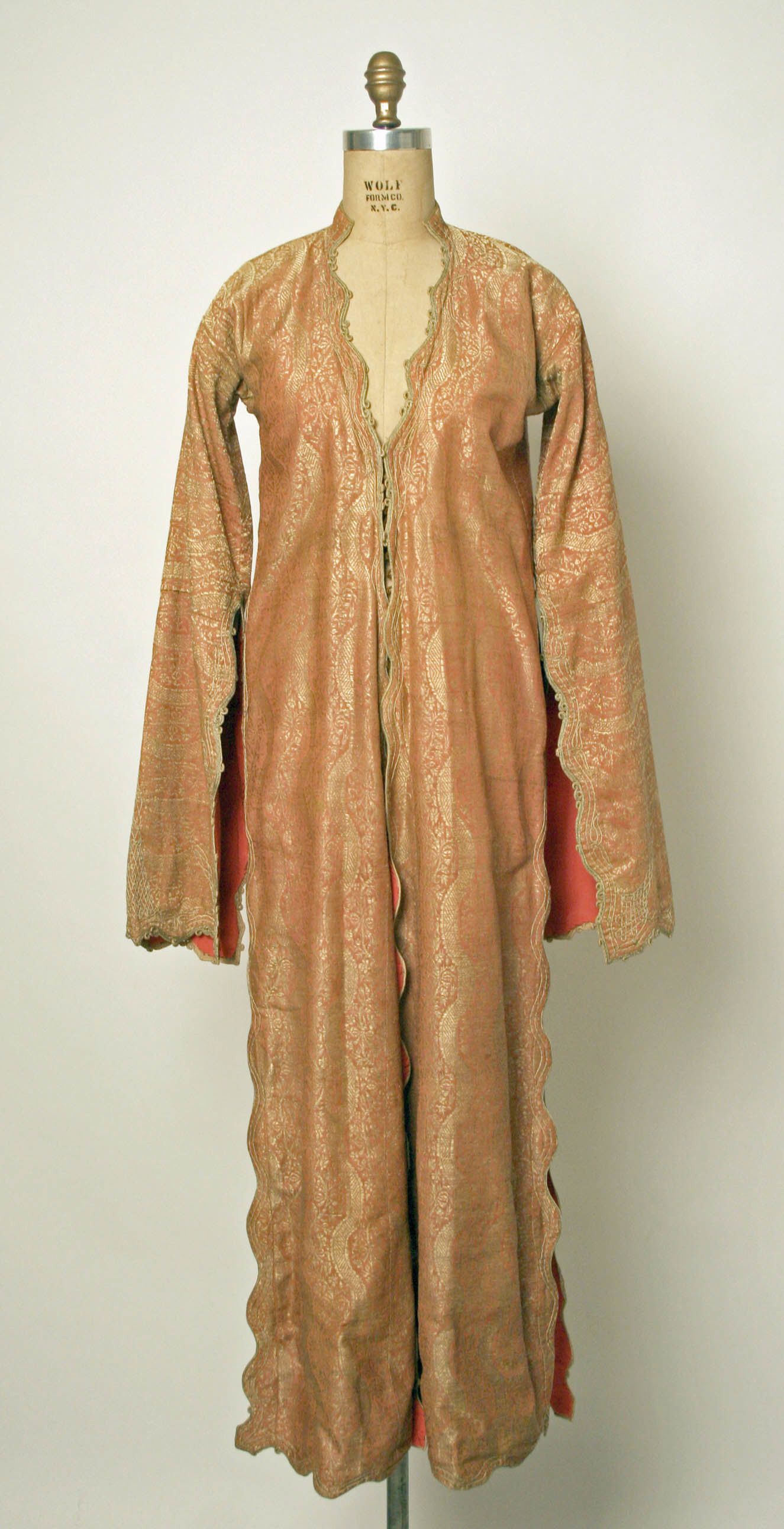
Deconstructing the Uçetek Entari: A Futurist Manifesto for SS26
The Uçetek Entari, a garment emerging from the nebulous territory of the Global Frontier, represents a seismic shift in the lexicon of avant-garde couture. It is not merely a dress; it is a structural argument, a dialogue between the ephemeral and the industrial, the organic and the engineered. For Zoey Fashion Laboratory’s SS26 collection, this piece serves as a thesis on the future of silhouette—a future where the body is not draped but architecturally framed by tension, weight, and deliberate asymmetry. The choice of materials—metal-wrapped thread interwoven with raw cotton—is a deliberate confrontation, a clash of the precious and the humble that redefines value in fashion.
The Material Paradox: Industrial Lace and Organic Armor
At first glance, the Uçetek Entari appears to be a study in contradiction. The metal-wrapped thread, gleaming with a cold, lunar sheen, is not applied as ornament but as structural scaffolding. It is woven into the cotton substrate in a grid-like pattern that recalls both medieval chainmail and futuristic data networks. This is not a fabric that yields; it is a fabric that resists. The cotton, conversely, introduces a tactile softness—a grounding element that prevents the garment from becoming a mere exoskeleton. The interplay creates a surface that is simultaneously rigid and pliable, a paradox that defines the garment’s kinetic potential. When the wearer moves, the metal threads catch light in a stroboscopic effect, while the cotton absorbs it, creating a visual oscillation between opacity and transparency. This material duality is the cornerstone of the SS26 design philosophy: fashion as a living interface between the human form and its technological environment.
Silhouette as Structural Innovation: The Asymmetric Vortex
The Uçetek Entari’s silhouette is a radical departure from traditional entari forms. Traditionally, the entari is a long, flowing robe-like garment, but this iteration is deconstructed and recomposed into a vortex of asymmetrical planes. The hemline is not a straight line but a cascading series of sharp, angular drops—some reaching the floor, others cut abruptly at the hip. This is achieved through a technique Zoey Fashion Laboratory calls “tension-draping.” The metal-wrapped threads are tensioned at specific anchor points—the shoulders, the mid-back, and the left hip—creating a web of forces that pull the cotton into unexpected folds and tucks. The result is a silhouette that appears to be in a state of perpetual motion, as if frozen mid-collapse or mid-expansion.
The key innovation lies in the negative space carved into the garment. Large, deliberate gaps are left where the metal threads are absent, revealing the skin or an underlayer. These voids are not random; they follow the body’s kinetic lines—the curve of the spine, the arc of the rib cage, the sweep of the collarbone. This is not about exposure for exposure’s sake; it is about structural articulation. The garment becomes a map of the body’s architecture, a blueprint of movement. For SS26, this is a critical statement: the future of couture is not about covering or revealing but about framing and defining the human form as a dynamic, ever-changing structure.
The Global Frontier: Aesthetic Nomadism and Cultural Synthesis
The Uçetek Entari’s origin as a “Global Frontier” piece is not a geographical claim but a conceptual one. It exists in a liminal space where cultural signifiers are abstracted into pure form. The garment borrows the elongated proportions of Ottoman entari, the grid-like precision of Japanese sashiko, and the industrial harshness of Western deconstruction. Yet, it does not reference any of these directly. Instead, it distills them into a universal language of structural tension. The metal-wrapped thread, for instance, evokes the shimmer of Byzantine silk but is rendered in a material that belongs to the 22nd century. This is the hallmark of the Global Frontier aesthetic: a deliberate decontextualization that allows the garment to speak to multiple histories without being bound by any single one.
This synthesis is particularly evident in the garment’s closure system. There are no buttons, zippers, or hooks. Instead, the metal threads are left long at strategic points—the left shoulder, the right hip—and are intended to be twisted and knotted by the wearer. This transforms the act of dressing into a ritual of self-construction. Each knot changes the silhouette, the tension, and the light play. The garment is not static; it is a collaborative architecture that evolves with the wearer’s body and intent. For SS26, this is a radical proposition: fashion as a participatory, ever-changing system rather than a fixed object.
Structural Innovation: The Tension Matrix and Zero-Waste Engineering
From an engineering perspective, the Uçetek Entari is a marvel of zero-waste construction. The metal-wrapped thread and cotton are not cut and sewn in the traditional sense. Instead, they are woven directly onto a custom loom that produces a single, continuous textile. The garment is then “sculpted” by cutting only the cotton threads, leaving the metal threads intact. This creates a tension matrix that holds the entire structure together. The result is a garment that produces no fabric waste—a critical consideration for a laboratory focused on sustainable futurism.
The silhouette’s innovation extends to its weight distribution. The metal threads are concentrated at the shoulders and down the back, creating a counterweight that pulls the garment away from the body at the front. This produces a dramatic, almost aerodynamic profile—a shape that suggests forward momentum. For SS26, this is a deliberate aesthetic choice: the Uçetek Entari is not a garment for standing still. It is designed for movement, for the kinetic energy of the modern world. The cotton, meanwhile, is treated with a water-repellent nanocoating, making it suitable for both controlled environments and the unpredictability of urban life.
Conclusion: A Blueprint for the Future of Couture
The Uçetek Entari is more than a garment; it is a manifesto for SS26. It challenges the very notion of what couture can be—a living, breathing system of structural tension, material paradox, and cultural synthesis. Zoey Fashion Laboratory has not simply designed a dress; it has engineered a wearable architecture that redefines the relationship between body, fabric, and space. The metal-wrapped thread and cotton are not just materials; they are agents of transformation. The asymmetric silhouette is not a style; it is a statement on the fluidity of identity. In an era where fashion often retreats into nostalgia, the Uçetek Entari stands as a bold, uncompromising vision of what comes next. It is not for the faint of heart. It is for the architects of tomorrow.