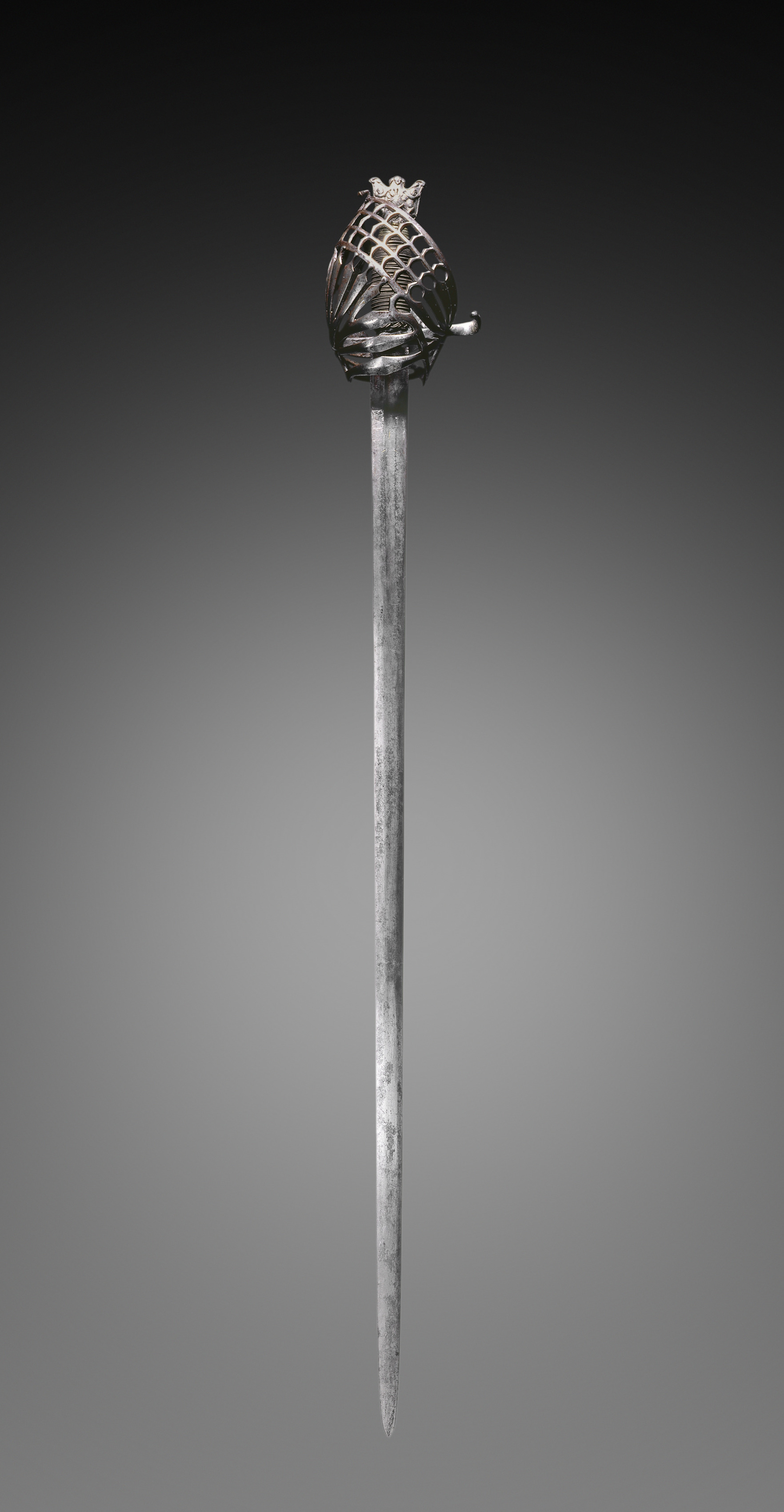
Deconstructing the Schiavona Broadsword: An Avant-Garde DNA Strand for Zoey Fashion Lab
As the Chief Fabric Deconstructionist at Zoey Fashion Lab, my role is to dismantle historical artifacts not merely as objects, but as living blueprints for radical, forward-facing design. The Schiavona Broadsword, a Venetian icon from the 16th and 17th centuries, presents a particularly compelling case. At first glance, it is a weapon of war—heavy, brutal, and functional. Yet, beneath its steel exterior lies a sophisticated narrative of geometry, tension, and organic form that resonates deeply with our avant-garde ethos. This analysis will deconstruct the Schiavona’s key components—its hilt, wire grip, and silver pommel—and reinterpret them as a New DNA Strand for a collection that blurs the line between armor and attire, structure and fluidity.
The Hilt: A Basket of Structural Complexity
The Schiavona’s most distinctive feature is its basket hilt, a complex lattice of steel bars that protect the hand. In traditional arms, this is a guard; in our deconstruction, it becomes a scaffolding for the human form. The hilt’s interwoven steel strips create a negative space pattern—a series of voids that are as important as the metal itself. For Zoey Fashion Lab, this translates into a design language where structural support is exposed and celebrated. Imagine a jacket or bodice where rigid, laser-cut steel or resin panels are connected by flexible, openwork grids. The hilt’s arrangement of vertical and diagonal bars suggests a ribcage-like structure, offering both protection and breathability. This is not about hiding the skeleton of the garment; it is about making it the focal point, a literal exoskeleton that redefines silhouette. The basket’s asymmetry—often with one side more open for the thumb—introduces a deliberate imbalance, a principle we can apply to asymmetrical hemlines, shoulder structures, or even the placement of metallic embellishments. The hilt’s functional geometry becomes a sculptural blueprint for garments that move with the wearer while maintaining a rigid, architectural presence.
The Wire Grip: Texture and Tension as Fabric
Moving from the hilt to the grip, we encounter a material paradox: steel and silver wire. The grip is traditionally wrapped in wire to provide a secure hold, even when wet with blood or sweat. In our avant-garde lens, this is not merely a handle; it is a textile of tension. The wire wrapping creates a rhythmic, spiral pattern that is both functional and decorative. For Zoey Fashion Lab, this translates into a radical rethinking of fabric construction. We can envision woven metal threads or coiled wire filaments integrated into a garment’s surface, not as embroidery but as primary structure. The spiral wrapping suggests a continuous, dynamic line—a DNA helix that wraps around a core. This can be applied to sleeves, torsos, or even accessories like belts and chokers. The grip’s tactile quality—rough, cool, and unyielding—offers a counterpoint to softer textiles. We can juxtapose cold, metallic wire against warm, organic fabrics like wool, silk, or even untreated linen, creating a sensory dialogue between protection and vulnerability. The wire’s tension is key: it must be tight enough to hold form but flexible enough to allow movement. This principle of controlled tension can inform our pattern cutting, where seams are not just sewn but actively pulled, creating puckers, pleats, and three-dimensional surfaces that mimic the grip’s coiled energy.
The Silver Pommel: A Terminal of Weight and Balance
The silver pommel at the base of the grip serves a dual purpose: it counterbalances the blade and provides a final, weighted point of contact. In our deconstruction, the pommel becomes a terminal of gravity. It is a dense, polished object that grounds the entire weapon. For fashion, this translates into weighted elements that alter a garment’s drape and movement. Imagine a long coat where the hem is lined with polished silver or steel discs, or a dress where the back is anchored by a single, heavy pendant. The pommel’s spherical or faceted shape introduces a singular, focal point. In the Schiavona, this is often ornately carved or inlaid, making it a piece of jewelry as much as a functional component. Zoey Fashion Lab can reinterpret this as detachable, sculptural hardware—a clasp, a brooch, or a chain termination that adds both visual weight and literal balance to a garment. The pommel’s role in distributing mass is crucial: it ensures the weapon feels alive in the hand. Similarly, our designs can use weighted elements to create a sense of kinetic equilibrium, where the garment moves with intention, not just chance. The silver’s reflective quality also introduces a play of light, catching the eye and creating a focal point that draws the viewer’s gaze downward, altering the visual hierarchy of an outfit.
The New DNA Strand: Synthesis and Avant-Garde Application
When we synthesize these elements—the hilt’s structural lattice, the grip’s coiled tension, and the pommel’s weighted terminus—we arrive at a New DNA Strand for Zoey Fashion Lab. This is not a literal reproduction of a broadsword; it is a genetic code for a new kind of garment. The strand is a continuous, spiraling thread that connects protection, texture, and balance. In our avant-garde collection, this translates into a series of pieces that are armored yet fluid, rigid yet organic. Consider a dress that begins with a high, openwork steel collar (the hilt), descends into a torso of coiled wire and leather (the grip), and terminates in a heavy, silver-weighted hem (the pommel). The garment would be a literal translation of the sword’s anatomy, but more importantly, it would embody its spatial logic—the way it occupies space, the way it balances weight, the way it protects the wearer while demanding attention.
The Schiavona’s DNA also suggests a narrative of duality. It is a weapon of defense, yet its beauty is undeniable. It is heavy, yet it is designed for swift, precise movement. This duality is the core of avant-garde fashion: the tension between form and function, between aggression and elegance. Zoey Fashion Lab can exploit this by using materials that challenge expectations—steel that drapes like silk, silver that feels warm to the touch. The wire grip’s spiral pattern can be scaled up into a full-body lattice, or miniaturized into intricate embroidery. The pommel’s weight can be distributed across a garment as a series of small, balanced weights, creating a kinetic sculpture that responds to the wearer’s every gesture.
In conclusion, the Schiavona Broadsword is not a relic of the past; it is a blueprint for the future of fashion. By deconstructing its components—the hilt’s lattice, the wire grip’s tension, and the silver pommel’s weight—we have extracted a new design vocabulary. This vocabulary is rooted in structural honesty, tactile contrast, and kinetic balance. For Zoey Fashion Lab, this means creating garments that are not just worn but inhabited, pieces that protect, define, and transform the wearer. The Schiavona’s DNA is now woven into our creative process, a strand of steel and silver that will guide our next collection toward a future where fashion is both armor and art.