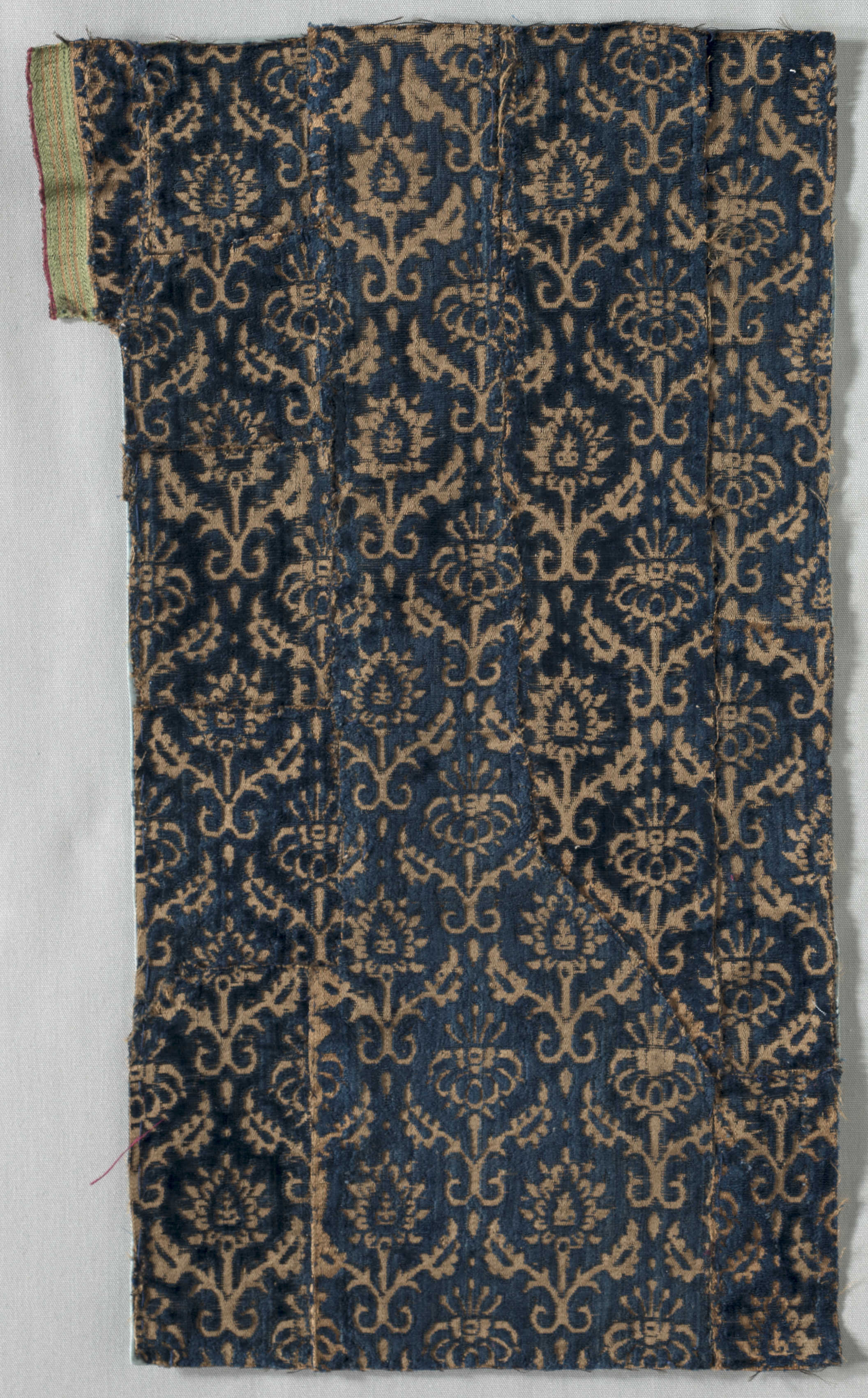
Deconstructing the Velvet Fragment: A 16th-17th Century Italian Textile as a New DNA Strand for Avant-Garde Fashion
As the Chief Fabric Deconstructionist for Zoey Fashion Lab, I am tasked with dissecting not merely the physical structure of historical textiles, but their latent potential. The subject of this analysis is a fragment of Italian velvet, dating from the 16th to 17th century, a period of unparalleled textile opulence in Europe. This is not a relic to be preserved under glass; it is a New DNA Strand—a genetic code for a radical, avant-garde future. By deconstructing its technical and aesthetic DNA, we can unlock a vocabulary of form, texture, and subversion that resonates profoundly with contemporary design.
Technical Autopsy: The Dual Nature of Cut and Uncut Velvet
The fragment’s primary technical feature is the masterful juxtaposition of cut and uncut velvet (also known as ciselé velvet). This is not a simple decorative choice; it is a foundational structural principle. Uncut velvet, or terry velvet, consists of loops of pile that remain closed, creating a matte, absorbent surface that plays with light in a diffused manner. Cut velvet, by contrast, has these loops sheared open, producing a dense, lustrous, and reflective pile that appears almost liquid. The interplay between these two states—one closed, one open; one matte, one glossy—creates a dynamic, three-dimensional topography.
From a deconstructionist perspective, this duality is a metaphor for the avant-garde itself: the tension between the concealed and the revealed. The uncut loops represent potential, a surface of unexpressed energy. The cut pile is the actualized form, the declaration of intent. To replicate this for Zoey Fashion Lab, we must consider modern material analogs. We are not bound by silk. We can engineer this binary using recycled polyester microfibers for the cut pile, offering a high-shine, almost metallic finish, while using a bio-based, plant-derived fiber for the uncut loops, which will naturally resist shearing and retain a soft, organic opacity. This creates a new, sustainable DNA strand that retains the historical principle while rejecting its material limitations.
Structural Grammar: Repeating Motifs and the Illusion of Depth
The fragment’s pattern, while fragmentary, reveals a rigorous structural grammar. Typically, 16th-17th century Italian velvet featured large, symmetrical motifs—pomegranates, thistles, or stylized floral forms—arranged in a repetitive, almost architectural grid. The cut pile would define the motif’s positive space, while the uncut pile formed the negative ground. This creates a chiaroscuro effect, a play of light and shadow that gives the fabric a sculptural, almost bas-relief quality.
For the avant-garde, this structural grammar offers a blueprint for modular design. We can deconstruct the repeating motif into discrete, interlocking components. Imagine a garment constructed from hundreds of small, laser-cut velvet “tiles,” each with its own cut-and-uncut pattern. These tiles could be mechanically fastened or thermally bonded, allowing for reconfiguration. The garment becomes a living, mutable structure—a direct challenge to the static, one-time construction of the historical original. The New DNA Strand here is not the motif itself, but the system of repetition and variation that allows for infinite re-combination.
Aesthetic DNA: Opulence as a Tool for Subversion
The aesthetic DNA of this velvet is rooted in conspicuous consumption and religious or aristocratic power. The deep, saturated dyes (often from kermes or cochineal for reds, or woad for blues) and the labor-intensive weaving process made it a fabric of immense social and economic capital. To the avant-garde, this very opulence is a weapon. We do not reject it; we weaponize it against its own history.
Consider the “New DNA Strand” as a form of aesthetic sabotage. We take the velvet’s inherent richness—its weight, its drape, its tactile sensuality—and apply it to forms that are deliberately anti-functional, anti-glamorous, or politically charged. A floor-length gown in this velvet, but with asymmetrical, deconstructed seams that expose the raw edges of the pile. A tailored jacket, but with the cut pile arranged in a pattern that spells out a subversive text when viewed from a certain angle. The velvet’s historical association with luxury becomes a Trojan horse for a critique of that very luxury. The fragment’s DNA is not about reverence; it is about re-contextualization.
Deconstruction Protocol for Zoey Fashion Lab
To fully integrate this 16th-17th century velvet fragment as a New DNA Strand, I propose a three-phase deconstruction protocol for Zoey Fashion Lab:
Phase 1: Material Decomposition. We will not weave the velvet. We will print it. Using advanced digital textile printing on a double-faced substrate, we can simulate the visual and tactile effect of cut and uncut pile. One side will receive a high-gloss, raised ink that mimics cut velvet’s sheen; the other side will use a matte, slightly textured ink for the uncut loops. This allows for rapid prototyping and infinite pattern variation without the constraints of traditional loom work.
Phase 2: Structural Disruption. The repeating motif will be analyzed as a fractal rather than a grid. We will extract the smallest unit of the pattern—a single petal or leaf—and scale it, rotate it, and distort it using generative design software. The resulting patterns will be non-repeating, organic, and algorithmically generated, yet they will retain the visual DNA of the original motif. This is the New DNA Strand in action: a mutation that preserves the genetic code while producing a radically different phenotype.
Phase 3: Application as Armor. The final garments will be constructed as soft armor. The velvet’s historical weight and density are reinterpreted as protective, almost architectural shells. Using the printed velvet over a flexible, 3D-printed lattice frame, we create pieces that are both plush and rigid, luxurious and confrontational. A bodice that appears to be a Renaissance corset but is actually a modular, wearable sculpture. A coat that drapes like a cloak but can be zipped into a rigid, shield-like form. The velvet’s opulence is not softened; it is hardened into a statement of defiance.
Conclusion: The Fragment as a Future Archive
This Italian velvet fragment is not a historical artifact to be copied; it is a New DNA Strand to be sequenced, edited, and expressed in a new context. Its technical mastery of cut and uncut pile offers a blueprint for tactile and optical depth. Its structural grammar of repeated motifs provides a system for modular, reconfigurable design. Its aesthetic DNA of opulence gives us a vocabulary for subversion and critique. For Zoey Fashion Lab, the velvet is a starting point, not an end. By deconstructing its physical and conceptual foundations, we can build a future where the avant-garde is not a rejection of history, but its most radical and intelligent mutation.