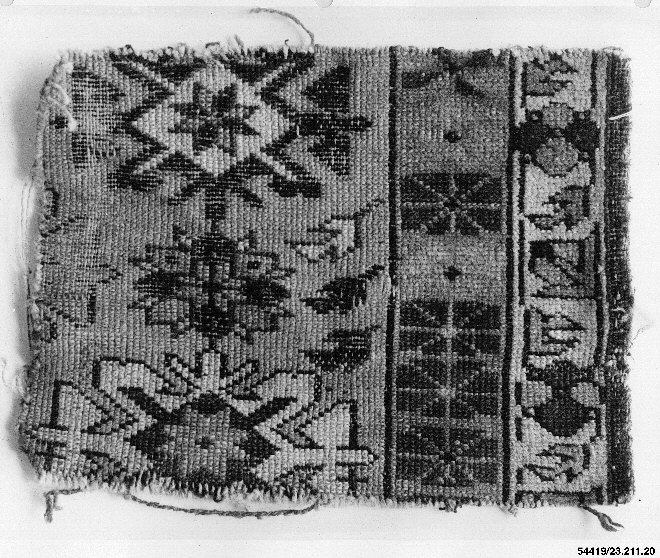
The Carpet Fragment: A Study in Deconstructive Topography for SS26
The artifact before us is not a textile in the conventional sense; it is a topological artifact, a frozen moment of globalized craft. The Carpet Fragment, sourced from the Global Frontier—a conceptual space where geopolitical boundaries dissolve into threads—presents a paradox. Its materiality is rooted in the ancient: wool, a biomaterial of pastoral economies, transformed through symmetrically knotted pile into a surface of ritualized repetition. For Zoey Fashion Laboratory’s SS26 avant-garde study, this fragment serves as a catalyst for futuristic silhouettes and structural innovation that interrogate the boundaries between ground and garment, ornament and architecture.
Deconstructing the Pile: From Horizontal to Vertical
The most immediate challenge—and opportunity—lies in the fragment’s inherent horizontality. Carpets are designed for floors, for weight and grounding. The avant-garde imperative is to lift, to suspend, to reorient the pile as a vertical, wearable surface. The symmetrical knotting, typically a technique for durability and pattern, becomes a structural grid for three-dimensional manipulation. By deconstructing the fragment into discrete sections—each a square of knotted wool—we can reassemble them as modular panels that drape, fold, and cantilever off the body. This is not mere appliqué; it is a re-engineering of the textile’s internal logic. The pile’s density, once a barrier to movement, is reimagined as a tactile armor that absorbs and redirects light, creating a silhouette that is at once archaic and extraterrestrial.
The futuristic silhouette emerges from this vertical reorientation. Imagine a sheath dress composed of multiple carpet fragments, each aligned to create a graduated topography of pile heights. The waist is not cinched but excavated—a negative space carved from the wool mass, leaving a floating, weightless contour. Shoulders become cantilevered ledges, where the fragment’s edge is left raw, frayed into a fringe that mimics the knotted warp ends. The hem is not a cut but a termination of structure, where the pile dissolves into loose loops, suggesting a garment perpetually in the process of becoming or unraveling. This is structural innovation as a form of geological time—slow, deliberate, and monumental.
Material Alchemy: Wool as a Futuristic Substrate
Wool, often dismissed as rustic, is here elevated to a high-performance architectural material. Its natural crimp provides memory and resilience; when heat-set or felted, it can hold sharp, angular pleats that contrast with the soft, organic pile. The symmetrical knotting offers a binary logic—each knot is a pixel of texture, a unit of data. For SS26, we propose laser-guided de-knotting: selectively removing knots to create negative-space patterns that reveal the underlying warp structure. This technique produces a lattice of voids through which the skin is glimpsed, transforming the garment into a semi-transparent architectural screen. The wool, treated with a nano-ceramic coating, becomes hydrophobic and reflective, catching light like a desert mirage. The result is a dual-materiality: the fragment’s tactile, ancient core married to a futuristic, almost digital sheen.
The Global Frontier origin is not a geographic accident but a conceptual anchor. This fragment is a palimpsest of trade routes, of nomadic and sedentary cultures. In the avant-garde context, it becomes a wearable cartography. The pattern of knots, once a decorative motif, is reinterpreted as a topographical map of a future landscape—a terrain of folds, peaks, and valleys that echo the body’s own geography. The garment becomes a site-specific artifact, not tied to a location but to a condition of transience. This is fashion as territorial performance, where the wearer is both the ground and the figure.
Silhouette as Architecture: The Cantilevered Form
The most radical departure for SS26 is the cantilevered silhouette. Drawing from the fragment’s rigidity—wool pile has surprising structural integrity when densely packed—we can create floating collars that extend outward from the neck, unconnected to the shoulder, as if the carpet had been folded and suspended mid-air. Similarly, asymmetric trains can be engineered to hover above the ground, supported by internal carbon-fiber armatures that are hidden within the wool’s thickness. These armatures are not structural crutches but integrated exoskeletons that allow the fragment to defy gravity. The silhouette is no longer a second skin but a satellite orbit around the body—a garment that exists in tension with its wearer, creating a negative space that is as important as the positive form.
This approach demands a redefinition of fit. The garment does not conform to the body’s curves; it intercepts them. The waist is defined by a horizontal slit cut through the pile, through which the torso is visible, while the fragment itself remains a rigid, almost sculptural plane. The arms are not inserted into sleeves but emerge from beneath the fragment’s overhang, creating a silhouette that is both armored and ethereal. This is futuristic couture as a dialogue between the organic and the engineered, where the Carpet Fragment is not a material but a structural proposition.
Conclusion: The Fragment as a Portal
The Carpet Fragment from the Global Frontier is not a relic. In the hands of Zoey Fashion Laboratory, it becomes a portal to SS26—a season defined by deconstructive topography, material alchemy, and architectural silhouettes. The wool, the knots, the symmetry—all are recontextualized as tools for a new sartorial language. This is not about decorating the body but redefining its spatial relationship to the world. The fragment, once a floor, is now a future—a wearable, floating terrain where every knot is a step toward the unknown. This is avant-garde couture at its most essential: a radical reimagining of what a garment can be when it is no longer bound by history or gravity.