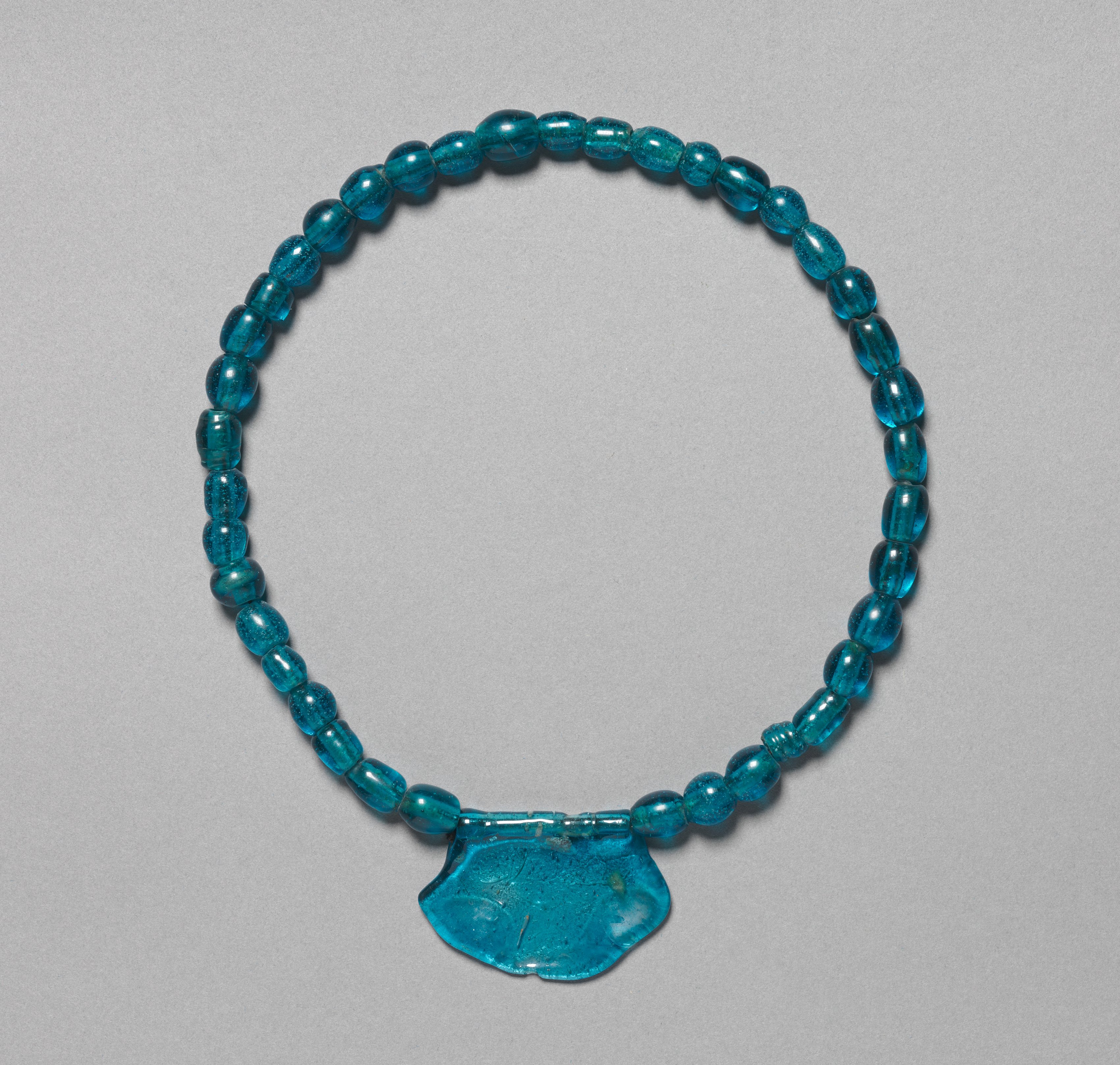
Deconstructing the Avant-Garde: Glass Beads with Pendant from Korea's Three Kingdoms Period
At Zoey Fashion Lab, our mission is to unravel the material and symbolic DNA of historical artifacts, reimagining them as catalysts for avant-garde design. Today, we turn our analytical lens to a singular artifact: a set of glass beads with a pendant from Korea's Three Kingdoms period (57 BCE–668 CE). This object, crafted from glass and bearing a pendant, is not merely an ornament but a materialized strand of cultural memory. By treating it as a "New DNA Strand," we can extract its technical, aesthetic, and symbolic codes to inform a revolutionary fashion language that transcends time and geography.
Technical Genesis: Glass as a Medium of Transformation
The glass beads and pendant from the Three Kingdoms period represent a sophisticated technological leap. Glassmaking in ancient Korea was not indigenous; it was introduced via trade networks with China and Central Asia, making these objects hybrid artifacts that embody cross-cultural exchange. The glass itself is a composite of silica, soda, and lime, fired at high temperatures to achieve translucency and color. The beads, often small and cylindrical, were meticulously shaped, while the pendant—likely a comma-shaped gogok or a symbolic animal form—demonstrates advanced casting or carving techniques.
For Zoey Fashion Lab, this technical genesis is a blueprint for avant-garde material innovation. The glass beads are not static; they are dynamic nodes that refract light, creating a play of transparency and opacity. In contemporary fashion, this translates to the use of recycled glass or bio-glass—materials that mimic the ancient composition while reducing environmental impact. The pendant, as a focal point, suggests a structural anchor. We can reimagine it as a 3D-printed, modular component that attaches to garments via magnetic or interlocking systems, echoing the original's function as a wearable talisman.
Moreover, the glass's fragility and durability are paradoxical. Ancient glass beads often survived burial for centuries, yet they are prone to breakage. This duality informs a design philosophy of controlled impermanence—garments that incorporate breakable elements, such as glass panels or bead clusters, which can be replaced or reconfigured. This challenges the fashion industry's emphasis on permanence and waste, aligning with avant-garde principles of deconstruction and renewal.
Symbolic DNA: The Pendant as a Narrative Node
The pendant is the artifact's narrative core. In the Three Kingdoms period, pendants often held shamanistic or protective meanings, serving as amulets for the living and the dead. They were buried with elites to guide their spirits or worn as status symbols. The glass beads, strung together, formed a necklace or bracelet that marked social hierarchy and spiritual connection. This symbolic DNA is a rich resource for avant-garde fashion, which thrives on narrative complexity and subversion.
We can deconstruct this pendant into a semiotic strand—a visual language of power, protection, and transformation. For instance, the comma-shaped gogok pendant, common in Korean archaeology, resembles a claw or a teardrop, symbolizing life force and renewal. In an avant-garde context, we can abstract this shape into a geometric pendant made of laser-cut acrylic or resin, embedded with LED lights that pulse like a heartbeat. This modern pendant becomes a wearable interface, connecting the wearer to the artifact's ancient energy while commenting on technology's role in contemporary spirituality.
The beads themselves are not mere fillers; they are micro-narratives. Each bead, with its unique color and transparency, can represent a different aspect of identity—gender, class, or emotion. In our design, we can use glass beads of varying sizes and hues, arranged in a chaotic yet harmonious pattern, to mirror the disruption of linear history. This aligns with the avant-garde's rejection of conventional beauty, embracing instead a fragmented, multiplicitous aesthetic that challenges the viewer to find coherence in disorder.
New DNA Strand: Recombining Ancient Codes for Avant-Garde Fashion
The concept of a "New DNA Strand" is central to Zoey Fashion Lab's methodology. We treat the artifact's material and symbolic elements as genetic sequences that can be recombined, mutated, and expressed in new forms. For the glass beads with pendant, this involves three key operations: extraction, recombination, and expression.
Extraction: We isolate the glass beads' optical properties—their ability to capture and scatter light—and the pendant's structural role as a focal point. We also extract the cultural codes: the shamanistic protection, the trade network origins, and the hierarchical significance. These are our raw materials.
Recombination: We then recombine these elements with contemporary technologies and materials. For example, we can fuse the glass beads with smart textiles that change color in response to temperature or touch, creating a garment that "communicates" like the ancient beads once did. The pendant can be reimagined as a wearable sensor that monitors the wearer's biometrics, transforming protection into self-awareness. This recombination respects the artifact's essence while pushing it into new, speculative territory.
Expression: The final expression is a garment or accessory that embodies this new DNA. Imagine a deconstructed dress made of transparent, bead-encrusted panels that hang like a fragmented necklace. The pendant, now a glowing orb, is suspended at the collarbone, emitting a soft light that intensifies with the wearer's breath. The beads are not uniform; some are recycled glass, others are digital screens displaying micro-animations of ancient Korean motifs. This garment is not a replica but a living artifact that bridges past and future, challenging the viewer to reconsider what "Korean heritage" means in a global, avant-garde context.
Avant-Garde Implications: Subverting Tradition Through Deconstruction
The avant-garde style demands a break from convention, and this artifact provides the perfect platform for such subversion. By deconstructing the glass beads and pendant, we challenge the traditional narrative of Korean ancient art as static and sacred. Instead, we present it as mutable, interactive, and irreverent. The beads, once symbols of elite status, become democratic components that anyone can wear and reconfigure. The pendant, once a protective amulet, becomes a tool for self-expression and technological critique.
This approach also critiques the fashion industry's fetishization of historical artifacts. Rather than reproducing "traditional" Korean designs for commercial gain, we deconstruct and recontextualize them, forcing the audience to engage with their material and symbolic complexities. This is not cultural appropriation but cultural translation—a respectful yet radical reinterpretation that honors the artifact's origins while pushing it into new, avant-garde territory.
Conclusion: The Glass Bead as a Catalyst for Future Fashion
The glass beads with pendant from Korea's Three Kingdoms period are far more than archaeological curiosities. They are DNA strands of creativity, encoding technical mastery, symbolic depth, and cross-cultural exchange. At Zoey Fashion Lab, we deconstruct these strands to forge an avant-garde fashion language that is both rooted in history and unbound by it. The result is a garment that is a time machine, a talisman, and a statement—a wearable testament to the power of deconstruction in reimagining the past for the future.