Deconstructing the Halberd: A Zoey Fashion Lab Analysis of Early 17th Century French Armament
Introduction: The Weapon as Textile
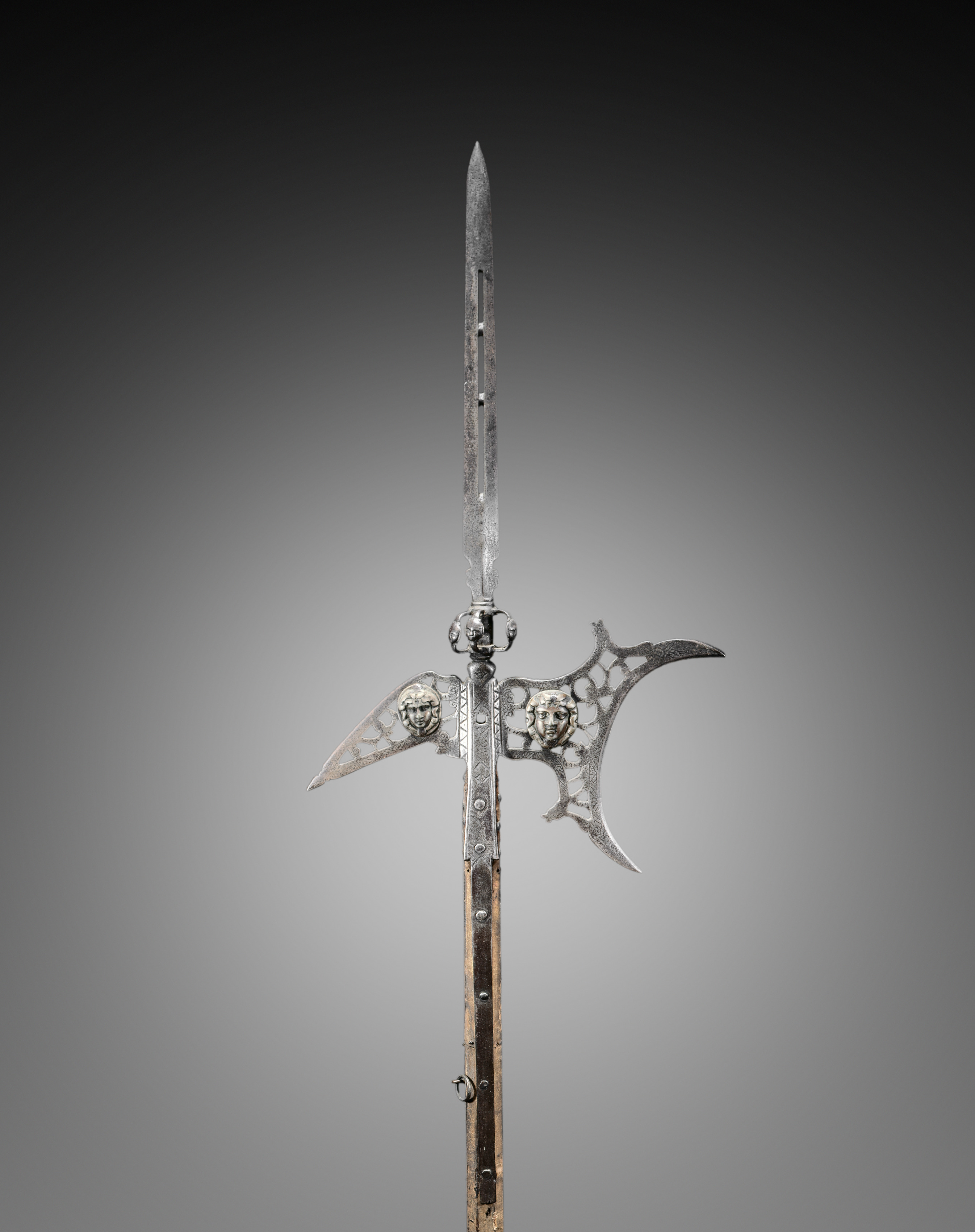
At Zoey Fashion Lab, we do not view artifacts through the lens of history alone. We deconstruct them as proto-fashion systems—assemblages of material, technique, and symbolic intent that speak to the human body’s relationship with power, protection, and performance. The object under scrutiny is a French halberd, circa 1620, forged from steel with pierced detailing, appliqué brass masks, and an octagonal wood haft reinforced with studs and leather straps. While conventionally classified as a polearm, we identify it as an early avant-garde garment component—a wearable architecture that prefigures the deconstructionist and hybrid aesthetics of contemporary fashion.
Materiality and Structural Grammar
The halberd’s composition reveals a deliberate tension between rigidity and ornament. The steel head, pierced with negative space, is not merely functional; it is a lacework of violence. The perforations reduce weight while creating a visual rhythm—a precursor to cutwork and laser-cut leather in modern design. The appliqué brass masks, affixed to the steel, introduce a contrasting material: warm, reflective, and sculptural. This is not a weapon of pure utility but one of theatrical identity. The octagonal wood haft, studded and strapped, suggests a grip that is both tactile and symbolic—a spine of authority that could be reinterpreted as a structural corset or a prosthetic limb in a Zoey runway piece.
The Avant-Garde Lens: Deconstruction and Reassembly
In our lab, we ask: What if the halberd is not a weapon but a fashion statement from a parallel timeline? The early 17th century French court was a theater of power, where armor and dress blurred into performance. The halberd’s pierced steel mirrors the slashed sleeves of Elizabethan and early Baroque fashion—a technique where fabric was cut to reveal underlayers. Here, the steel is slashed to reveal air, light, and the wearer’s movement. The brass masks, often depicting grotesque or mythical faces, function as appliqué embellishments—similar to the embroidered motifs on a doublet or the metal studs on a punk jacket. The studs and leather straps on the haft are not merely functional; they are hardware details that prefigure the rivets and belts of avant-garde designers like Rei Kawakubo or Yohji Yamamoto.
Reference to the New DNA Strand: Hybridity and Fragmentation
Zoey Fashion Lab’s New DNA Strand methodology posits that fashion evolves through the recombination of historical fragments. The halberd is a perfect candidate. Its steel head, when detached from the haft, becomes a shoulder pauldron or a collar piece—a rigid, protective element that challenges the softness of fabric. The pierced pattern can be reinterpreted as a laser-cut leather overlay on a bodice, revealing skin or a contrasting textile beneath. The brass masks, when scaled down, become brooches or ear cuffs—decorative armor that adorns rather than protects. The octagonal haft, with its studs and straps, can be reimagined as a structural belt or a spine-like corset stay, integrating the weapon’s verticality into a garment’s silhouette.
Deconstruction in Practice: The Halberd as Garment
Let us deconstruct the halberd into wearable components:
1. The Steel Head as Bodice Armor: The pierced steel, when shaped to the torso, creates a breastplate that is both protective and revealing. The perforations allow for breathability and visual intrigue—a nod to the cut-out trends in contemporary fashion. The appliqué brass masks can be positioned at the shoulders or sternum, functioning as emblematic focal points that evoke heraldry or myth.
2. The Haft as Structural Spine: The octagonal wood haft, when sectioned and rearticulated, becomes a back support or a cage skirt structure. The studs and leather straps can be used as adjustable closures, allowing the garment to conform to the body. This echoes the work of designers like Thierry Mugler, who used rigid materials to create sculptural silhouettes.
3. The Leather Straps as Harness Elements: The straps, often used to secure the haft to the wielder’s hand, can be repurposed as harness straps that crisscross the torso or limbs. This references the BDSM-inspired aesthetics of avant-garde fashion, where restraint becomes adornment.
Symbolic Resonance: Power, Performance, and Protection
The halberd is not merely a weapon; it is a symbol of authority—a tool of the guard, the executioner, or the ceremonial officer. In fashion, this translates to power dressing. The brass masks, often depicting faces of demons or lions, suggest a dual identity: the wearer is both protector and aggressor, human and mythic. This aligns with the avant-garde interest in persona and transformation. The pierced steel, with its negative space, hints at vulnerability within strength—a theme explored by designers like Alexander McQueen, who used armor-like silhouettes to comment on the fragility of the human form.
Technical Reinterpretation: From Metal to Textile
To translate the halberd into a garment, Zoey Fashion Lab would explore material substitution. The steel can be replaced by molded leather or resin-reinforced fabric, allowing for flexibility while retaining the visual weight. The pierced patterns can be achieved through laser cutting or embroidery, creating a lace-like effect. The brass masks can be cast in lightweight metal alloys or 3D-printed in metallic polymers, reducing bulk while maintaining the reflective quality. The wood haft can be reinterpreted as corset boning or structural padding, using materials like carbon fiber or rigid foam for a modern, lightweight feel.
Conclusion: The Halberd as Proto-Avant-Garde
The early 17th century French halberd is a forgotten ancestor of avant-garde fashion. Its pierced steel, appliqué masks, and structural haft prefigure the deconstructionist techniques and hybrid materiality that define contemporary design. At Zoey Fashion Lab, we see this object not as a relic but as a blueprint for future garments—a New DNA Strand that weaves history, power, and theatricality into wearable art. By deconstructing the halberd, we honor its origins while liberating it from function, transforming it into a statement of identity, protection, and rebellion. This is the essence of our work: to find the fashion in the forgotten, and to dress the body in the stories of the past, reimagined for the future.