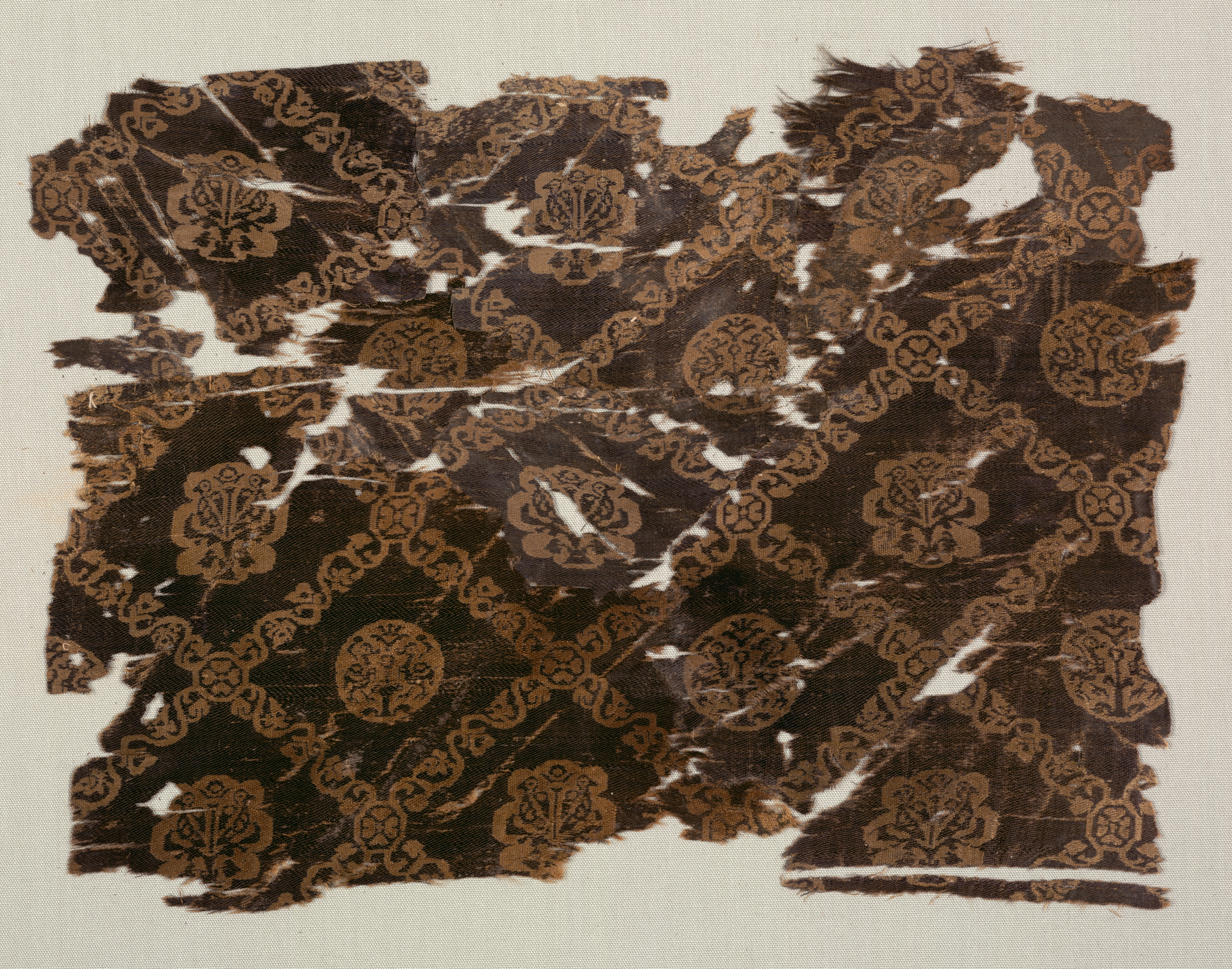
Deconstructing the Samite: An Avant-Garde Analysis of a Silk Lattice Medallion Textile
As Chief Fabric Deconstructionist for Zoey Fashion Lab, I am tasked with dissecting not merely the physical threads of a textile, but its narrative, its potential, and its radical future. The subject of this analysis is a fragment of silk samite, likely originating from 14th–15th century Egypt or Syria. Its surface is a dense, luminous field of interlocking medallions, each a microcosm teeming with stylized animal forms—hares, birds, perhaps mythical griffins—all woven in a lattice of sacred geometry. The technical designation is silk: samite, a compound weave of extraordinary complexity. The reference point is a new DNA strand—not biological, but structural: a codex of pattern, tension, and light. Our lens is the Avant-garde. We are not here to preserve. We are here to deconstruct and re-encode.
Technical Autopsy: The Samite as a Digital Ancestor
Samite, from the Old French samit and ultimately the Greek hexamiton (“six threads”), is a weft-faced compound weave. In its classical form, it employs a warp of silk for the ground and a weft of silk for the pattern, often with a supplementary weft of gold or silver thread. The result is a fabric of dense, almost liquid weight, where the pattern is built from the surface, not printed upon it. For the Avant-garde, this is profoundly relevant. The samite is not a two-dimensional image; it is a topography of light.
The lattice of animals in medallions is a repeating cellular structure. Each medallion is a self-contained unit, yet it interlocks with its neighbors to form a continuous, infinite field. This is the same logic that underpins digital pixelation, fractal geometry, and algorithmic pattern generation. The medieval weaver was a programmer, encoding a design into a grid of warp and weft, using a drawloom that required a second operator to lift pattern threads. The Avant-garde designer today can look at this samite and see a pre-digital bitmap.
Our deconstruction begins with the DNA strand reference. The medallion lattice is the double helix of the fabric’s identity. The warp is the backbone, the weft the base pairs. The animals are the genetic information—the phenotype. To deconstruct this, we must isolate the unit cell. The Avant-garde process involves:
- Disruption of Scale: Magnifying the medallion to architectural proportions, or shrinking it to a micro-print, breaking the viewer’s expectation of a fixed, precious object.
- Material Inversion: Replacing the silk weft with industrial materials—carbon fiber, recycled polymer, or even conductive threads. The gold thread becomes a circuit trace. The samite becomes a wearable interface.
- Structural Weakening: Deliberately cutting the warp to create controlled fraying, allowing the lattice to collapse into a new, chaotic order. The animal forms become ghost-like, their edges dissolving.
Cultural and Symbolic Deconstruction: The Animal as Avant-Garde Signifier
The animals in the medallions are not arbitrary. In Mamluk and Syrian textile traditions, animals like hares, birds, and lions carried symbolic weight—fertility, swiftness, royalty, protection. They were woven into a cosmology where the fabric was a microcosm of the universe. The Avant-garde rejects fixed symbolism. Instead, we treat these animals as signs in a state of flux.
Our deconstruction asks: What happens when the hare, traditionally a symbol of timidity, is rendered in a lattice that suggests digital surveillance? What if the bird, a symbol of freedom, is trapped in a repeating, inescapable grid? The Avant-garde uses the original symbolism as a scaffold for critique. The medallion becomes a cage. The lattice becomes a network.
We can apply a semiotic slash to the pattern. For example:
- Fragment and Reassemble: Cut the samite into irregular shards and reassemble them on a new ground, like a broken mosaic. The animals lose their bodies, becoming abstract limbs and eyes.
- Negative Space Reversal: Weave the lattice in black on black, or use a transparent base, so the animals are only visible in certain light. The medallions become ghosts in the machine.
- Digital Translation: Scan the pattern, then use AI to generate a “corrupted” version—one where the lattice is warped, the animals mutated. This new digital file is then woven on a modern jacquard loom, creating a samite of the future that carries the genetic memory of the original.
The Avant-Garde Application: From Relic to Radical Garment
For Zoey Fashion Lab, the deconstruction is not an end in itself. It is a blueprint for creation. The silk samite with its animal medallions becomes the source code for a new collection. The garment is not a dress; it is a statement on time, technology, and tradition.
Consider a deconstructed coat. The body is cut from a new, digitally woven samite that uses the original lattice but with asymmetrical repeats. The medallions are scaled to different sizes, creating a sense of visual vertigo. The animals are rendered in a glitch aesthetic—their forms are pixelated, their colors are neon versions of the original indigo, crimson, and gold. The coat is lined with a traditional silk, but the seams are left raw, the edges frayed. This is not a sign of decay, but of deliberate incompleteness—a nod to the fragmentary nature of the historical artifact.
Another application: a modular garment. The medallions are printed on individual, interlocking panels of a high-tech, breathable fabric. The wearer can reconfigure the lattice—adding or removing panels to change the silhouette. The animals become interchangeable icons. This garment is a living system, a direct descendant of the samite’s cellular logic, but now responsive to the user.
Finally, a performance piece. A model wears a full-length gown made from the original samite, but with embedded LEDs at the center of each medallion. As the model moves, the lights pulse in a pattern derived from the DNA strand reference—a bioluminescent lattice. The animals are illuminated from within, their forms glowing through the silk. The garment is a bridge between the medieval and the post-human.
Conclusion: The Samite as a Living Codex
The silk samite from Egypt or Syria is not a dead object. It is a living codex of technique, symbolism, and material intelligence. The Avant-garde deconstruction does not destroy it; it releases its latent potential. The lattice of animals in medallions is a structural DNA, a pattern that can be mutated, hybridized, and reprogrammed for a new age.
At Zoey Fashion Lab, we see this textile as a starting point for a conversation between past and future, between craft and code, between the sacred and the subversive. The samite is not a relic to be worshipped; it is a tool to be wielded. By deconstructing its threads, we weave a new narrative—one where the animals in the medallions are no longer trapped in history, but set free into the avant-garde.