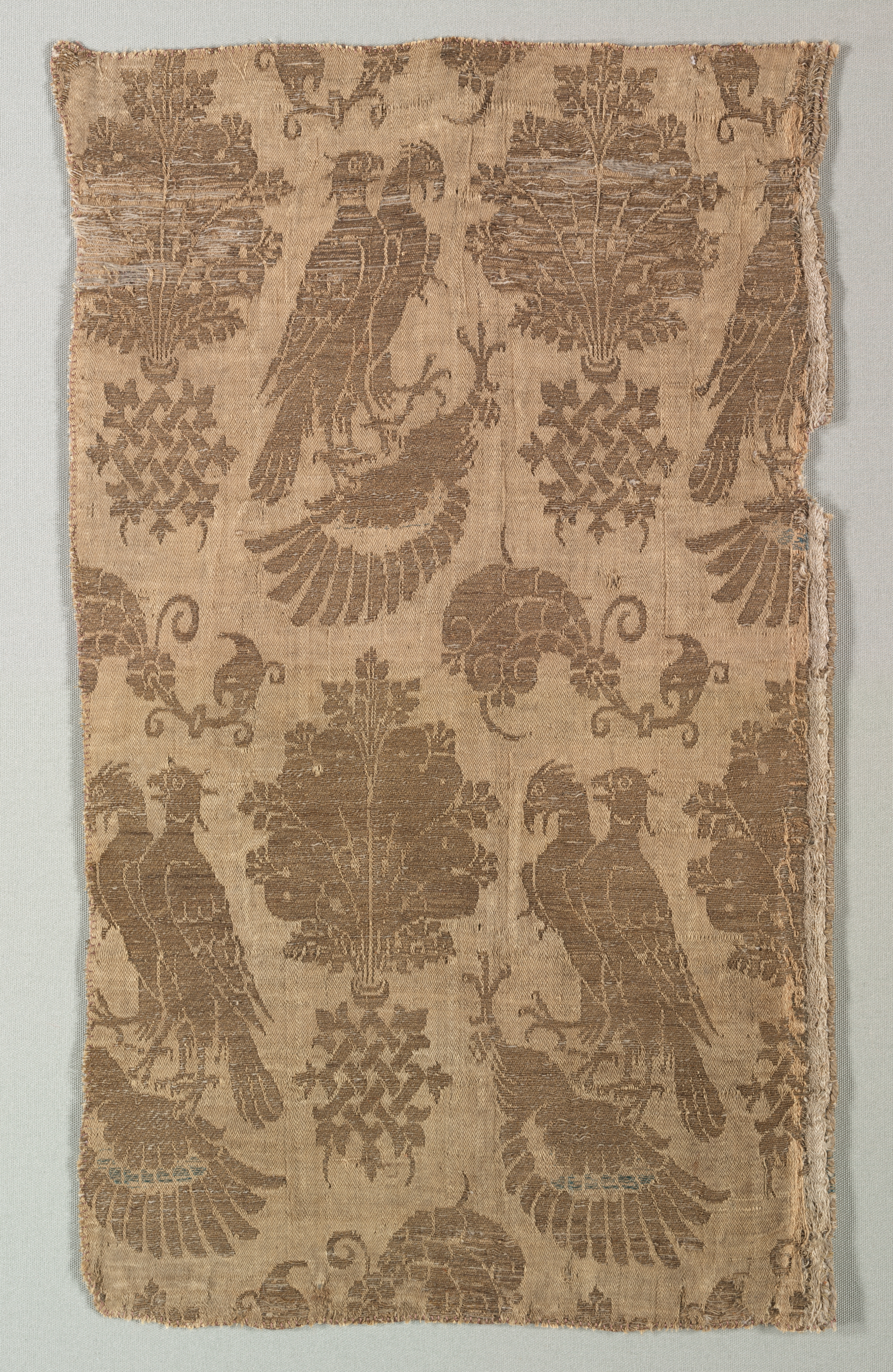
Deconstructing the Avant-Garde: A Technical and Stylistic Analysis of a 14th-Century Italian Silk
At Zoey Fashion Lab, we approach historical textiles not as artifacts to be preserved in amber, but as living DNA—a code that can be re-spliced, re-expressed, and re-contextualized. The subject of this analysis is a remarkable fragment of gold-patterned silk, woven in Italy during the last third of the 14th century. Its technical composition—silk and gold thread executed in a combination of two weaves (lampas)—and its iconography of falcons and heraldry present a rich, multi-layered text. Our deconstruction will focus on the material, structural, and symbolic elements, culminating in a proposal for an avant-garde reinterpretation that treats this historical weave as a new strand in the DNA of modern fashion.
Material Evidence: The Silk and Gold Thread
The primary material, silk, was the preeminent luxury fiber of the medieval world, sourced from the Far East and later cultivated in Italy, particularly in Lucca and Venice. Its natural luster, drape, and dye-affinity made it the canvas for elite expression. The gold thread, however, is the true protagonist. In 14th-century Italy, this was typically a composite material: a thin strip of gold leaf or gilded silver wound around a core of silk or linen. The gold does not merely add color; it introduces a third dimension—a reflective, metallic surface that shifts with light, creating a kinetic interplay between the observer and the textile. This is not a passive background; it is an active, almost aggressive, declaration of wealth and power.
From a deconstructionist perspective, the gold thread is a material paradox. It is both rigid and pliable, precious and functional. In an avant-garde context, we would isolate this paradox. Imagine a garment where the gold thread is not woven into the fabric but is exposed as a separate structural element—a metallic thread lattice worn over a sheer silk base, or a series of gold-wrapped cables that articulate the silhouette, creating a tension between the soft body and the hard, metallic exoskeleton. This would echo the original silk's function as armor for the elite, but in a fragmented, deconstructed form.
Technical Structure: The Lampas Weave
The technical designation "lampas" refers to a compound weave structure where a pattern (the "figure") is created by an additional warp and weft system, floating over a ground weave. In this case, the ground is likely a plain or twill weave of silk, while the pattern—the falcons and heraldry—is woven in a supplementary bound system using the gold thread. This creates a relief effect: the gold pattern stands slightly above the silk ground, both physically and visually. The lampas technique allowed for complex, repeating motifs without compromising the fabric's flexibility.
Our analysis focuses on the dual-weave system as a metaphor for layered identity. The ground weave represents the functional, structural body of the garment; the supplementary gold weave represents the symbolic, performative layer. In avant-garde fashion, we can deconstruct this binary. Consider a dress where the front panel is woven in the original lampas technique, while the back panel is a negative impression—a woven void where the gold thread has been removed, leaving only the ground weave and the ghost of the pattern. Or, we could invert the hierarchy: use the gold thread as the ground weave and the silk as the floating pattern, creating a mirror-world where power is the substrate and luxury is the exception.
Iconography: Falcons and Heraldry
The motifs—falcons and heraldic devices—are not merely decorative; they are a coded language of sovereignty, lineage, and territorial claim. The falcon, a bird of prey, symbolizes nobility, martial prowess, and the hunt. Heraldry, with its shields, crests, and geometric partitions, represents familial or political identity. Together, they form a visual manifesto of power. In the 14th century, such textiles were likely used for liturgical vestments, aristocratic garments, or diplomatic gifts—objects that performed identity.
For an avant-garde reinterpretation, we must fragment and re-code this iconography. The falcon can be abstracted into a series of sharp, angular lines—a deconstructed silhouette that suggests flight without depicting it. The heraldic devices can be reduced to their geometric core: bars, chevrons, and crosses, then re-arranged into asymmetrical, randomized patterns that defy the original orderly repetition. This is not a rejection of the heraldic language but a re-sequencing of its DNA. A jacket might feature a single falcon's wing, rendered in gold thread, that extends from the shoulder to the hem, while the opposite side is bare silk—a visual asymmetry that speaks to the imbalance of power in the original context.
Reference: The New DNA Strand
The reference to a "New DNA Strand" is critical. We are not reconstructing the past; we are using it as a genetic template for mutation. The original silk is a strand of cultural DNA, encoding the values, technologies, and aesthetics of 14th-century Italy. Our task is to splice that strand with contemporary materials, techniques, and sensibilities. This could involve:
- Material mutation: Replace the gold thread with conductive metallic fibers that can light up or change color in response to touch or environment. The falcon motif becomes a living, responsive pattern.
- Structural mutation: Use 3D-printed polymer components that mimic the relief of the lampas weave but are detachable and reconfigurable. The garment becomes a modular system, allowing the wearer to assemble or disassemble the heraldic pattern at will.
- Digital mutation: Scan the original pattern and project it via augmented reality onto a minimalist silk shift. The physical garment is plain; the heraldry exists only in the digital layer, visible through a device. This critiques the original textile's exclusivity—the pattern is now accessible to anyone with a screen, yet remains intangible.
Conclusion: The Avant-Garde as Deconstruction and Re-Coding
The 14th-century Italian silk is not a relic; it is a blueprint for subversion. By deconstructing its material, technical, and iconographic elements, we reveal the power structures embedded within it. The avant-garde fashion we propose does not simply mimic the past; it re-codes it for the present. A gold-patterned falcon becomes a symbol of individual sovereignty, not aristocratic lineage. The lampas weave becomes a metaphor for layered, contradictory identities. The silk and gold become a dialogue between the organic and the industrial, the precious and the disposable.
At Zoey Fashion Lab, we treat every historical textile as a new DNA strand—a genetic code waiting to be re-expressed. The result is not a reproduction but a mutation: a garment that honors the original's technical mastery while dismantling its ideological framework. This is the essence of the avant-garde: to look backward with a critical eye, and forward with a radical hand.