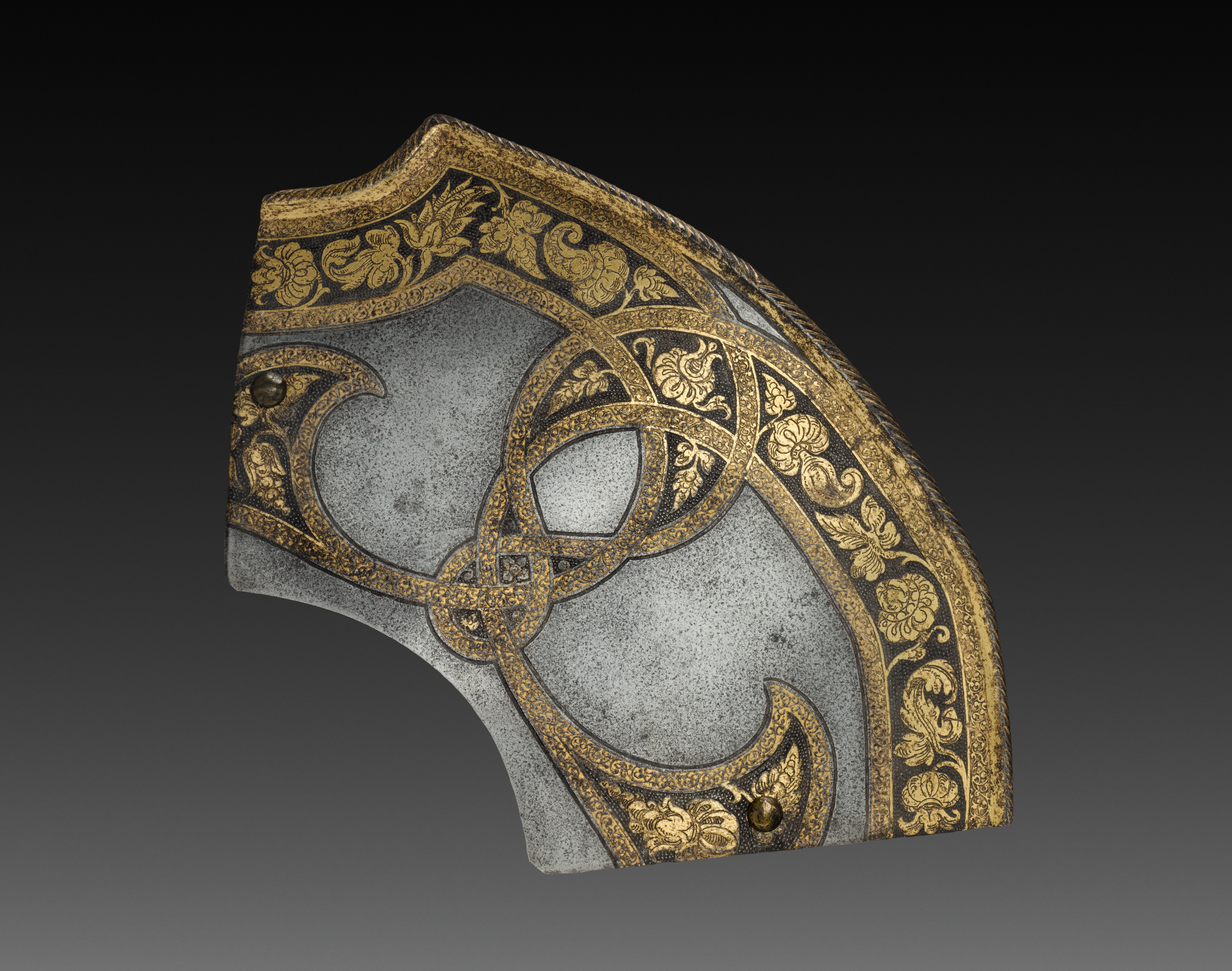
Deconstructing the Pommel Plate: An Avant-Garde Analysis of the "Flechtband" Garniture
At Zoey Fashion Lab, our mandate is to deconstruct historical artifacts not as relics, but as living blueprints for radical design. The Pommel Plate from the "Flechtband" Garniture of Rudolf II and Archduke Ernst—a piece of blued, etched, and gilded steel from Augsburg, Germany—presents a paradox. It is a functional object of war, yet its surface is a canvas of intricate, almost obsessive, ornamentation. For the avant-garde designer, this plate is not merely a piece of armor; it is a New DNA Strand, encoding a language of structural tension, surface alchemy, and symbolic power that can be transcribed into modern fashion.
I. The Paradox of the Armored Surface: Blueing, Etching, and Gilding as Textile Technologies
The technical execution of this pommel plate is its first and most potent lesson. The blued steel—a controlled oxidation that creates a deep, midnight indigo—is not a color in the traditional sense. It is a chemical transformation of the metal itself. This process, akin to the patination of leather or the dyeing of silk, imbues the steel with a living, mutable surface. The etched patterns, likely achieved through acid resist, are then carved into this darkened field, revealing the raw, silvery steel beneath. Finally, gilding—the application of gold—is used to highlight specific elements, creating a tripartite hierarchy of light and shadow.
For the avant-garde fashion lab, this process becomes a textile technology. We can translate "blueing" into a dyeing technique for high-tensile synthetic fabrics, creating a deep, iridescent black that shifts in light. The "etching" can be reinterpreted as laser-cut or chemically eroded patterns on layered leathers or metallic organza, where the base material is revealed through the top layer. The "gilding" is not just metallic thread; it is the strategic application of liquid metal, foil, or even electroluminescent wiring to trace the "etched" lines, creating a garment that is both armor and illumination. The pommel plate teaches us that surface is not decoration; it is a record of process.
II. The "Flechtband" Motif: Braided Structure as a New Silhouette Language
The "Flechtband" (braided band) motif is the core of this garniture's aesthetic. It is a continuous, interlacing ribbon that weaves across the steel surface, creating a sense of infinite, unbroken movement. This is not a static pattern; it is a dynamic, kinetic structure that suggests growth, connection, and containment. On a saddle pommel, this braided band serves both decorative and symbolic functions—it evokes the binding of power, the interlacing of dynastic lines (Rudolf II and Archduke Ernst), and the protective enclosure of the rider's hand.
In avant-garde fashion, this motif can be exploded into a new silhouette language. Instead of a flat pattern, we can construct garments using actual braided structural elements: tubular forms of carbon fiber, resin-impregnated fabric, or even knitted metal mesh that are woven together to create the garment's armature. The pommel plate's curved, ergonomic shape suggests that this braided structure can be used to create sculptural, body-hugging forms—a corset that is literally a braided lattice, or a sleeve that is a continuous, interlaced tube. The "Flechtband" becomes a generative system, where the garment's shape is derived from the weaving of its components, rather than from cutting and sewing flat patterns.
III. The Pommel as a Gestural Interface: Ergonomics of Power
The pommel plate is not a passive object; it is a gestural interface. It is the point where the rider's hand grips the saddle, where command is exerted over the horse. Its form is ergonomic, molded to fit the palm, yet its surface is aggressively textured with the etched and gilded patterns. This creates a tactile tension between comfort and danger, between function and ornament. The rider's hand is both protected and stimulated by this intricate surface.
For fashion, this translates into a new approach to wearable technology and accessories. We can design garments that incorporate haptic surfaces—areas where the fabric is textured, embossed, or structured to provide sensory feedback to the wearer. A glove, for instance, could feature a "pommel plate" on the palm, made of a flexible, conductive material that is etched with a "Flechtband" circuit. This circuit could control a garment's color-changing properties, its sound output, or even its temperature regulation. The ergonomics of power become the ergonomics of control, where the wearer's touch activates the garment's dynamic capabilities. The pommel plate reminds us that the most intimate point of contact between body and object is also the most charged with potential.
IV. The New DNA Strand: Encoding History into the Avant-Garde
The reference to a New DNA Strand is critical. This pommel plate is not a fossil to be replicated; it is a genetic sequence to be recombined. The "Flechtband" garniture was a product of its time—a symbol of Habsburg power, of Augsburg's master craftsmanship, of the Mannerist love for intricate, intellectual ornament. But its DNA—its principles of surface alchemy, structural braiding, and gestural ergonomics—can be extracted and spliced into a completely new context.
In the Zoey Fashion Lab, we would use this DNA to:
- Develop a new material palette: Combining blueing techniques with modern alloys and polymers to create fabrics that change color through oxidation or light exposure.
- Create a new construction methodology: Using braided, interlaced structural elements instead of traditional seams, allowing for garments that are both flexible and rigid, like a second skin of armor.
- Design interactive, wearable interfaces: Embedding the "Flechtband" motif as a conductive circuit, turning the garment into a responsive, communicative object.
The pommel plate, in its original context, was a piece of a larger whole—a saddle, a garniture, a suit of armor. In our lab, it becomes a prototype for a new kind of fashion: one that is not just worn, but inhabited; not just decorated, but engineered; not just historical, but future-facing. The blued, etched, and gilded steel is not a relic; it is a recipe for radical innovation.