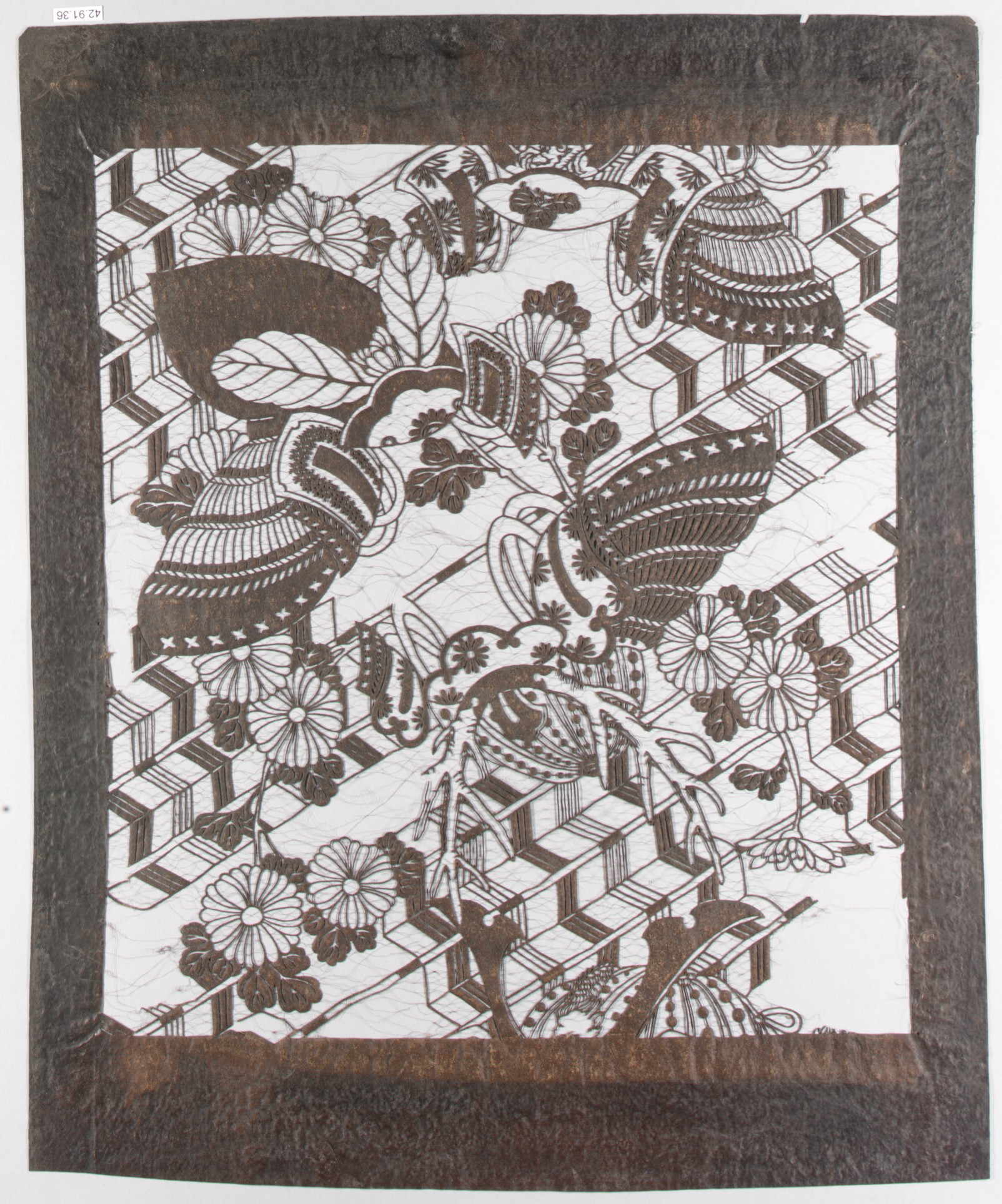
The Stencil Unbound: Deconstructive Cartography for SS26
In the rarefied echelons of avant-garde couture, where garment architecture transcends mere clothing to become a dialogue with time, space, and materiality, the stencil emerges not as a tool of replication, but as a radical cartography of absence and presence. For Zoey Fashion Laboratory’s SS26 study, the subject—Stencil—originating from the precision-driven aesthetic of Japan, is reimagined through a lens of structural innovation and futuristic silhouettes. This analysis dissects how a humble template, married to the ethereal tension of paper and silk, becomes a standalone manifesto for deconstructive elegance.
I. The Dialectic of Negative Space: Stencil as Architectural Blueprint
The stencil, in its traditional Japanese context (known as kata for resist dyeing or kirie for paper cutting), is a system of controlled voids. Yet, in the hands of Zoey Fashion Laboratory, it is inverted. The stencil is no longer a mask for surface decoration; it is the primary structural skeleton. For SS26, the silhouette is defined by what is removed rather than what is added. Think of a sculpted paper grid—a lattice of origami-like folds—that forms the bodice. The negative spaces are not empty; they are portals. Silk panels, suspended from these paper armatures, drape through the voids, creating a kinetic interplay of opacity and transparency. This is not a dress; it is a wearable architectural section.
The innovation lies in the binary nature of materials. Paper, rigid and fragile, provides the stencil’s geometric authority. Silk, fluid and luminous, provides the garment’s breath. The stencil’s cutouts become a grammar of exposure: a sharp, angular shoulder void that reveals a cascade of raw-edged silk; a series of perforations along the spine that mimic the precision of a CNC-milled mold, yet are hand-cut with a knife’s intimacy. The silhouette is futuristic in its asymmetry—a single, exaggerated sleeve that is a continuous stencil loop, while the opposite side is a bare, silk-wrapped armature. This is deconstruction as a logical, almost algorithmic, process.
II. Material Alchemy: Paper as a Living Membrane
The choice of paper from Japan—specifically washi or kōzo fiber paper—is critical. Unlike Western paper, Japanese paper possesses a tensile strength and a fibrous memory that allows it to be folded, creased, and even slightly dampened to hold shape. For SS26, this paper is not merely a temporary pattern; it is a permanent, structural component. The stencil is treated with a micro-coating of resin to resist humidity, yet retains its tactile, almost skin-like quality. When layered over silk, the paper stencil becomes a second epidermis—a rigid exoskeleton that controls the silk’s drape.
Consider a skirt constructed from a single, continuous stencil of paper, cut in a helical pattern from waist to hem. The silk is sandwiched between two layers of this stencil, creating a laminated yet breathable structure. As the wearer moves, the paper stencil articulates at the joints, creating a sound like parchment rustling—an auditory dimension to the garment. This is not a costume; it is a wearable sculpture that responds to the body’s biomechanics. The stencil’s edges are left raw, revealing the layered fibers of the paper and the frayed silk. This is a celebration of process, of the imperfect perfection of hand-cut lines.
III. Silhouette as Cartography: The Futuristic Body
The SS26 silhouette is a radical departure from the organic. It is geometric, fragmented, and volumetric. The stencil’s logic dictates a new proportion: the torso is a series of interlocking paper plates, each cut with a stencil pattern that references traditional Japanese mon (family crests) but reinterpreted as asymmetrical, pixelated grids. The shoulders are sharp, cantilevered points that extend beyond the body, creating a futuristic, almost robotic profile. The waist is cinched not by a belt, but by a paper corset that is a stencil of its own—a series of vertical slits through which silk ribbons are threaded, pulling the structure taut.
The most innovative element is the back silhouette. A large, circular stencil cutout—a negative space—is positioned between the shoulder blades. Through this void, a panel of silk is pleated and released, forming a dynamic, butterfly-like cape that billows with movement. This is deconstruction as liberation: the stencil does not confine; it creates a portal for motion. The hemline is a jagged, stencil-cut edge that mimics the topography of a mountain range, with silk trailing behind like a vapor trail. This is a garment that exists in three dimensions, defying the flatness of traditional couture.
IV. Structural Innovation: The Stencil as a Joinery System
The genius of this study lies in how the stencil becomes a joinery system without sewing. In traditional Japanese construction, paper is often used as a temporary adhesive or a pattern. Here, the stencil is the permanent fastener. Paper tabs, cut as part of the stencil, are folded and slotted through corresponding slits in the silk, creating a tension-fit structure. No glue, no thread—just pure geometric interlocking. This is a zero-waste system: every cut of the stencil is a negative shape that becomes a positive element elsewhere. The silk is not cut; it is draped and anchored by the paper stencil’s tabs.
For example, a jacket is constructed from a single sheet of paper stencil that wraps around the body. The stencil’s cutouts are shaped like interlocking hexagons, each holding a silk panel in place. The closure is a series of paper loops that hook onto silk buttons—a marriage of fragile paper and supple silk. The result is a garment that is lightweight, breathable, and structurally audacious. It challenges the very definition of tailoring, proposing a future where garments are assembled like architectural models, with the stencil as the blueprint and the silk as the living skin.
V. Conclusion: The Stencil as a Futuristic Relic
In this standalone avant-garde study for SS26, the stencil transcends its historical role as a tool of replication. It becomes a philosophical framework for deconstruction, where absence defines presence, and fragility yields strength. The fusion of Japanese paper and silk creates a dialogue between the ephemeral and the eternal, the rigid and the fluid. The silhouette is not merely futuristic; it is prophetic—a vision of clothing as modular, sculptural, and deeply intelligent. Zoey Fashion Laboratory has not designed a garment; it has designed a system of thought, where every cut is a question, and every void is an answer. The stencil, once a humble guide, is now the architecture of a new, deconstructive reality.