Deconstructing the Valentine: An Avant-Garde Analysis for SS26
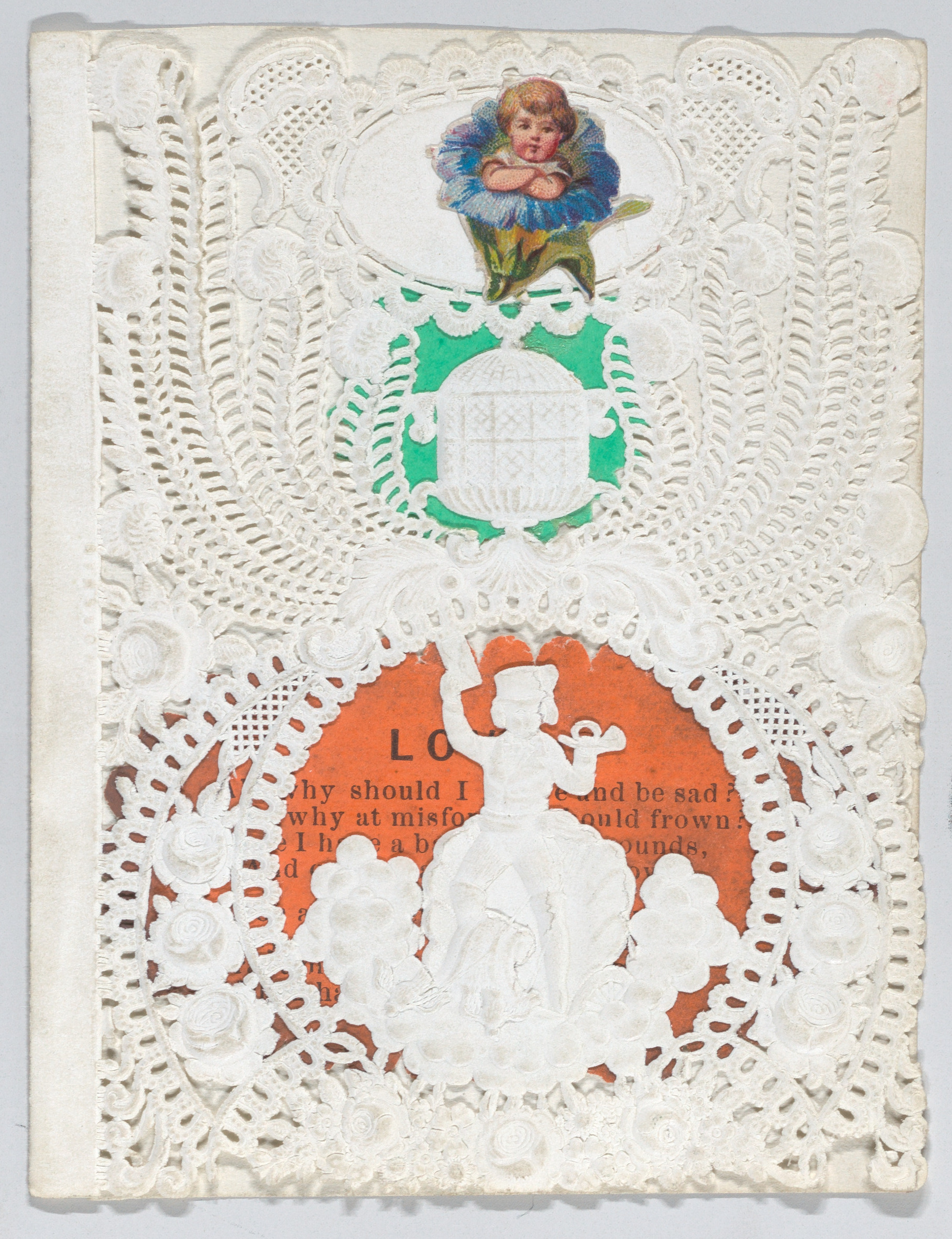
The archetype of the Valentine, steeped in Victorian sentimentality and the saccharine iconography of love, presents a formidable challenge to the avant-garde. To approach this subject is to navigate a terrain cluttered with cliché—cupids, hearts, and roseate hues—all of which demand a radical recontextualization. For Zoey Fashion Laboratory’s SS26 collection, the Valentine is not a nostalgic relic but a conceptual springboard for exploring the tension between permanence and ephemerality, intimacy and structural violence. This analysis dissects a singular, standalone study: a garment constructed from cameo-embossed, open-work lace paper, chromolithography, colored paper, and graphite. Through this material palette, we witness a futuristic silhouette that interrogates the very nature of affection, memory, and the body as a site of architectural innovation.
Materiality as Narrative: The Paradox of Paper and Lace
The selection of materials in this study is a deliberate act of subversion. Cameo-embossed, open-work lace paper immediately evokes the handmade valentines of the 19th century—fragile, intricate, and laden with sentimental value. Yet, by employing it as a primary structural element, the designer transforms this delicate signifier into a rigid, almost armor-like casing. The open-work pattern, typically a symbol of permeability and romantic vulnerability, is here rendered as a grid of negative space, suggesting a protective membrane that both reveals and conceals the wearer’s form. This is not the soft drape of silk or the fluidity of chiffon; it is a paper architecture that demands careful negotiation with the body.
Complementing this is the use of chromolithography, a 19th-century printing technique that once democratized color imagery. In this context, chromolithographic fragments are applied as decals or inlays, their vivid, almost garish hues—crimson, magenta, gold—clashing against the muted off-white of the lace paper. This creates a visual dissonance, a deliberate anachronism that positions the Valentine as a palimpsest of historical manufacturing processes. The colored paper, in shades of deep indigo and oxidised copper, introduces a futuristic patina, suggesting decay or chemical reaction. Finally, graphite is employed not as a drawing tool but as a surface treatment—smudged, rubbed, and layered onto the paper to create a metallic sheen or a ghostly, ashen residue. This graphite application evokes industrial drafting, the blueprints of a love affair, and the cold precision of architectural rendering. Together, these materials form a dialectic: the romantic and the industrial, the fragile and the durable, the sentimental and the analytical.
Structural Innovation: The Silhouette as Exoskeleton
The futuristic silhouette of this Valentine study is defined by its exoskeletal logic. The garment is not draped or sewn in the traditional sense; it is assembled through a series of interlocking paper panels, reinforced with graphite-infused adhesive and stitched with fine copper wire. The resulting form is a hybrid of corsetry and carapace, a second skin that redefines the human torso as a geometric abstraction. The shoulders are exaggerated into sharp, angular peaks, reminiscent of architectural buttresses or the wings of a mechanical insect. The waist is cinched not by fabric but by a rigid, cameo-embossed band that flares outward into a bell-like skirt, its layers of open-work lace paper creating a translucent, stratified volume.
Deconstructing the Heart: Negative Space and Asymmetry
A key innovation lies in the treatment of the heart motif, traditionally the centerpiece of any Valentine. Here, the heart is deconstructed and dispersed across the garment’s surface. Instead of a single, recognizable symbol, we find a series of negative-space cutouts in the lace paper, arranged in a non-linear, almost chaotic pattern. These cutouts are not symmetrical; they shift from the left shoulder to the right hip, creating a dynamic, unbalanced tension that forces the eye to travel across the form. The chromolithographic elements are placed within these voids, appearing as fragmented, bleeding images of anatomical hearts or stylized floral blooms. This is not a celebration of love as a cohesive whole, but an exploration of its fractured, often contradictory nature. The asymmetry challenges the classical ideal of the balanced, harmonious silhouette, proposing instead a body that is in constant flux, a site of emotional and structural rupture.
Futuristic Silhouettes for SS26: The Body as a Contested Space
This Valentine study is a manifesto for SS26’s broader thematic concerns: the body as a contested space between the organic and the synthetic, the past and the future. The silhouette is deliberately non-ergonomic; it does not follow the natural curves of the human form but imposes its own architectural logic. The wearer becomes a participant in a performance of constraint and liberation. The open-work lace paper allows for glimpses of skin, but the graphite smudges and chromolithographic overlays obscure and abstract the body’s surface, creating a palimpsest of identity. This is a direct challenge to the fashion industry’s obsession with the eternal, the pristine, and the youthful. Here, the Valentine is aged, processed, and re-engineered—a relic of a future that has already begun to decay.
Graphite as a Temporal Marker
The use of graphite is particularly significant in this context. As a material, graphite is both a tool of creation (drawing, writing) and a residue of industry (pencil dust, lubricant). In this garment, it functions as a temporal marker, suggesting the passage of time, the erasure of memory, and the impermanence of sentiment. The smudged graphite on the paper panels creates a gradient effect, from deep, almost black shadows at the center of the cutouts to lighter, ghostly traces at the edges. This mimics the fading of a love letter or the gradual loss of detail in a photograph. The futuristic silhouette is thus not one of sleek, unblemished surfaces, but of patina and wear, a deliberate embrace of entropy as an aesthetic principle.
Conclusion: A New Lexicon for Affection
In this standalone avant-garde study, Zoey Fashion Laboratory redefines the Valentine as a site of structural and conceptual innovation. The marriage of cameo-embossed lace paper, chromolithography, colored paper, and graphite yields a silhouette that is at once fragile and formidable, nostalgic and futuristic. The deconstructive approach to the heart motif, the exoskeletal architecture, and the embrace of asymmetry and decay challenge the viewer to reconsider the very meaning of love and intimacy in a post-industrial age. For SS26, this is not merely a garment; it is a theoretical proposition—a blueprint for a future where sentiment is distilled into structure, and where the body becomes the ultimate canvas for avant-garde expression. The Valentine, in this iteration, is no longer a passive object of affection but an active, aggressive statement of self-definition. It is, in essence, a love letter written in graphite and paper, folded into the geometry of a new world.